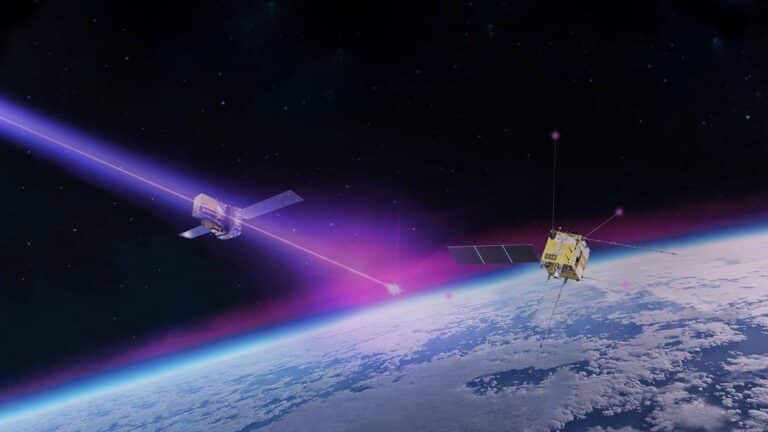
About Gamma-ray burst
- It is a powerful astronomical cosmic burst of high-energy gamma-ray.
- It emits more energy in a few seconds than our Sun will emit in its lifetime.
- It has two distinct emission phases: the short-lived prompt emission (the initial burst phase that emits gamma-rays), followed by a long-lived multi-wavelength afterglow phase.
- The shortest GRBs likely mark the collision of two compact stellar remnants called neutron stars, and the longest bursts are thought to arise when a massive, rapidly spinning star collapses to form a black hole.
- Sources of Gamma Ray
- They are produced by the hottest and most energetic objects in the universe, such as neutron stars and pulsars, supernova explosions, and regions around black holes.
- On Earth, gamma waves are generated by nuclear explosions, lightning, and the less dramatic activity of radioactive decay.
What is the Ionosphere?
- It is a layer of the planet’s upper atmosphere that contains electrically charged gases called plasma.
- It is situated about 30-600 miles (50-950 km) above Earth’s surface.
- It helps form the boundary between the vacuum of space and the lower atmosphere.
- It helps protect life on Earth by absorbing harmful ultraviolet rays from the sun.
- It is highly sensitive to changing magnetic and electrical conditions in space, usually connected to solar activity.
- It also expands and contracts in response to solar radiation.
Q1) What is Solar radiation?
It refers to the energy emitted by the Sun in the form of electromagnetic waves. It’s the primary source of energy for Earth and plays a crucial role in sustaining life and driving various natural processes. This radiation encompasses a spectrum of wavelengths, including visible light, ultraviolet (UV) radiation, and infrared radiation.
Source: Gamma-ray burst in faraway galaxy disturbed Earth’s upper atmosphere






 Last updated on March, 2026
→ UPSC Final Result 2025 is now out.
→ UPSC has released UPSC Toppers List 2025 with the Civil Services final result on its official website.
→ Anuj Agnihotri secured AIR 1 in the UPSC Civil Services Examination 2025.
→ UPSC Marksheet 2025 is now out.
→ UPSC Notification 2026 & UPSC IFoS Notification 2026 is now out on the official website at upsconline.nic.in.
→ UPSC Calendar 2026 has been released.
→ Check out the latest UPSC Syllabus 2026 here.
→ UPSC Prelims 2026 will be conducted on 24th May, 2026 & UPSC Mains 2026 will be conducted on 21st August 2026.
→ The UPSC Selection Process is of 3 stages-Prelims, Mains and Interview.
→ Prepare effectively with Vajiram & Ravi’s UPSC Prelims Test Series 2026 featuring full-length mock tests, detailed solutions, and performance analysis.
→ Enroll in Vajiram & Ravi’s UPSC Mains Test Series 2026 for structured answer writing practice, expert evaluation, and exam-oriented feedback.
→ Join Vajiram & Ravi’s Best UPSC Mentorship Program for personalized guidance, strategy planning, and one-to-one support from experienced mentors.
→ Shakti Dubey secures AIR 1 in UPSC CSE Exam 2024.
→ Also check Best UPSC Coaching in India