Gas Hydrates Latest News
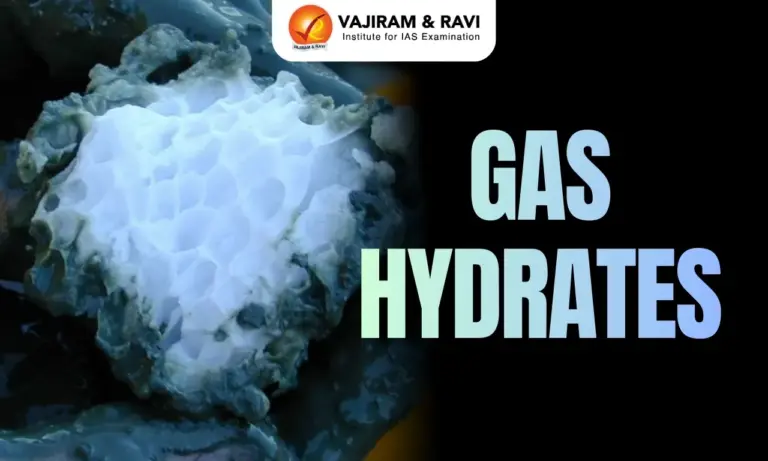
A reserve of natural gas bubbling from a cage of ice discovered on the ocean floor to the west of Greenland may be the deepest gas hydrate cold seep on record, and it happens to be teeming with animal life.
About Gas Hydrates
- Gas hydrates are ice-like crystalline structures that form when a low-density gas, like methane, ethane, or carbon dioxide, combines but does not chemically bond with water and freezes into a solid under low temperature and moderate pressure conditions.
- Most gas hydrates are formed from methane (CH4), which has led to the terms “gas hydrate” and “methane hydrate” often being used interchangeably.
- They are classified as clathrates, compounds formed by the inclusion of one molecule within cavities in the crystal lattice of another.
- A unique property of clathrates is the absence of chemical bonding, which makes it possible to separate them relatively easily.
- For example, when methane hydrates are warmed or depressurized, it will revert back to water and natural gas.
- On Earth, gas hydrates occur naturally in some marine sediments and within and beneath permafrost.
- They are also speculated to form on other planets.
- Gas Hydrates are important for a variety of reasons:
- Gas hydrate deposits may contain roughly twice the carbon contained in all reserves of coal, oil, and conventional natural gas combined, making them a potentially valuable energy resource.
- Their decomposition can release large amounts of methane, which is a greenhouse gas that could impact Earth’s climate.
- Sudden release of pressurized methane gas may cause submarine landslides, which in turn can trigger tsunamis.
- Gas hydrates in the ocean can be associated with unusual and possibly unique biological communities that use hydrocarbons or hydrogen sulfide for carbon and energy via a process known as chemosynthesis.
Source: SA






 Last updated on April, 2026
→ UPSC Final Result 2025 is now out.
→ UPSC has released UPSC Toppers List 2025 with the Civil Services final result on its official website.
→ Anuj Agnihotri secured AIR 1 in the UPSC Civil Services Examination 2025.
→ UPSC Marksheet 2025 is now out.
→ UPSC Notification 2026 & UPSC IFoS Notification 2026 is now out on the official website at upsconline.nic.in.
→ UPSC Calendar 2026 has been released.
→ Check out the latest UPSC Syllabus 2026 here.
→ UPSC Prelims 2026 will be conducted on 24th May, 2026 & UPSC Mains 2026 will be conducted on 21st August 2026.
→ The UPSC Selection Process is of 3 stages-Prelims, Mains and Interview.
→ Prepare effectively with Vajiram & Ravi’s UPSC Prelims Test Series 2026 featuring full-length mock tests, detailed solutions, and performance analysis.
→ Enroll in Vajiram & Ravi’s UPSC Mains Test Series 2026 for structured answer writing practice, expert evaluation, and exam-oriented feedback.
→ Join Vajiram & Ravi’s Best UPSC Mentorship Program for personalized guidance, strategy planning, and one-to-one support from experienced mentors.
→ Shakti Dubey secures AIR 1 in UPSC CSE Exam 2024.
→ Also check Best UPSC Coaching in India
Gas Hydrates FAQs
Q1. What are gas hydrates?+
Q2. Which gas is most commonly involved in the formation of gas hydrates?+
Q3. Where do gas hydrates occur naturally on Earth?+
Q4. Why are gas hydrates considered a potential energy resource?+
Q5. How can gas hydrates influence Earth’s climate?+
Tags: gas hydrates