GI Tag and Cultural Protection Latest News
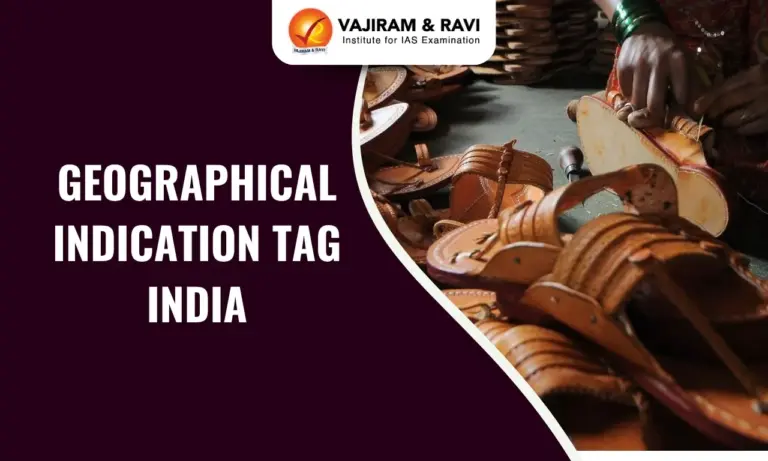
- Recently, an Italian luxury brand Prada unveiled footwear inspired by India’s Geographical Indication (GI)-tagged Kolhapuri chappals.
India’s Geographical Indications and the Threat of Cultural Appropriation
- In June 2025, Italian fashion house Prada showcased a footwear line inspired by India’s iconic GI-tagged Kolhapuri chappals at its Spring/Summer 2026 menswear show in Milan.
- The move triggered sharp criticism in India, reigniting debates over cultural appropriation and the effectiveness of Geographical Indications (GI) in safeguarding traditional knowledge and craftsmanship.
- The incident is part of a broader pattern where Indian cultural and artisanal products are used, often without acknowledgement or benefit-sharing, by global corporations.
- As the conversation around cultural appropriation intensifies, GI tags emerge as a legal and policy mechanism to both protect and promote India’s cultural heritage.





Understanding Geographical Indications (GI)
- A Geographical Indication is a form of intellectual property right that identifies goods as originating from a particular geographical region, where specific qualities, reputation, or characteristics of the product are essentially attributable to its place of origin.
- India currently has 658 registered GI-tagged products, spanning diverse categories such as textiles (e.g., Kancheepuram silk), agriculture (e.g., Basmati rice), handicrafts (e.g., Madhubani paintings), and food (e.g., Darjeeling tea).
- What sets GIs apart from trademarks is their collective ownership. Unlike a trademark owned by a single entity, a GI belongs to a community of producers, artisans, or cultivators, and it cannot be sold, assigned, or transferred.
Legal Framework in India and Globally
- India, as a signatory to the TRIPS Agreement under the WTO framework, enacted the Geographical Indications of Goods (Registration and Protection) Act, 1999, which came into effect in 2003. This law provides:
- Registration of GI goods
- Legal protection against unauthorised usage
- Penalties for infringement
- Legal standing for authorised users to initiate action against misuse
- Internationally, GI protection stems from agreements like the Paris Convention for the Protection of Industrial Property (1883) and more clearly from the TRIPS Agreement (1995).
- However, GI rights are territorial; there is no globally recognised GI tag. This means that even if Kolhapuri chappals are GI-protected in India, that protection doesn’t extend automatically to countries like Italy or the U.S.
India’s Experience with Cultural and Biological Appropriation
- India’s struggle against cultural misappropriation is not new. Some notable past instances include:
- Basmati Rice Patent (1997): Ricetec Inc., a U.S.-based company, was granted a patent for novel lines and grains of Basmati rice. After legal intervention by Indian authorities, the patent was eventually nullified.
- Turmeric Patent (1995): The University of Mississippi was granted a patent for turmeric’s wound-healing properties, a use deeply embedded in Indian Ayurveda. India successfully challenged and revoked the patent.
- Neem Patent (2000): A neem-based antifungal patent granted to a U.S. agency and a multinational firm was revoked by the European Patent Office after evidence of traditional Indian knowledge was submitted.
- These cases exemplify the vulnerability of traditional Indian knowledge and the need for pre-emptive protection mechanisms.
Towards Stronger Cultural Safeguards
- While GI tags offer domestic legal protection, they fall short when it comes to transnational enforcement. There are some pathways to international GI protection, such as:
- Seeking bilateral or multilateral recognition.
- Registering GIs in foreign jurisdictions.
- Using trade negotiations to include GI protections in Free Trade Agreements.
- Furthermore, experts advocate for the expansion of the Traditional Knowledge Digital Library (TKDL), a government-run initiative that documents traditional medicinal knowledge.
- The proposal is to widen its scope to include cultural artefacts, arts, crafts, and grassroots expressions, and to make it a searchable database. This could aid brands and foreign agencies in conducting due diligence before launching culturally inspired products.
Conclusion
- The Prada-Kolhapuri incident highlights the urgency for robust international frameworks and enhanced domestic capabilities to prevent cultural misappropriation.
- While GI tags serve as effective tools for domestic enforcement, their scope must be broadened through diplomacy, global advocacy, and digital documentation of traditional knowledge.
- India must continue to build institutional capacity, strengthen cross-border GI enforcement mechanisms, and raise awareness globally about the significance and sanctity of its cultural and artisanal heritage.
Source: TH

 Last updated on March, 2026
→ UPSC Final Result 2025 is now out.
→ UPSC has released UPSC Toppers List 2025 with the Civil Services final result on its official website.
→ Anuj Agnihotri secured AIR 1 in the UPSC Civil Services Examination 2025.
→ UPSC Marksheet 2025 is now out.
→ UPSC Notification 2026 & UPSC IFoS Notification 2026 is now out on the official website at upsconline.nic.in.
→ UPSC Calendar 2026 has been released.
→ Check out the latest UPSC Syllabus 2026 here.
→ UPSC Prelims 2026 will be conducted on 24th May, 2026 & UPSC Mains 2026 will be conducted on 21st August 2026.
→ The UPSC Selection Process is of 3 stages-Prelims, Mains and Interview.
→ Prepare effectively with Vajiram & Ravi’s UPSC Prelims Test Series 2026 featuring full-length mock tests, detailed solutions, and performance analysis.
→ Enroll in Vajiram & Ravi’s UPSC Mains Test Series 2026 for structured answer writing practice, expert evaluation, and exam-oriented feedback.
→ Join Vajiram & Ravi’s Best UPSC Mentorship Program for personalized guidance, strategy planning, and one-to-one support from experienced mentors.
→ Shakti Dubey secures AIR 1 in UPSC CSE Exam 2024.
→ Also check Best UPSC Coaching in India
GI Tag and Cultural Protection FAQs
Q1. What is a Geographical Indication (GI) tag?+
Q2. How many products in India currently have a GI tag?+
Q3. Can GI tags offer international protection?+
Q4. What legal recourse exists if GI-tagged Indian products are misused abroad?+
Q5. What reforms are suggested to prevent cultural misappropriation?+
Tags: geographical indication tag india mains article upsc mains current affairs