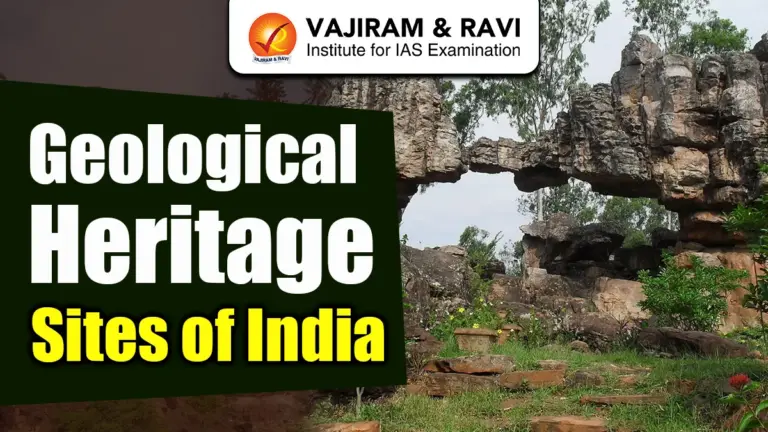
Geological Heritage Sites of India represent locations of exceptional geological importance that reveal the long and complex history of the Earth. These sites preserve rock formations, fossils, minerals and landforms formed over billions of years through natural processes. Recognizing this value, India safeguards these sites to support scientific research, education and awareness about Earth’s evolution, climate history and natural resources.
Geological Heritage Sites of India
Geological Heritage Sites of India are officially recognized locations that showcase unique geological features holding scientific, educational or cultural importance. Designated by the Geological Survey of India, these sites act as natural archives recording Earth’s evolution from over 2.5 billion years ago to recent geological times. They include impact craters, fossil parks, volcanic structures, ancient sedimentary layers and tectonic features. Together, they help explain continental drift, volcanic activity, climate shifts and the origin of life, making them invaluable for understanding India’s geological and environmental past.
Geological Heritage Sites of India Organizations
Geological Heritage Sites of India are identified, documented and maintained through coordinated efforts of scientific and administrative institutions working under national and international heritage frameworks.
- Geological Survey of India (GSI): Established in 1851, GSI is the primary authority identifying geo-heritage sites and national geological monuments, conducting surveys, research and awareness initiatives across India.
- Ministry of Mines: The ministry provides administrative support and policy direction to GSI, ensuring geological heritage protection aligns with national mineral and conservation strategies.
- Archaeological Survey of India (ASI): ASI acts as the nodal agency for UNESCO World Heritage Convention submissions, assisting in global recognition of geological and natural heritage sites.
- UNESCO World Heritage Convention: India’s membership enables global safeguarding standards, allowing geological sites to enter the Tentative List as a prerequisite for World Heritage status.
- State Governments: State authorities assist in site protection, land management, signage installation and tourism regulation at recognized geological heritage locations.





Geological Heritage Sites of India List
As of 2025, India has officially recognized 69 Geological Heritage Sites and National Geological Monuments, representing diverse geological processes across multiple states and time periods. Mawmluh Cave in Meghalaya is considered as the first Geological Heritage Site of India. The list of major Geological Heritage Sites in India is given below:
- Volcanogenic Bedded Barytes, Mangampeta: Located in Andhra Pradesh, this deposit represents submarine volcanic activity and is one of the world’s largest bedded baryte formations.
- Eparchaean Unconformity, Tirumala Hills: This site exposes a time gap of over 800 million years between ancient granite and younger sedimentary rocks.
- Erra Matti Dibbalu, Visakhapatnam: These red sand hills preserve paleo-climatic records and coastal geomorphological evolution.
- Varkala Cliff Section, Kerala: India’s only seaside cliff formation reveals Mio-Pliocene sedimentary layers and fossil bearing strata.
- Fossil Wood Park, Tiruvakkarai: Fossilized tree trunks over 20 million years old demonstrate ancient tropical forest ecosystems.
- National Fossil Wood Park, Sattanur: This park preserves silicified wood dating back to the Cretaceous period.
- Charnockite, St. Thomas Mount: The site displays charnockite rock, significant in understanding Precambrian crust formation.
- Badlands of Karai Formation: Cretaceous fossils here provide evidence of ancient marine environments.
- Lonar Lake, Maharashtra: A hyper velocity meteorite impact crater formed around 576,000 years ago in basaltic Deccan Traps.
- Sedimentary Eddy Markings, Kadan Dam: These structures reveal ancient water current directions and sediment deposition patterns.
- Sendra Granite, Rajasthan: Demonstrates plutonic igneous activity and continental crust evolution.
- Barr Conglomerate: Represents ancient river systems depositing rounded pebbles under high energy conditions.
- Stromatolite Fossil Park, Jhamarkotra: Contains Precambrian stromatolites, evidence of early microbial life over 2 billion years old.
- Akal Fossil Wood Park, Jaisalmer: Preserves Jurassic age fossilized tree trunks from desert environments.
- Great Boundary Fault, Bundi: A major tectonic feature marking crustal displacement in the Indian subcontinent.
- St. Mary’s Islands, Karnataka: Columnar basalt formations formed around 85 million years ago during Deccan volcanism.
- Peninsular Gneiss, Lalbagh: One of the oldest rock formations, representing early continental crust.
- Pillow Lavas, Chitradurga: Formed by underwater volcanic eruptions.
- Lower Permian Marine Beds, Manendragarh: Evidence of ancient marine conditions during Gondwana times.
- Siwalik Fossil Park, Himachal Pradesh: Rich in vertebrate fossils from the Plio-Pleistocene period.
Recently Added Geological Heritage Sites of India
Recently added Geological Heritage Sites reflect India’s growing focus on global recognition and advanced geo-conservation practices. These sites have been added to the UNESCO’s Tentative List of World Heritage Sites.
- Deccan Traps, Panchgani-Mahabaleshwar: Among the world’s largest volcanic provinces, these lava flows document massive eruptions 66 million years ago linked to mass extinction events.
- St. Mary’s Island Cluster: Late Cretaceous columnar basalts provide rare insights into mantle plume volcanism during India’s drift from Gondwana.
- Meghalayan Age Caves, Meghalaya: Mawmluh Cave serves as the global stratotype for the Meghalayan Age of the Holocene Epoch.
- Naga Hill Ophiolite: Represents mid-ocean ridge crust and deep-sea mantle materials uplifted through tectonic collisions.
- Natural Heritage of Tirumala Hills: Showcases the Eparchaean Unconformity and Silathoranam natural arch spanning 1.5 billion years of history.
- Varkala Cliffs, Kerala: Expose Warkalli Formation sediments, natural springs and erosional features of Mio-Pliocene age.
- Erra Matti Dibbalu: Recognized for paleo-climate indicators and coastal evolution evidence.
Geological Heritage Sites of India Significance
Geological Heritage Sites of India play a vital role in advancing scientific knowledge, education, environmental awareness and sustainable tourism.
- Understanding Earth’s Evolution: Rock layers and fossils help reconstruct geological history spanning billions of years.
- Evidence of Plate Tectonics: Deccan Traps and ophiolite belts demonstrate continental drift and mantle processes.
- Volcanic Activity Records: Sites like Lonar Lake and St. Mary’s Islands reveal ancient volcanic events.
- Paleoenvironment Studies: Fossil parks provide insights into extinct ecosystems and biodiversity changes.
- Climate History Reconstruction: Sedimentary formations record past climate variations and environmental shifts.
- Mineralogical Insights: Mineral rich sites explain ore formation and metamorphic processes.
- Educational Value: These sites serve as outdoor classrooms for geology students and researchers.
- Tourism Potential: Geo-tourism supports local economies while promoting scientific awareness.
Geological Heritage Sites of India Challenges
Despite recognition, Geological Heritage Sites of India face multiple structural, legal and social challenges affecting their long term preservation.
- Low Public Awareness: Geo-conservation receives less attention compared to biodiversity or cultural heritage.
- Development Pressure: Mining, construction and urban expansion threaten fossil and rock formations.
- Absence of Dedicated Legislation: India lacks a specific geo-heritage conservation law.
- Limited Enforcement Powers: GSI identifies sites but cannot legally prevent damage or encroachment.
- Administrative Gaps: Delayed implementation of proposed geo-conservation frameworks weakens protection.
- Tourism Mismanagement: Unregulated tourism leads to vandalism and physical degradation.
Way Forward:
- Dedicated Geo-Conservation Law: A law similar to the Biological Diversity Act should safeguard geological heritage.
- National Geo-Conservation Authority: An independent body can oversee site protection and enforcement.
- Comprehensive Site Inventory: Expanding identification beyond current GSI listed sites is essential.
- Community Participation: Local involvement ensures awareness and shared responsibility.
- Scientific Autonomy: Protecting researchers and collectors from bureaucratic constraints encourages innovation.
- Integrated Tourism Planning: Geo-tourism must balance education, conservation and economic benefits.

 Last updated on March, 2026
→ UPSC Final Result 2025 is now out.
→ UPSC has released UPSC Toppers List 2025 with the Civil Services final result on its official website.
→ Anuj Agnihotri secured AIR 1 in the UPSC Civil Services Examination 2025.
→ UPSC Marksheet 2025 is now out.
→ UPSC Notification 2026 & UPSC IFoS Notification 2026 is now out on the official website at upsconline.nic.in.
→ UPSC Calendar 2026 has been released.
→ Check out the latest UPSC Syllabus 2026 here.
→ UPSC Prelims 2026 will be conducted on 24th May, 2026 & UPSC Mains 2026 will be conducted on 21st August 2026.
→ The UPSC Selection Process is of 3 stages-Prelims, Mains and Interview.
→ Prepare effectively with Vajiram & Ravi’s UPSC Prelims Test Series 2026 featuring full-length mock tests, detailed solutions, and performance analysis.
→ Enroll in Vajiram & Ravi’s UPSC Mains Test Series 2026 for structured answer writing practice, expert evaluation, and exam-oriented feedback.
→ Join Vajiram & Ravi’s Best UPSC Mentorship Program for personalized guidance, strategy planning, and one-to-one support from experienced mentors.
→ Shakti Dubey secures AIR 1 in UPSC CSE Exam 2024.
→ Also check Best UPSC Coaching in India
Geological Heritage Sites of India FAQs
Q1. What are Geological Heritage Sites?+
Q2. Who declares Geological Heritage Sites of India?+
Q3. How many Geological Heritage Sites are there in India?+
Q4. Why are Geological Heritage Sites of India important?+
Q5. What are major threats to Geological Heritage Sites of India?+
Tags: geological heritage sites of india