Glacial Lake Outburst Floods Latest News
- India has launched a national programme to monitor and mitigate Glacial Lake Outburst Flood (GLOF) risks, prioritising 195 high-risk lakes in the Himalayan region amid rising climate-induced disasters.
Introduction
- On July 8, 2025, a severe Glacial Lake Outburst Flood (GLOF) struck Nepal, sweeping away a China-built friendship bridge and rendering multiple hydropower plants inoperative.
- This catastrophe underscored the growing threat posed by glacial melt in the Himalayas, a region already vulnerable due to global warming and seismic activity.
- For India, which houses over 7,500 glacial lakes across 11 river basins, GLOF events pose a serious risk to infrastructure, livelihoods, and ecosystems.
- The Indian government, through the National Disaster Management Authority (NDMA), has initiated a multi-pronged strategy focused on early warning, risk mitigation, and community engagement to tackle this emerging challenge.





Rising GLOF Risk in the Himalayas
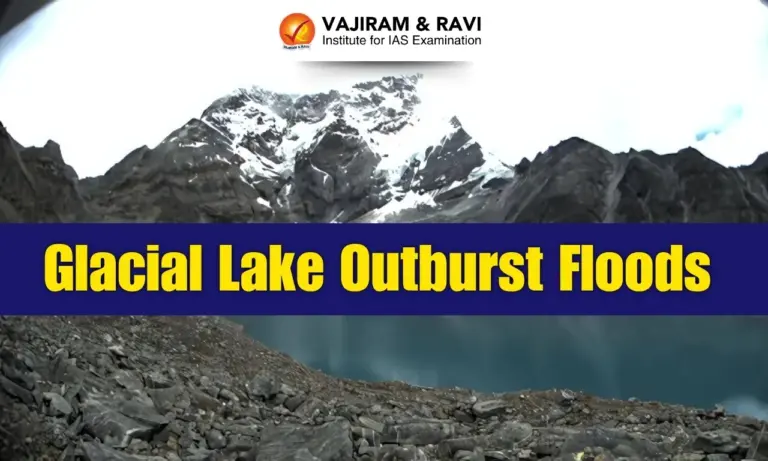
- GLOFs occur when unstable glacial lakes, formed due to melting glaciers, suddenly burst, releasing massive volumes of water downstream. In the Indian Himalayan Region (IHR), two major types of glacial lakes are found:
- Supraglacial Lakes: Formed on the glacier surface, vulnerable to summer melting.
- Moraine-Dammed Lakes: Formed at the glacier toe and dammed by loose debris, highly prone to collapse due to avalanches or ice-core instability.
- According to the National Remote Sensing Centre, India is home to around 28,000 glacial lakes, with most situated above 4,500 metres, making ground access difficult and monitoring sparse.
Catastrophic Events and Growing Vulnerability
- India has already experienced several GLOF disasters, such as:
- Chorabari GLOF (2013): Triggered the Kedarnath tragedy with cascading floods and landslides, killing hundreds.
- South Lhonak GLOF (2023, Sikkim): Destroyed the 1,250 MW Chungthang dam, raising the Teesta riverbed and decreasing its water-carrying capacity.
- The risk is compounded by rising temperatures. 2023 and 2024 were the hottest years globally, leading to increased glacier melt and destabilisation of lake structures.
- Additionally, the lack of weather and water monitoring stations in high-altitude areas has left most glacial lakes unmapped and unguarded.
National Strategy for GLOF Mitigation
- Recognising the scale of the threat, the NDMA launched a $20 million national programme, identifying 195 high-risk lakes, classified into four levels of vulnerability.
- The initiative, under the Committee on Disaster Risk Reduction (CoDRR), focuses on five core objectives:
- Hazard Assessment of each lake
- Installation of Automated Weather and Water Stations (AWWS)
- Deployment of Early Warning Systems (EWS)
- Water drawdown or retention structures at critical lakes
- Community engagement and education to improve response readiness
- States housing glacial lakes were encouraged to lead the effort by sending scientific expeditions to 40 of the most vulnerable lakes during the summer of 2024.
Scientific Techniques and Innovations
- To bridge India’s existing data and monitoring gaps, several advanced tools and technologies have been deployed:
- Synthetic Aperture Radar (SAR) Interferometry: Used for micro-level monitoring of slope stability and lake expansion, accurate up to a centimetre.
- Electrical Resistivity Tomography (ERT): Helps detect subsurface ice cores that could lead to dam failure.
- Bathymetry and UAV Surveys: Assess lake volume and surrounding terrain.
- Notably, two lakes in Sikkim are now equipped with AWWS units, transmitting water level and weather data every 10 minutes along with daily images of lake perimeters, establishing India’s first operational monitoring stations in the cryosphere.
Institutional and Community Preparedness
- Apart from technical tools, India has turned to ground-level institutions like the Indo-Tibetan Border Police (ITBP) for manual early warnings.
- Given their high-altitude deployments, ITBP personnel are now being trained to detect visible signs of GLOF risk.
- Community engagement has also emerged as a critical element. Several scientific teams were welcomed or rejected based on their rapport with local residents.
- The importance of culturally sensitive engagement became apparent when an expedition team had to leave behind a member to honour the sanctity of a lake considered sacred by locals.
Future Outlook and Scaling Efforts
- The government intends to scale the national programme under the upcoming 16th Finance Commission (FY2027–31).
- The plan includes expanding risk surveillance across thousands of lakes, scaling up scientific monitoring, and building institutional capacities for coordinated response.
- However, critical gaps remain:
- The lack of Indian startups or foundations working in Himalayan risk mitigation
- Limited use of remote sensing technologies despite their availability
- Absence of a pan-Himalayan early warning network in partnership with neighbouring countries like Nepal and China
- Bridging these gaps will be essential for India to protect its mountain communities and key river systems downstream.
Source: TH

 Last updated on April, 2026
→ UPSC Final Result 2025 is now out.
→ UPSC has released UPSC Toppers List 2025 with the Civil Services final result on its official website.
→ Anuj Agnihotri secured AIR 1 in the UPSC Civil Services Examination 2025.
→ UPSC Marksheet 2025 is now out.
→ UPSC Notification 2026 & UPSC IFoS Notification 2026 is now out on the official website at upsconline.nic.in.
→ UPSC Calendar 2026 has been released.
→ Check out the latest UPSC Syllabus 2026 here.
→ UPSC Prelims 2026 will be conducted on 24th May, 2026 & UPSC Mains 2026 will be conducted on 21st August 2026.
→ The UPSC Selection Process is of 3 stages-Prelims, Mains and Interview.
→ Prepare effectively with Vajiram & Ravi’s UPSC Prelims Test Series 2026 featuring full-length mock tests, detailed solutions, and performance analysis.
→ Enroll in Vajiram & Ravi’s UPSC Mains Test Series 2026 for structured answer writing practice, expert evaluation, and exam-oriented feedback.
→ Join Vajiram & Ravi’s Best UPSC Mentorship Program for personalized guidance, strategy planning, and one-to-one support from experienced mentors.
→ Shakti Dubey secures AIR 1 in UPSC CSE Exam 2024.
→ Also check Best UPSC Coaching in India
Glacial Lake Outburst Floods FAQs
Q1. What are Glacial Lake Outburst Floods (GLOFs)?+
Q2. How many glacial lakes are located in India’s Himalayan region?+
Q3. What national efforts are underway to mitigate GLOF risks?+
Q4. Which technologies are used to monitor GLOF threats?+
Q5. Why is community engagement critical in GLOF mitigation?+
Tags: global lake outburst floods mains articles upsc current affairs upsc mains current affairs