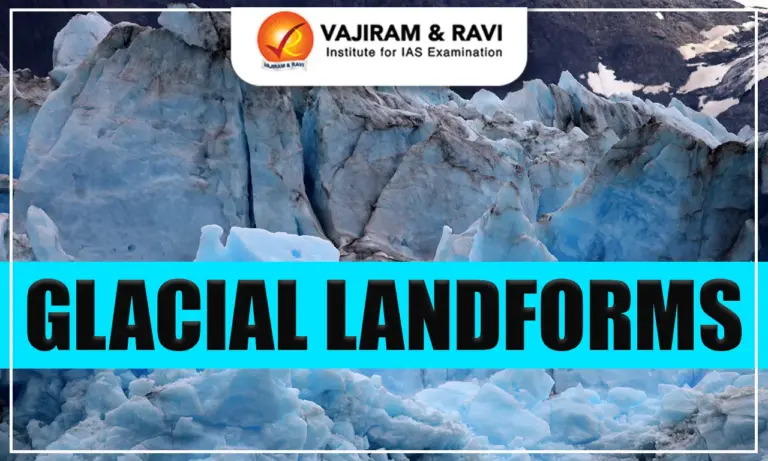
Glacial landforms are physical geographical features that are shaped by the movement and melting of glaciers that transform landscapes through erosion, deposition and transportation of sediments. These landforms include valleys, cirques, moraines and fjords that help in giving clues about past climates and help in forming mountainous and polar terrains. In this article, we are going to cover glacial landforms, their formation, types and significance.
Glacial Landforms
Glacial Landforms are very unique geographical features that are carved by glacial erosion, transportation and deposition. Huge ice sheets, that are impacted by gravity, help reshape landscapes and leave diverse formations that mirror their dynamic processes. Through plucking and abrasion, glaciers carve U-shaped valleys, cirques and aretes. Meltwater and debris deposition creates moraines, drumlins and eskers. These glacial formations are found in high-altitude mountains and polar areas, and these formations record historical climate shifts. Glacier formations act as natural reservoirs, supply freshwater, influence weather and sustain ecosystems. Protecting glacial features is important to understand Earth’s geological past and address climate impacts.
Glacial Landforms Formation Process
The glacials follow the following process when it comes to formation:
- Snow Accumulation: In areas like high mountains and polar regions, layers of snow compress into ice.
- Glacial Movement: The floating of ice under the influence of gravity, reshapes the terrains via plucking and abrasion.
- Erosion: The rocks get uplifted due to plucking while the surfaces get scraped due to abrasion. These processes form striations and U-shaped valleys as well as polished rocks.
- Transportation: The glaciers lead to the movement of rocks and sediments over long distances.
- Deposition: The melting of glaciers lead to the deposition of materials and form marines, drumlins and eskers.
- Retreat: The ice glaciers that are receding leave kettle lakes, outwash plains and fjords, formed by ice and meltwater.





Glacial Landforms Types
Glacial Landforms are of two types. The glacial formations are divided into: Erosional Landforms and Depositional Landforms
Erosional Glacial Landforms
The erosional glacial landforms can be sub-divided into the following types:
- Cirques: These are depressions that are in the shape of a bowl formed due to glacial erosion at the glacier head.
- Arêtes: This is formed in between two cirques like sharp, knife edge ridge or glacial valleys.
- U-shaped Valleys: These valleys are formed by glacier movement and reshape the river valleys into broad, flat bottomed valleys.
- Horns: These are formed around mountains in the form of a pyramid shaped peak formed by the multiple cirques erosion.
- Glacial Striations: The rocks embedded in glacial ice form scratches or grooves on bedrocks.
- Fjords: These are made by rising sea levels that form a U-shaped valley and leads to the formation of deep, narrow inlets.
Depositional Landforms
Depositional landforms can be sub-divided into the following types:
- Moraines: Deposits of rock debris left by glaciers, occurring along the sides (lateral), at the snout (terminal), or beneath the ice (ground).
- Drumlins: Oval-shaped, elongated hills of glacial till that show the direction of ice movement.
- Eskers: Sinuous ridges of sand and gravel laid down by meltwater streams flowing beneath glaciers.
- Kettle Lakes: Hollow depressions formed by melting ice blocks, later filled with water to form lakes.
- Outwash Plains: Wide, flat expanses of sediments spread by meltwater beyond a glacier’s front.
- Erratics: Isolated, large boulders carried and deposited by glaciers, often resting far from their origin.
Glacial Landforms Importance
Glacial Landforms are important due to many reasons. These reasons include:
- Store freshwater and sustain rivers: Glaciers act as massive natural reservoirs, releasing meltwater seasonally, which feeds rivers and provides drinking water, irrigation, and hydropower.
- Indicate past climatic conditions: Features like moraines, drumlins, and U-shaped valleys serve as natural records of glacial advances and retreats, offering insights into historical climate patterns.
- Support ecosystems and biodiversity: Unique habitats such as kettle lakes, fjords, and outwash plains foster diverse species, including many cold-adapted and endemic organisms.
- Enrich soils with minerals for agriculture: Glacial deposits carry finely ground rock flour and minerals that improve soil fertility, making certain regions highly productive for farming.
- Promote tourism and recreation: Landscapes shaped by glaciers, like fjords, cirques, and snow-capped valleys, attract tourists for trekking, skiing, and sightseeing, boosting local economies.
- Act as barriers against floods and hazards: Depositional features like moraines and outwash plains can reduce the impact of flooding, landslides, and avalanches by acting as natural buffers.
- Aid scientific research on geomorphology and ice ages: Glacial landforms provide data for studying Earth’s surface processes, past ice ages, and ongoing climate change.
- Hold cultural, ecological, and aesthetic value: Many communities consider glacial landscapes sacred, while their scenic beauty inspires art, literature, and cultural heritage.
Glacial Landforms Global Impacts
Glacial Landforms have the following impact on the environment:
- Regulate freshwater and river flows: Seasonal glacial melt sustains major rivers worldwide, ensuring water availability for billions of people in arid and semi-arid regions.
- Contribute to sea-level rise through melting: Accelerated glacial retreat adds to rising sea levels, threatening coastal cities, islands, and ecosystems.
- Create unique habitats fostering biodiversity: Features like fjords and kettle lakes harbor specialized aquatic and terrestrial ecosystems, often supporting rare and endemic life.
- Enrich soils, boosting regional agriculture: Mineral-rich sediments left by glaciers improve soil fertility, enabling productive farming in areas like Northern Europe and the Indo-Gangetic plain.
- Attract global tourism, supporting economies: Iconic glacial regions such as the Alps, Himalayas, and Patagonia draw millions of tourists annually, generating significant revenue.
- Pose risks like GLOFs, avalanches, and landslides: Rapid melting or destabilization of glacial lakes increases risks of sudden floods and slope failures in mountain regions.
- Influence climate via albedo effect and circulation: Glaciers reflect solar radiation, regulating Earth’s heat balance, while their melt affects ocean currents and global climate systems.
- Record Earth’s geological and climatic history: Glacial striations, deposits, and erosional features act as archives of past ice ages, helping scientists reconstruct paleoclimates.
- Shape hydrological cycles and sediment transport: Meltwater flows redistribute sediments, alter river courses, and impact downstream water systems across continents

 Last updated on March, 2026
→ UPSC Final Result 2025 is now out.
→ UPSC has released UPSC Toppers List 2025 with the Civil Services final result on its official website.
→ Anuj Agnihotri secured AIR 1 in the UPSC Civil Services Examination 2025.
→ UPSC Marksheet 2025 is now out.
→ UPSC Notification 2026 & UPSC IFoS Notification 2026 is now out on the official website at upsconline.nic.in.
→ UPSC Calendar 2026 has been released.
→ Check out the latest UPSC Syllabus 2026 here.
→ UPSC Prelims 2026 will be conducted on 24th May, 2026 & UPSC Mains 2026 will be conducted on 21st August 2026.
→ The UPSC Selection Process is of 3 stages-Prelims, Mains and Interview.
→ Prepare effectively with Vajiram & Ravi’s UPSC Prelims Test Series 2026 featuring full-length mock tests, detailed solutions, and performance analysis.
→ Enroll in Vajiram & Ravi’s UPSC Mains Test Series 2026 for structured answer writing practice, expert evaluation, and exam-oriented feedback.
→ Join Vajiram & Ravi’s Best UPSC Mentorship Program for personalized guidance, strategy planning, and one-to-one support from experienced mentors.
→ Shakti Dubey secures AIR 1 in UPSC CSE Exam 2024.
→ Also check Best UPSC Coaching in India
Glacial Landforms FAQs
Q1. What are the landforms of glaciers?+
Q2. Where are some famous examples of glacial landforms?+
Q3. What is an example of a glacial environment?+
Q4. What is a moraine?+
Q5. What is an arête?+
Tags: glacial landforms