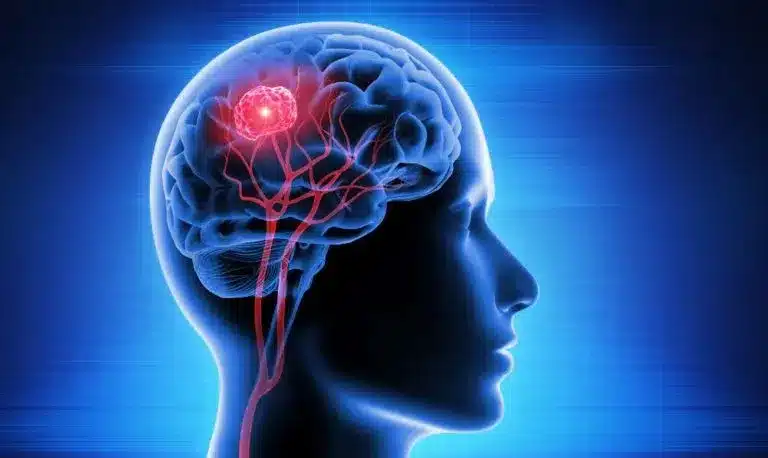
About Glioblastoma:
- It is a type of cancer that starts as a growth of cells in the brain or spinal cord.
- Like all cancers, glioblastoma is caused by DNA mutations that result in uncontrolled cell growth. The underlying causes for these genetic cell mutations are largely unknown.
- Glioblastoma forms from cells called astrocytes that support nerve cells.
- Astrocytes help give your brain the nutrients it needs.
- Glioblastoma tumors make their own blood supply, which helps them grow. It’s easy for them to invade normal brain tissue.
- It grows quickly and can invade and destroy healthy tissue.
- It can happen at any age. But it tends to happen more often in older adults.
- It accounts for almost half of all cancerous brain tumors in adults.
- Symptoms:
- Glioblastoma symptoms may include headaches that keep getting worse, nausea and vomiting, blurred or double vision, trouble speaking, altered sense of touch, and seizures.
- There also may be trouble with balance, coordination, and moving parts of the face or body.
- Treatment:
- There’s no cure for glioblastoma. Treatments might slow cancer growth and reduce symptoms.
- The main treatments for glioblastomas are surgery, radiotherapy, and chemotherapy.
Q1: What are Dendritic cells (DCs)?
Dendritic cells are a type of immune cell that play a crucial role in the body’s defense against pathogens. Dendritic cells are derived from bone marrow and are found in tissues that have contact with the external environment, such as the skin (where they are known as Langerhans cells), and the linings of the nose, lungs, stomach, and intestines. They are also present in blood in an immature state.The primary function of dendritic cells is to act as antigen-presenting cells (APCs). They capture antigens (foreign substances) from pathogens like bacteria and viruses and then process and present these antigens on their surface to T cells, initiating an immune response.
Source: AI reprograms glioblastoma cells into dendritic cells for cancer immunotherapy






 Last updated on March, 2026
→ UPSC Final Result 2025 is now out.
→ UPSC has released UPSC Toppers List 2025 with the Civil Services final result on its official website.
→ Anuj Agnihotri secured AIR 1 in the UPSC Civil Services Examination 2025.
→ UPSC Marksheet 2025 is now out.
→ UPSC Notification 2026 & UPSC IFoS Notification 2026 is now out on the official website at upsconline.nic.in.
→ UPSC Calendar 2026 has been released.
→ Check out the latest UPSC Syllabus 2026 here.
→ UPSC Prelims 2026 will be conducted on 24th May, 2026 & UPSC Mains 2026 will be conducted on 21st August 2026.
→ The UPSC Selection Process is of 3 stages-Prelims, Mains and Interview.
→ Prepare effectively with Vajiram & Ravi’s UPSC Prelims Test Series 2026 featuring full-length mock tests, detailed solutions, and performance analysis.
→ Enroll in Vajiram & Ravi’s UPSC Mains Test Series 2026 for structured answer writing practice, expert evaluation, and exam-oriented feedback.
→ Join Vajiram & Ravi’s Best UPSC Mentorship Program for personalized guidance, strategy planning, and one-to-one support from experienced mentors.
→ Shakti Dubey secures AIR 1 in UPSC CSE Exam 2024.
→ Also check Best UPSC Coaching in India