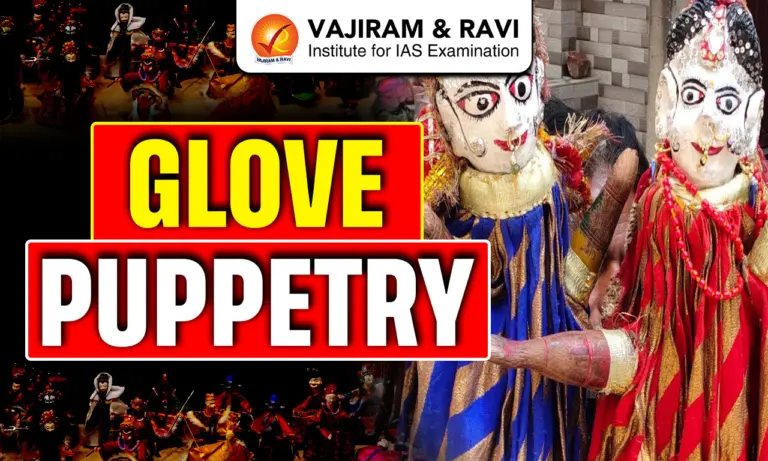
Glove Puppetry is a traditional performing art in which Puppets are controlled by hand movements, making them appear lively and expressive. It originated in the 17th century Fujian province of China, particularly in Quanzhou and Zhangzhou regions and later spread to Taiwan and other parts of Asia. In India, it evolved into diverse regional forms across states like Uttar Pradesh, Odisha, Kerala and West Bengal, reflecting strong cultural, religious and social narratives.
Glove Puppetry Features
Glove Puppetry involves simple hand controlled techniques and cloth based Puppets that allow expressive storytelling across cultures and regions.
- Structure and Material: Puppets have hollow wooden heads with cloth bodies, while hands and feet are wooden, enabling durability and flexibility in performance movements.
- Manipulation Technique: The Puppeteer inserts fingers inside the Puppet, using the index finger for the head and thumb and middle finger for arms, creating lifelike gestures.
- Costume Design: Puppets resemble cloth sacks with flowing skirts, giving the name “cloth bag opera” in Chinese tradition and allowing easy concealment of hand movements.
- Performance Style: Shows are divided into two parts, including demonstration and storytelling with orchestra, emphasizing dexterity, narration and coordinated movements.
- Themes and Narratives: Performances generally avoid vocal singing and focus on narration, poetry and instrumental music to convey mythological and social themes effectively.
Also Read: Rod Puppetry
This regional form reflects social narratives and humor through simple storytelling techniques using Glove Puppets controlled by skilled artists.
- Gulabo Sitabo Tradition: This form represents two co-wives married to the same man, highlighting domestic conflicts, humor and social satire through semi improvised performances.
- Material Evolution: Earlier Puppets used wooden heads, but modern versions use papier mache, making them lighter and easier to handle during performances.
- Performance Style: Puppeteers often use acapella narration, incorporating local songs, jokes and audience interaction to make performances engaging and relatable.
- Cultural Context: Shows are often performed during fairs and festivals, especially in Lucknow region, reflecting everyday social issues and community life.
Glove Puppetry of Odisha
Odisha’s Glove Puppetry is deeply connected with devotional themes and traditional storytelling rooted in Krishna legends.
- Sakhi Kundhei Nata: This popular form is practiced in regions like Bhubaneswar and Cuttack, focusing mainly on stories of Radha and Krishna.
- Puppeteer Technique: Artists operate Puppets using both hands while simultaneously playing musical instruments like dhol, showcasing multitasking skills.
- Narrative Themes: Stories are derived from Puranas and medieval poetry, emphasizing devotional love and divine adventures of Krishna.
- Performance Groups: Puppeteers travel in groups across villages, presenting shows with musical accompaniment and narration, maintaining a strong community tradition.
Also Read: Shadow Puppetry





Glove Puppetry of Kerala
Kerala’s Glove Puppetry shows strong influence of classical dance traditions and elaborate visual aesthetics.
- Pavakoothu Tradition: Developed under the influence of Kathakali, it incorporates elaborate costumes, facial designs and dramatic storytelling elements.
- Puppet Design: Puppets are decorated with paints, peacock feathers and metallic ornaments, resembling Kathakali performers in miniature form.
- Musical Accompaniment: Instruments like chenda, chengila, cymbals and conch shells are used, requiring at least six performers for a complete show.
- Themes and Stories: Narratives are mainly drawn from epics like Mahabharata and Ramayana, focusing on heroic and moral episodes.
Glove Puppetry of West Bengal
West Bengal’s Glove Puppetry combines artistic craftsmanship with social and historical significance.
- Beni Putul Form: The name refers to braided hair structure, symbolizing the Puppet’s three part construction of head, arms and flowing skirt.
- Material Composition: Puppets have terracotta or wooden heads, wooden arms and cloth skirts, making them durable and visually appealing.
- Historical Role: It was used as a medium of resistance against British oppression, reflecting socio-political awareness among performers.
- Performance Themes: Stories include Krishna Radha legends and domestic narratives like Madan Puti, often depicting everyday conflicts humorously.
Glove Puppetry of Karnataka
Karnataka presents a unique folk adaptation of Glove Puppetry rooted in tribal and street performance traditions.
- Chinni Patti Form: Named after small wooden dolls, this form uses simple Puppets made from wood and rice straw for storytelling.
- Performer Background: Traditionally practiced by marginalized communities, including beggars, who perform on streets using minimal resources.
- Themes of Narration: Stories focus on daily life situations such as trickery, social humor and moral lessons involving common people.
- Cultural Roots: The tradition is linked to tribal rituals and early social practices, reflecting indigenous cultural expressions.
Glove Puppetry of Tamil Nadu
Tamil Nadu’s Glove Puppetry is associated with ritual performances and mythological storytelling during festivals.
- Pava Koothu Tradition: This form is performed mainly during festivals and religious occasions, emphasizing ritualistic significance.
- Puppet Design: Puppets are small in size and made using rice straw and paper, making them lightweight and easy to manipulate.
- Narrative Focus: Stories highlight divine victories, especially goddess Lakshmi’s triumph over demons, symbolizing good over evil.
- Revival Efforts: The art form had declined but has recently been revived by cultural scholars and local communities.
Glove Puppetry Across Globe
Glove Puppetry exists in multiple forms worldwide, adapting to different cultural contexts and technological advancements.
- Chinese Glove Puppetry: Originated in Fujian province during the 17th century, it spread across Min Nan speaking regions and became popular in Taiwan.
- Taiwanese Glove Puppetry: Yunlin County is a major center, with modern adaptations like Pili productions integrating computer animation and global collaborations.
- Indonesian Glove Puppetry: Known as Wayang Potehi, it evolved through Chinese-Javanese cultural interaction and is preserved in Java regions like Semarang and Jombang.
- Global Variants: Other forms include Black Light Puppets using UV light, Bunraku in Japan, Carnival Puppets in USA and South Africa and Object Puppets made from everyday materials.
Glove Puppetry Significance
Glove Puppetry holds cultural, educational and artistic significance across regions, despite facing challenges in modern times.
- Cultural Importance: It represents traditional storytelling, reflecting religious beliefs, folklore and social values across different societies.
- Educational Value: Puppetry enhances language skills, creativity, emotional development and listening abilities, especially among children.
- Decline Factors: Competition from electronic media, lack of patronage and outdated stage techniques have reduced its popularity in recent decades.
- Revival Efforts: Institutional support, cultural initiatives and modern adaptations like television integration have helped preserve and promote this art globally.

 Last updated on April, 2026
→ UPSC Final Result 2025 is now out.
→ UPSC has released UPSC Toppers List 2025 with the Civil Services final result on its official website.
→ Anuj Agnihotri secured AIR 1 in the UPSC Civil Services Examination 2025.
→ UPSC Marksheet 2025 is now out.
→ UPSC Notification 2026 & UPSC IFoS Notification 2026 is now out on the official website at upsconline.nic.in.
→ UPSC Calendar 2026 has been released.
→ Check out the latest UPSC Syllabus 2026 here.
→ UPSC Prelims 2026 will be conducted on 24th May, 2026 & UPSC Mains 2026 will be conducted on 21st August 2026.
→ The UPSC Selection Process is of 3 stages-Prelims, Mains and Interview.
→ Prepare effectively with Vajiram & Ravi’s UPSC Prelims Test Series 2026 featuring full-length mock tests, detailed solutions, and performance analysis.
→ Enroll in Vajiram & Ravi’s UPSC Mains Test Series 2026 for structured answer writing practice, expert evaluation, and exam-oriented feedback.
→ Join Vajiram & Ravi’s Best UPSC Mentorship Program for personalized guidance, strategy planning, and one-to-one support from experienced mentors.
→ Shakti Dubey secures AIR 1 in UPSC CSE Exam 2024.
→ Also check Best UPSC Coaching in India
Glove Puppetry FAQs
Q1. What is Glove Puppetry?+
Q2. What are Glove Puppets made of?+
Q3. Which Indian states are famous for Glove Puppetry?+
Q4. What are the main themes in Glove Puppetry performances?+
Q5. What is Pavakoothu in Kerala Glove Puppetry?+
Tags: glove puppetry history history notes