About Golden Langurs
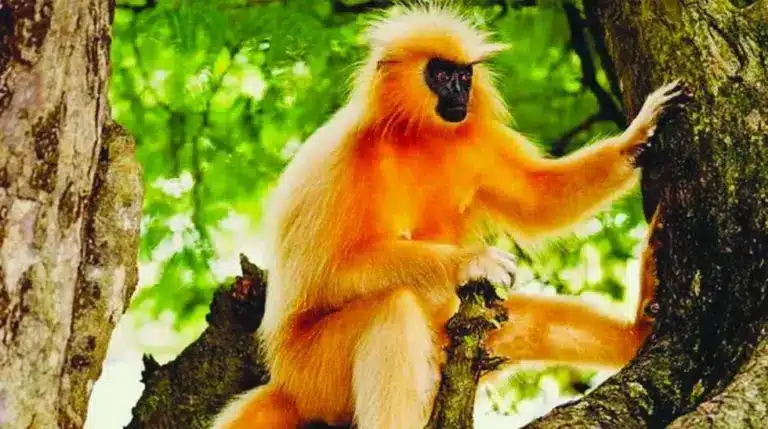
- It can be most easily recognized by the color of their fur, after which they are named.
- It has been noted that their fur changes colors according to the seasons.
- The color of the young also differs from adults in that they are almost pure white.
- Geographic Range:
- o It is limited to Assam, India and neighboring Bhutan where they live year-round.
- o The area they inhabit is restricted to the region surrounded by four geographical landmarks: the foothills of Bhutan (north), Manas river (east), Sankosh river (west), and Brahmaputra river (south).
- Habitat
- o They occupy moist evergreen and tropical deciduous forests as well as some riverine areas and savannas in Assam and Bhutan.
- o They are very much dependent on trees, living in the upper canopy of sub-tropical forests in the south and in more temperate forests in the north.
- o They may be found at elevations close to sea level in the south and up to 3000 m at the foothills of Bhutan in the north.
- Conservation status
- o IUCN: Endangered
- o CITES: Appendix I
- o Wildlife Protection Act, 1972 : Schedule I
Q1) What is the Convention on International Trade in Endangered Species of Wild Fauna and Flora (CITES)?
It is an international agreement between governments that aims to ensure that international trade in wild animals and plants does not threaten their survival. CITES was adopted in 1973 and entered into force in 1975.There are 184 member parties, and trade is regulated in more than 38,000 species.
Source: India’s golden langur population estimated at 7,396





 Last updated on April, 2026
→ UPSC Final Result 2025 is now out.
→ UPSC has released UPSC Toppers List 2025 with the Civil Services final result on its official website.
→ Anuj Agnihotri secured AIR 1 in the UPSC Civil Services Examination 2025.
→ UPSC Marksheet 2025 is now out.
→ UPSC Notification 2026 & UPSC IFoS Notification 2026 is now out on the official website at upsconline.nic.in.
→ UPSC Calendar 2026 has been released.
→ Check out the latest UPSC Syllabus 2026 here.
→ UPSC Prelims 2026 will be conducted on 24th May, 2026 & UPSC Mains 2026 will be conducted on 21st August 2026.
→ The UPSC Selection Process is of 3 stages-Prelims, Mains and Interview.
→ Prepare effectively with Vajiram & Ravi’s UPSC Prelims Test Series 2026 featuring full-length mock tests, detailed solutions, and performance analysis.
→ Enroll in Vajiram & Ravi’s UPSC Mains Test Series 2026 for structured answer writing practice, expert evaluation, and exam-oriented feedback.
→ Join Vajiram & Ravi’s Best UPSC Mentorship Program for personalized guidance, strategy planning, and one-to-one support from experienced mentors.
→ Shakti Dubey secures AIR 1 in UPSC CSE Exam 2024.
→ Also check Best UPSC Coaching in India