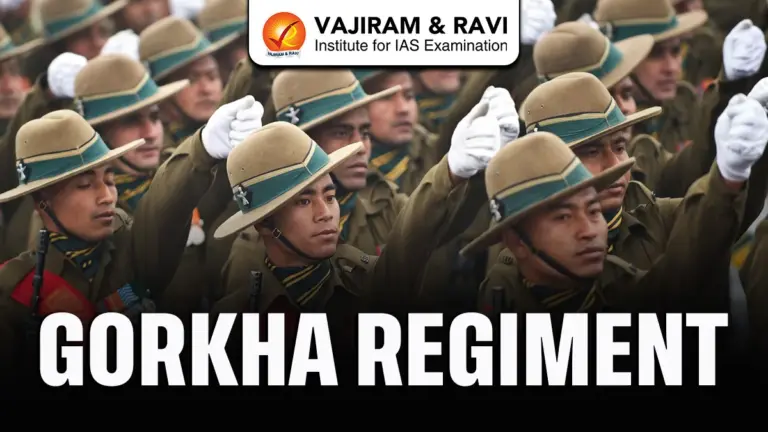
The Gorkha Regiment is one of the oldest and most prominent regiment of Indian Army. It is famous for its discipline, bravery and fierce nature of warfare. The regiment usually consist of soldiers of Gurkha (Nepali) origin, which uses its traditional weapon Khukri.
Who are Gorkhas?
- Gorkhas (or Gurkhas) are people of Nepali origin, who are named after Guru Gorakhnath, a revered warrior-saint and the historic hill region of Gorkha in Nepal.
- In India, the term is used to distinguish Indian Gorkhas (Indian citizens) from Nepali nationals who live or work in India.
- Indian Gorkhas trace their roots to families that settled in India during British rule, especially when Gorkha soldiers were recruited into the colonial army.
- After the British annexation of Assam in 1826, many Nepali-speaking soldiers moved into eastern and northeastern India, leading to permanent settlements.
- Over time, Gorkhas became an integral part of Indian society, known for their military service, discipline, loyalty and hard work in both defence and civilian life.
Gorkha Regiment History
The history of Gorkha Regiment can be traced back to the Anglo-Nepal war (1814-1816) and their continued contribution in the Indian Army post Independence.
Pre-Independence
- After the Anglo-Nepal war (1814-1816) which is also known as the Gorkha War, the Britishers were so impressed by the fighting style and bravery of Gorkha soldiers that they started recruiting them in their army after signing the Tretay of Sugauli (1816).
- Being then part of the British army, the Gorkah regiment created a strong reputation by participating in 1857 revolt, both Word wars and other colonial expeditions, fighting across Asia, Africa and South-east Asia.
- In the colonial army, the Gorkha regiment was recognized as one the most effective and reliable infantry .
Post-Independence
- After Independenc, the Tripartite Agreement was signed in 1947 between India, Nepal and the Britain, under which out of 10 Gurkha regiments, six regiments were transferred to Indian Army, while the four regimentts went to the British Army.
- The 11th Gorkha Rifles was raised in 1948. At present, the Indian army has seven Gorkha regiments.
- The Gorkha regiment played a crucial role in many major battles like the Kashmir war (1947-48), Indo-China war (1962), Indo-Pak war (1965, 1971) and the Kargil war (1999).
- The regiment has contributed immensely in various operations like the counter-insurgency operations, border security, UN Peacekeeping missions and disaster relief.





Structure of the Gorkha Regiment
- The Gorkha Regiment is part of the Infantry arm of the Indian Army, which forms an integral part of ground combat forces.
- It consists of several Gorkha regiments, such as 1st, 3rd, 4th, 5th, 8th, 9th, and 11th Gorkha Rifles, each of them having its own history and identity.
- Each Gorkha regiment is divided into battalions, which are the basic fighting units of the Army.
- A battalion usually have around 800-900 soldiers and is commanded by a Colonel.
- Battalions are further divided into companies, platoons and sections to make sure effective command and control during operations.
- The soldiers are mostly recruited from Gorkha communities, including Indian Gorkhas and Nepalese Gorkhas, according to government rules.
- Officers in the Gorkha Regiment are trained at Indian Military Academy (IMA) and other defence training institutions as like the officers of other regiments.
- The regiment follows the standard Indian Army command structure, while keeping their unique traditions such as the Khukri, regimental dress and customs.
Gorkha Regiment Characteristics
- The Gorkha Regiment is famous for its bravery, discipline and loyalty, with a long record of fearless service in peacekeeping missions, wars and counter-insurgency operations.
- Gorkha soldiers are respected for their physical strength, mental toughness, and ability to fight in difficult geography, especially in high-altitude areas and mountain
- The regiment has a strong warrior tradition, as symbolised by the Khukri, which reflects courage, honour and readiness to defend the nation.
- A deep sense of unity, regimental pride and teamwork helps them to maintain high morale and effectiveness on the battlefield.
- The motto “Kayar Hunu Bhanda Marnu Ramro” highlights the regiment’s value system, fighting spirit and commitment to duty.
- Overall, the Gorkha Regiment stands for professional excellence, rich cultural identity and an important link in India-Nepal military relations.
Gorkha’s Kukri/Khukri
- Symbol & identity: The Kukri is the traditional curved knife of the Gorkhas and represents their bravery, honour and martial tradition.
- Design & effectiveness: Its inward-curved, forward-heavy blade makes it highly effective for powerful cuts, especially in close combat.
- Military role: Closely linked with the Gorkha Regiments of the Indian Army, the Kukri is both a combat weapon and a source of psychological fear for enemies.
- Dual purpose: Besides warfare, it is also used as a daily utility tool, showing its practical importance in Gorkha life.
- Cultural significance: The kukri is hand-forged and used in ceremonies and traditional dress, reflecting Gorkha culture and heritage.
Other missions of Gorkhas
- Internal security & border duties: Gorkhas are deployed in counter-insurgency, counter-terrorism and border protection, especially in difficult terrain.
- International contribution: They have served significantly in United Nations peacekeeping missions thus, strengthening India’s global standing.
- Disaster relief & civil support: Gorkha troops even assist in disaster rescue operations and provide aid to civil authorities during emergencies and to keep law-and-order situations stable.
- Training & nation-building: They have even contributed by training soldiers and created unity in diversity within the Indian Army
Why is the Gorkha regiment the most feared?
- Fearless fighting spirit and discipline: Gorkha soldiers are known for their exceptional courage, strong discipline and loyalty to duty. They continue fighting even in extreme conditions and never retreat easily, which makes them highly respected and feared.
- Expertise in close combat and use of Kukri: They are highly skilled in hand-to-hand combat, especially using the Kukri, which is both a weapon and a symbol of their warrior tradition. This gives them a strong advantage in close-range battles.
- Ability to operate in difficult terrain: Gorkhas are naturally suited for mountains, forests and high-altitude areas. Their physical endurance and adaptability allow them to fight effectively where many forces struggle.
- Strong psychological impact and proven record: Their long history of success in wars, counter-insurgency and peacekeeping missions has created a powerful psychological fear among enemies and earned them a legendary reputation.

 Last updated on April, 2026
→ UPSC Final Result 2025 is now out.
→ UPSC has released UPSC Toppers List 2025 with the Civil Services final result on its official website.
→ Anuj Agnihotri secured AIR 1 in the UPSC Civil Services Examination 2025.
→ UPSC Marksheet 2025 is now out.
→ UPSC Notification 2026 & UPSC IFoS Notification 2026 is now out on the official website at upsconline.nic.in.
→ UPSC Calendar 2026 has been released.
→ Check out the latest UPSC Syllabus 2026 here.
→ UPSC Prelims 2026 will be conducted on 24th May, 2026 & UPSC Mains 2026 will be conducted on 21st August 2026.
→ The UPSC Selection Process is of 3 stages-Prelims, Mains and Interview.
→ Prepare effectively with Vajiram & Ravi’s UPSC Prelims Test Series 2026 featuring full-length mock tests, detailed solutions, and performance analysis.
→ Enroll in Vajiram & Ravi’s UPSC Mains Test Series 2026 for structured answer writing practice, expert evaluation, and exam-oriented feedback.
→ Join Vajiram & Ravi’s Best UPSC Mentorship Program for personalized guidance, strategy planning, and one-to-one support from experienced mentors.
→ Shakti Dubey secures AIR 1 in UPSC CSE Exam 2024.
→ Also check Best UPSC Coaching in India
Gorkha Regiment FAQs
Q1. Who are Gorkhas?+
Q2. What is Gorkha Regiment?+
Q3. When did the Gorkha regiment originated?+
Q4. What changed after Independence?+
Q5. What is Kukri?+
Tags: gorkha regiment modern history