What’s in today’s article:
- Different types of trade remedies: Anti-dumping, subsidies, safeguards
- Directorate General of Trade Remedies (DGTR)
- News Summary
Why In News?
- At least two judicial pronouncements have taken a dim view of the finance ministry’s decisions against imposing anti-dumping and safeguard duties.
- Recently, in many cases, the Centre chose not to impose anti-dumping duty.
- This was despite the findings and recommendations of the Directorate General of Trade Remedies (DGTR) establishing adverse impact of cheap or subsidised imports on domestic industry.
Different types of trade remedies: Anti-dumping, subsidies, safeguards
- Binding tariffs, and applying them equally to all trading partners (most-favoured-nation treatment, or MFN) are key to the smooth flow of trade in goods.
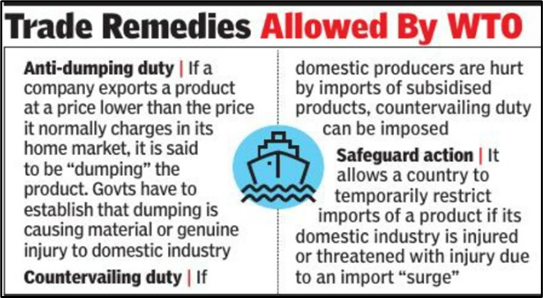
- The WTO agreements uphold the principles, but they also allow exceptions — in some circumstances. Three of these issues are:
- Actions taken against dumping (selling at an unfairly low price) – by imposing anti-dumping duties.
- Special “countervailing” duties to offset the subsidies made to producers of these goods in the exporting country.
- Emergency measures to limit imports temporarily, designed to “safeguard” domestic industries.
- A WTO member may restrict imports of a product temporarily (take safeguard actions) if its domestic industry is injured or threatened with injury caused by a surge in imports.
- These duties are extra import duties imposed on goods in addition to the normal duties that apply in the country.





Directorate General of Trade Remedies (DGTR)
- Earlier known as DGAD (Directorate General of Anti-Dumping & Allied Duties), it was renamed in May 2018.
- It works under the Ministry of Commerce and Industry.
- It was formed as a single national entity dealing with all kinds of Trade Remedial measures (anti-dumping, countervailing, safeguard).
- The DGTR provides a level playing field to the domestic industry against the unfair trade practices like dumping, subsidization and surge in imports.
News Summary
Background:
- Recently, the revenue department opted to be selective in imposing anti-dumping or safeguard duties to protect domestic industry.
- E.g., the revenue department decided to unilaterally suspend countervailing duty on certain varieties of stainless steel from China, which was quashed and set aside by the Gujarat high court.
- Many a times, it chose to do so against the recommendations of the designated authority such as DGTR.
- Several Indian companies and industry bodies have gone to court against the revenue department’s these decisions.
- Hearing a set of cases, the Customs, Excise & Service Tax Appellate Tribunal asked the Centre to reconsider its decisions in a bunch of cases where it decided against accepting the designated authority’s recommendations.
- It asked the Centre to give tentative reasons for not accepting the recommendations so as to give the domestic industry an opportunity to submit a representation.
- In several cases, where the revenue department in the finance ministry did not bother to communicate its final decision, the tribunal has taken the same view.
- The law governing anti-dumping cases requires the revenue department to decide on a matter within three months of the DGTR’s recommendations.
Imposition of anti-dumping duty: difference in opinion
- The finance ministry and NITI Aayog are of the view that imposing anti-dumping duty impact other producers in the chain adversely.
- On the other hand, the commerce ministry believes the DGTR recommendations come after establishing adverse impact on domestic producers and are in line with World Trade Organization rules.
- The commerce department is of the opinion that unless such an action is taken, domestic industry will be wiped out.

 Last updated on March, 2026
→ UPSC Final Result 2025 is now out.
→ UPSC has released UPSC Toppers List 2025 with the Civil Services final result on its official website.
→ Anuj Agnihotri secured AIR 1 in the UPSC Civil Services Examination 2025.
→ UPSC Marksheet 2025 is now out.
→ UPSC Notification 2026 & UPSC IFoS Notification 2026 is now out on the official website at upsconline.nic.in.
→ UPSC Calendar 2026 has been released.
→ Check out the latest UPSC Syllabus 2026 here.
→ UPSC Prelims 2026 will be conducted on 24th May, 2026 & UPSC Mains 2026 will be conducted on 21st August 2026.
→ The UPSC Selection Process is of 3 stages-Prelims, Mains and Interview.
→ Prepare effectively with Vajiram & Ravi’s UPSC Prelims Test Series 2026 featuring full-length mock tests, detailed solutions, and performance analysis.
→ Enroll in Vajiram & Ravi’s UPSC Mains Test Series 2026 for structured answer writing practice, expert evaluation, and exam-oriented feedback.
→ Join Vajiram & Ravi’s Best UPSC Mentorship Program for personalized guidance, strategy planning, and one-to-one support from experienced mentors.
→ Shakti Dubey secures AIR 1 in UPSC CSE Exam 2024.
→ Also check Best UPSC Coaching in India