About Gravity Energy Storage:
- It is a new technology that stores energy using gravity.
- How does it work?
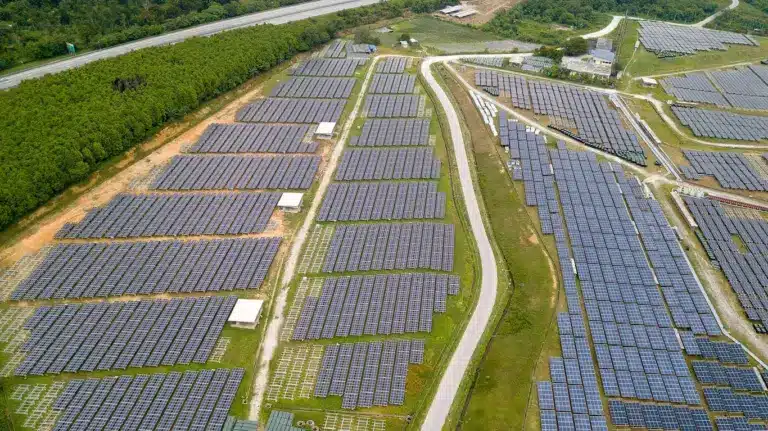
- It involves lifting a heavy mass during excess energy generation and releasing it to produce electricity when demand rises or solar energy is unavailable.
- The types of weights used are often water, concrete blocks or compressed earth blocks.
- Unlike pumped-hydro energy storage, gravity energy storage offers more flexibility in site selection.
- A typical setup involves a heavy piston within a fluid-filled cylindrical container.
- When solar energy production exceeds demand, surplus electricity lifts the piston, converting the surplus electrical energy into stored energy.
- When demand surpasses supply, the piston descends, driving water through a turbine to generate electricity supply to meet demand.
- Advantages
- It can last for decades with minimal maintenance, unlike batteries that degrade over time.
- It avoids harmful chemical reactions, reducing environmental impact and disposal issues, an important consideration in the move towards a greener planet.
- It can also be more cost-effective for large-scale applications, with lower level costs of energy and storage.
- It is particularly advantageous in areas with space constraints or environmental concerns that restrict the deployment of other storage systems.
Q1: What is Renewable energy?
It is energy derived from natural sources that are replenished at a higher rate than they are consumed. Sunlight and wind, for example, are such sources that are constantly being replenished. Renewable energy sources are plentiful and all around us.
News: How gravity can be harnessed to store renewable energy






 Last updated on April, 2026
→ UPSC Final Result 2025 is now out.
→ UPSC has released UPSC Toppers List 2025 with the Civil Services final result on its official website.
→ Anuj Agnihotri secured AIR 1 in the UPSC Civil Services Examination 2025.
→ UPSC Marksheet 2025 is now out.
→ UPSC Notification 2026 & UPSC IFoS Notification 2026 is now out on the official website at upsconline.nic.in.
→ UPSC Calendar 2026 has been released.
→ Check out the latest UPSC Syllabus 2026 here.
→ UPSC Prelims 2026 will be conducted on 24th May, 2026 & UPSC Mains 2026 will be conducted on 21st August 2026.
→ The UPSC Selection Process is of 3 stages-Prelims, Mains and Interview.
→ Prepare effectively with Vajiram & Ravi’s UPSC Prelims Test Series 2026 featuring full-length mock tests, detailed solutions, and performance analysis.
→ Enroll in Vajiram & Ravi’s UPSC Mains Test Series 2026 for structured answer writing practice, expert evaluation, and exam-oriented feedback.
→ Join Vajiram & Ravi’s Best UPSC Mentorship Program for personalized guidance, strategy planning, and one-to-one support from experienced mentors.
→ Shakti Dubey secures AIR 1 in UPSC CSE Exam 2024.
→ Also check Best UPSC Coaching in India