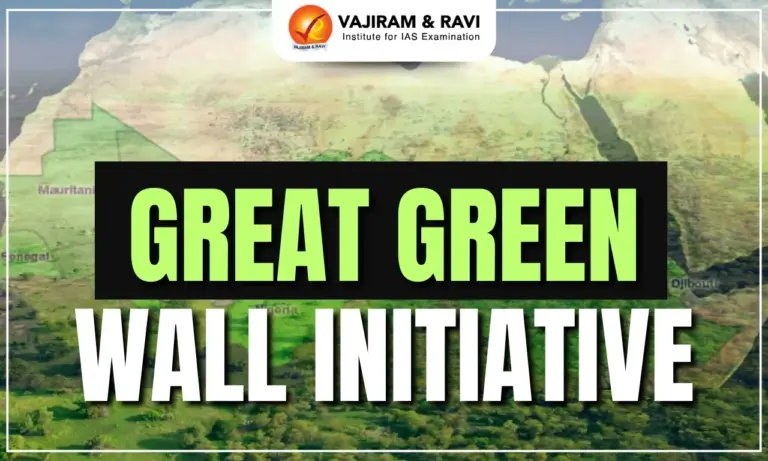
The Great Green Wall Initiative (GGWI) is one of the most ambitious environmental and sustainable development efforts in the world. It was launched in 2007 by the African Union to restore degraded lands across the Sahel region of Africa. The project stretches for 8,000 kilometers across the continent, transforming barren areas into fertile land. Its main goal is to fight desertification, climate change, and poverty, while improving the lives of millions living in the region. The initiative now unites 22 African countries working together for a greener future.
Great Green Wall Initiative
The Great Green Wall aims to combat environmental challenges by restoring degraded landscapes and promoting sustainable livelihoods. It focuses on improving soil health, water availability, and biodiversity. The Great Green Wall is not just about planting trees, it is about creating a mosaic of productive ecosystems, ensuring both environmental and economic growth. Some key facts about the initiative are:
- It was launched by the African Union in 2007.
- It covers an 8,000 km stretch across Africa.
- The project involves 22 African countries.
- It is implemented under the leadership of the Pan-African Agency of the Great Green Wall (PAAGGW).
- Over USD 19 billion has been raised for its implementation.
- The awareness campaign “Growing a World Wonder” is led by the United Nations Convention to Combat Desertification (UNCCD).
Great Green Wall Initiative Objectives
The Great Green Wall was designed to tackle several problems simultaneously, land degradation, food insecurity, poverty, and migration. Its main goals for 2030 are:
- To restore 100 million hectares of degraded land.
- To sequester 250 million tons of carbon from the atmosphere.
- To create 10 million green jobs across rural Africa.
The initiative supports local communities by:
- Protecting fertile land and increasing crop productivity.
- Strengthening food and water security.
- Offering new income opportunities for rural populations.
- Promoting climate resilience and sustainable living.





Great Green Wall Initiative Countries Participating
The Great Green Wall involves both core and supporting African countries. It directly passes through 11 key nations in the Sahel region, with 22 countries participating in total. The 11 core countries are Burkina Faso, Chad, Djibouti, Eritrea, Ethiopia, Mali, Mauritania, Niger, Nigeria, Senegal, and Sudan. Other participating nations include Benin, Cape Verde, Ghana, Kenya, Somalia, South Sudan, Togo, Uganda, The Gambia, Egypt, and Libya. Together, these countries work with international organizations like the World Bank, UNCCD, and the African Development Bank to achieve the project’s shared goals.
Great Green Wall Initiative Funding and Partnerships
The Great Green Wall Initiative is a joint effort between African nations and global partners. Funding comes from a combination of multilateral, bilateral, and private donors.
Key details include:
- USD 14.3 billion was pledged at the One Planet Summit in 2021, led by France.
- Total funding so far exceeds USD 19 billion.
- Main supporters include the World Bank, African Development Bank, European Commission, and the Irish Government.
- The UNCCD Global Mechanism plays a key role in managing and coordinating funds.
- This collaboration ensures that both financial and technical resources are directed effectively to achieve the 2030 targets.
Great Green Wall Accelerator
To speed up the implementation of the project, the Great Green Wall Accelerator was launched in January 2021. It is coordinated by the Pan African Agency of the Great Green Wall (PAAGGW) with assistance from the UNCCD.
The main goals of the Accelerator are to:
- Improve coordination among donors and implementing agencies.
- Track and measure progress in real time.
- Align investments with GGW’s 2030 objectives.
Great Green Wall Accelerator Pillars
The Great Green Wall Initiative focuses on five key pillars. This mechanism helps ensure transparency, accountability, and measurable impact across all GGW activities.
- Strengthening small and medium-sized farms and value chains.
- Restoring degraded land and managing ecosystems sustainably.
- Developing climate-resilient infrastructure and renewable energy access.
- Building better governance and institutional support systems.
- Enhancing training and capacity building for local communities.
Great Green Wall Accelerator Need
Despite its successes, the Great Green Wall faced several challenges in its early years. A Landmark Report in 2021 identified key issues, such as:
- Limited attention to national environmental priorities.
- Weak local institutions and implementation processes.
- Lack of coordination and communication between countries.
- Funding shortages and inconsistent data tracking.
To meet the 2030 goals, an estimated USD 33 billion is required. The Accelerator was designed to fill these gaps by promoting cooperation, strengthening systems, and monitoring performance effectively.
Great Green Wall Initiative Impact
The Great Green Wall is built on local ownership and community participation. One of the best examples of this approach is the FLEUVE Initiative (2014-2019), financed by the European Commission and implemented by the UNCCD Global Mechanism. This initiative strengthened the capacity of local communities to manage their land, conserve biodiversity, and generate income while building resilience to drought and climate change.
Key features of the FLEUVE Initiative include:
- Empowerment of 23 local communities across Burkina Faso, Chad, Mali, Niger, and Senegal.
- Focus on micro-investment projects for land restoration and sustainable livelihoods.
- Support for rural women and youth through job creation and training.
- Development of sustainable value chains for local dryland products.
Great Green Wall Initiative Achievements
Since 2007, the Great Green Wall has achieved significant progress across Africa. As of now, more than 18 million hectares of degraded land have been restored, and around 350,000 green jobs have been created.
Highlights of progress in selected countries:
- Burkina Faso: Over 29,000 hectares of land restored, 16.6 million seedlings produced, and 45,000 jobs created.
- Ethiopia: Nearly 1 million hectares of land restored, 5 billion plants grown, and 218,000 jobs created.
- Nigeria: More than 2,800 hectares reforested, 709 km of windbreaks established, and over 1,300 jobs generated.
- Senegal: About 850,000 hectares restored and 322,000 residents benefited from agroforestry activities.
- Sudan: Over 85,000 hectares of land restored, 1.9 million plants produced, and over 1,700 people trained in environmental conservation.
Great Green Wall Initiative Country Case Studies
The progress and impact of the Great Green Wall Initiative in several countries has been discussed below based on the official data released. These examples highlight the measurable social and environmental benefits achieved through national-level implementation.
Ethiopia
The Great Green Wall program in Ethiopia covers 58 woredas across three regions. The country has:
- Produced 5 billion plants and seeds.
- Restored over 1 million hectares of land.
- Developed 893,000 hectares of watershed and forest areas.
- Created more than 218,000 jobs.
Nigeria
Nigeria’s project includes a 1,359 km shelterbelt stretching from Kebbi State to Borno State. Key outcomes include:
- Planting of 7.6 million seedlings.
- Establishment of 709 km windbreaks.
- Creation of 1,396 jobs for local people.
Senegal
Senegal’s program spans 817,500 hectares and focuses on agroforestry and food security. The country has:
- Restored 850,000 hectares of land.
- Reforested 119,000 hectares.
- Benefited over 322,000 residents through training and community initiatives.
Great Green Wall Initiative Challenges
While the Great Green Wall has achieved remarkable success, several challenges remain. With these steps, the Great Green Wall can achieve its 2030 vision of a restored and sustainable Sahel.
- Insufficient funding: Increase global investments through blended climate finance.
- Weak local governance: Strengthen institutions and local monitoring systems.
- Poor coordination: Establish regional collaboration hubs under PAAGGW.
- Impact of climate change: Use renewable energy and drought-resistant crops.
- Limited data sharing: Build a real-time GGW digital monitoring platform.
- Policy gaps: Integrate GGW into national climate and development policies.
- Lack of awareness: Promote school-level and community-based awareness programs.
- Land ownership issues: Develop fair legal frameworks to protect local land rights.
- Skill shortages: Expand training for youth and women in sustainable land use.
- Monitoring inefficiency: Improve digital tracking systems to measure progress.
Great Green Wall Initiative Campaign
The UNCCD launched the “Growing a World Wonder” campaign to inspire people worldwide to support the Great Green Wall. The campaign uses storytelling, films, and public outreach to build awareness.
It emphasizes that the Great Green Wall is a symbol of hope, showing how humanity and nature can work together. Millions of people have already been reached through media, cultural events, and community movements. A documentary film featuring Oscar-nominated filmmaker Fernando Meirelles and Malian singer Inna Modja further promotes this African-led vision to global audiences.
Great Green Wall Initiative UPSC
The Great Green Wall Initiative is Africa’s landmark movement for environmental restoration and sustainable development. Since its launch in 2007, over 18 million hectares of land have been restored, USD 19 billion raised, and 350,000 jobs created.
By 2030, the Great Green Wall aims to stand as a living monument of hope, protecting the Sahel from desertification while improving food security, creating jobs, and combating climate change. It represents a global lesson in resilience, cooperation, and human determination to heal the planet.

 Last updated on March, 2026
→ UPSC Final Result 2025 is now out.
→ UPSC has released UPSC Toppers List 2025 with the Civil Services final result on its official website.
→ Anuj Agnihotri secured AIR 1 in the UPSC Civil Services Examination 2025.
→ UPSC Marksheet 2025 is now out.
→ UPSC Notification 2026 & UPSC IFoS Notification 2026 is now out on the official website at upsconline.nic.in.
→ UPSC Calendar 2026 has been released.
→ Check out the latest UPSC Syllabus 2026 here.
→ UPSC Prelims 2026 will be conducted on 24th May, 2026 & UPSC Mains 2026 will be conducted on 21st August 2026.
→ The UPSC Selection Process is of 3 stages-Prelims, Mains and Interview.
→ Prepare effectively with Vajiram & Ravi’s UPSC Prelims Test Series 2026 featuring full-length mock tests, detailed solutions, and performance analysis.
→ Enroll in Vajiram & Ravi’s UPSC Mains Test Series 2026 for structured answer writing practice, expert evaluation, and exam-oriented feedback.
→ Join Vajiram & Ravi’s Best UPSC Mentorship Program for personalized guidance, strategy planning, and one-to-one support from experienced mentors.
→ Shakti Dubey secures AIR 1 in UPSC CSE Exam 2024.
→ Also check Best UPSC Coaching in India
Great Green Wall Initiative FAQs
Q1. What is the Great Green Wall Initiative? +
Q2. How long is the Great Green Wall? +
Q3. How much funding has been raised for the Great Green Wall Initiative? +
Q4. What are the main goals of the Great Green Wall Initiative by 2030? +
Q5. Which countries have made the most progress in the Great Green Wall Initiative? +
Tags: great green wall initiative