About Greenhouse Gas Bulletin:
- It has been published annually since 2004 by the World Meteorological Organization.
- It shows globally averaged surface mole fractions for carbon dioxide (CO2), methane (CH4) and nitrous oxide (N2O) and compares them with the mole fractions during the previous year and with preindustrial levels.
- It also provides insights into the change in radiative forcing by long-lived GHGs (LLGHGs) and the contribution of individual gases to this increase.
- It is one of WMO’s flagship publications released to inform the UN Climate Change conference (COP).
Highlights of the Bulletin
- The globally averaged surface concentration of carbon dioxide reached 420 parts per million (ppm), methane 1934 parts per billion and nitrous oxide 336.9 parts per billion (ppb) in 2023.
- Carbon dioxide is the single most important greenhouse gas in the atmosphere related to human activities, accounting for approximately 64 per cent of the warming effect on the climate, mainly because of fossil fuel combustion and cement production,
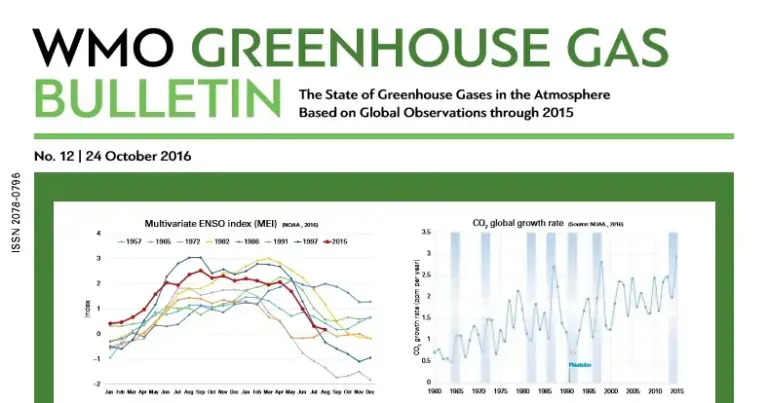
- The long-term carbon dioxide increase is due to fossil fuel combustion, but there are year-to-year variations due to the El Nino–Southern Oscillation, which impacts photosynthetic carbon dioxide uptake, respiratory release, and fires.
- Methane is a powerful greenhouse gas which remains in the atmosphere for about a decade. Methane accounts for about 16 per cent of the warming effect of long-lived greenhouse gases.
- Nitrous oxide, an ozone depleting chemical, accounts for about 6 per cent of the radiative forcing – the warming effect on the climate — by long-lived greenhouse gases.
- From 1990 to 2023, radiative forcing — the warming effect on our climate — by long-lived greenhouse gases increased by 51.5%, with CO2 accounting for about 81 per cent of this increase.
Q1: What is the World Meteorological Organization?
It is a specialized agency of the United Nations (UN). It was established in 1950, WMO became the specialized agency of the UN for meteorology (weather and climate), operational hydrology and related geophysical sciences.
News: With 11% increase over 2 decades, carbon dioxide accumulates faster in atmosphere






 Last updated on April, 2026
→ UPSC Final Result 2025 is now out.
→ UPSC has released UPSC Toppers List 2025 with the Civil Services final result on its official website.
→ Anuj Agnihotri secured AIR 1 in the UPSC Civil Services Examination 2025.
→ UPSC Marksheet 2025 is now out.
→ UPSC Notification 2026 & UPSC IFoS Notification 2026 is now out on the official website at upsconline.nic.in.
→ UPSC Calendar 2026 has been released.
→ Check out the latest UPSC Syllabus 2026 here.
→ UPSC Prelims 2026 will be conducted on 24th May, 2026 & UPSC Mains 2026 will be conducted on 21st August 2026.
→ The UPSC Selection Process is of 3 stages-Prelims, Mains and Interview.
→ Prepare effectively with Vajiram & Ravi’s UPSC Prelims Test Series 2026 featuring full-length mock tests, detailed solutions, and performance analysis.
→ Enroll in Vajiram & Ravi’s UPSC Mains Test Series 2026 for structured answer writing practice, expert evaluation, and exam-oriented feedback.
→ Join Vajiram & Ravi’s Best UPSC Mentorship Program for personalized guidance, strategy planning, and one-to-one support from experienced mentors.
→ Shakti Dubey secures AIR 1 in UPSC CSE Exam 2024.
→ Also check Best UPSC Coaching in India