What’s in today’s article:
- Groundwater and its availability in India
- GW governance in India
- GW crisis in India
- News Summary
Why in news?
- The Ministry of Jal Shakti recently released the National Compilation on Dynamic Ground Water Resources of India, 2022.
- According to this groundwater assessment report, annual groundwater extraction for irrigation, domestic and industrial uses has decreased by approximately 6 billion cubic metres (bcm) from 2020 to 239 bcm in 2022.
- The assessment was jointly carried out by the Central Ground Water Board (CGWB), States and Union Territories.
- Last assessment was carried out in 2020.
- The assessment was jointly carried out by the Central Ground Water Board (CGWB), States and Union Territories.
Groundwater and its availability in India:
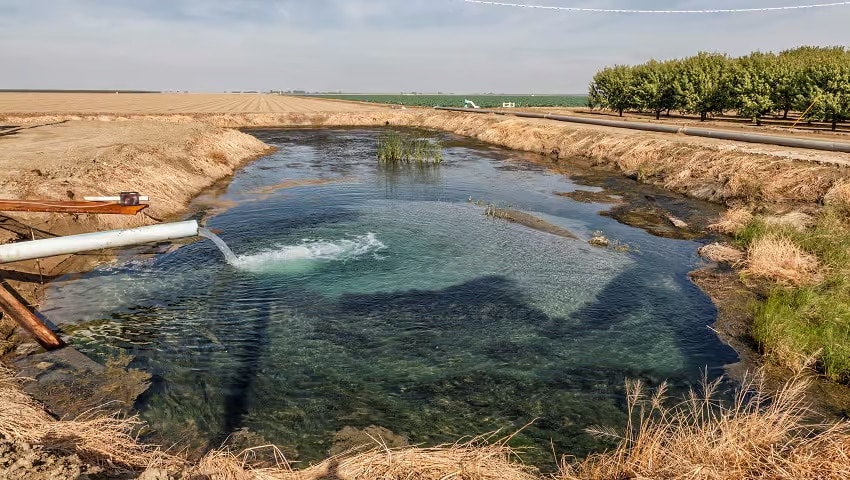
- Groundwater (GW) is the water that seeps through rocks and soil and is stored below the ground. The rocks in which GW is stored are called aquifers.
- This hidden resource accounts for just 62% of the total water and 30% of the freshwater available on earth.
- The underground (hydrogeological) setting in India can be divided into –
- Hard-rock aquifers of peninsular India: These represent around 65% of India’s overall aquifer surface area, mostly found in central peninsular India.
- Alluvial aquifers of the Indo-Gangetic plains: Found in the Gangetic and Indus plains in Northern India, these have significant storage spaces.
- GW availability in India:

- Out of the 1,123 BCM/year usable water, the share of GW is 433 BCM/.

Groundwater (GW) governance in India:
- Legal framework in India does not explicitly define GW ownership and rights, as these are still determined by the archaic Indian Easement Act, 1882.
- These rights tied to land ownership rights exclude a large part of the society and give landowners the liberty to withdraw limitless water. This leads to violation of the fundamental right to water and the right to life (Article 21).
- The Central GW Board (CGWB) was formed in 1970 specifically to develop GW policies and programs.
- It was later empowered by the Environment (Protection) Act in 1986 to form the Central Ground Water Authority (CGWA).
- Under this GW was acknowledged as a public resource supporting the 2004 Supreme Court judgement highlighting the ‘public trust doctrine’ – GW are so important to the population that making them a matter of private ownership would be unjustified.


GW crisis in India:
- In India, GW accounts for a quarter of total GW extraction in the world and is more than the combined extraction in China and the US.
- Given the interdependence of water, the environment and socioeconomic well-being, the challenges in GW resource management are –
- Unregulated extraction
- Excessive irrigation
- Poor knowledge of GW management system
- GW pollution
- Climate change
- As per the 2021 CAG report, GW extraction in India increased from 58% to 63%, between 2004-17, exceeding the GW recharge rate and over extraction at the current rate can threaten nearly 80% of drinking water over next two decades.
- Climate change effects such as intermittent rainfall further alters the recharge potential, posing a huge threat to equitable, healthy and pollution-free access to GW.
- As per CGWB estimates many regions are overexploited and a majority were also reported as critical and semi-critical.
- Atal Bhujal Yojana is a GW management scheme launched by the Government of India in 2019, with the purpose to improve GW management in 7 states of India.
News Summary – Highlights of the National Compilation on Dynamic Ground Water Resources of India, 2022:

- The total annual GW recharge was assessed at around 438 bcm in 2022, witnessing an increase by 1.29 bcm as compared to the last assessment (2020).
- The total annual extractable GW resources have increased by ~1 bcm, however, the annual GW extraction for irrigation, domestic and industrial uses have decreased by ~6 bcm during this period, in line with the similar decline trend since 2017.
- Irrigation accounts for approximately 87% (~208 bcm) of total annual GW extraction, the rest ~31 bcm is for domestic and industrial use.
- These variations are attributed mainly to refinement of parameters, refinement in well census data and changing GW regime.

 Last updated on Oct, 2026
→ UPSC 2027 Notification will be released on 13 January 2027 at upsconline.nic.in.
→ Check Nobel Prize 2026 Winners List here.
→ Download PIB PRiSM Monthly Magazine 2026 here.
→ Check UPSC Monthly Current Affairs Magazine The Recitals here.
→ Check out the latest UPSC Syllabus here.
→ Download UPSC Model Answers for Mains 2026
→ UPSC Mains Question Paper 2026 is out now for Essay & GS Paper 1, 2, 3 & 4.
→ UPSC Calendar 2027 has been released.
→ Enroll in Vajiram & Ravi’s UPSC Mains Test Series 2027 for structured answer writing practice, expert evaluation, and exam-oriented feedback.
→ Join Vajiram & Ravi’s UPSC Mentorship Program 2027 for personalized guidance, strategy planning, and one-to-one support from experienced mentors.
→ Go through the UPSC Mains Previous Year Papers to enhance your preparation.
→ UPSC has released UPSC Toppers List 2025 with the Civil Services final result on its official website.
→ Also check Best UPSC Coaching in India