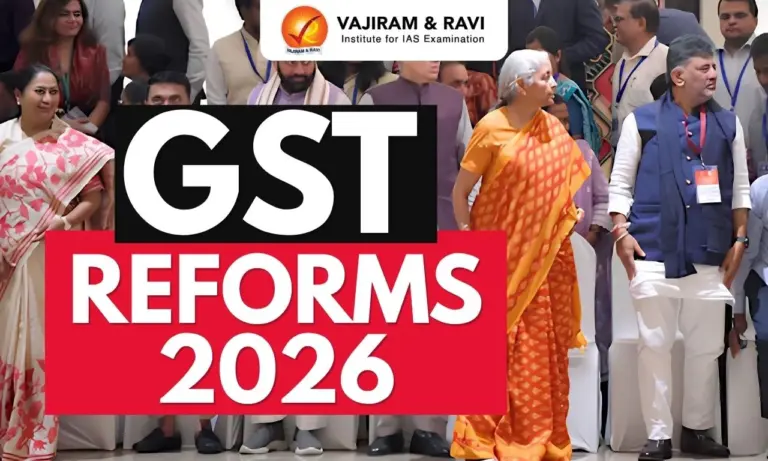
GST Reforms 2026 Latest News
- The 57th meeting of the Goods and Services Tax (GST) Council recommended major process reforms to simplify compliance, accelerate refunds, reduce litigation-related burdens and improve certainty for businesses.
Background: From Rate Rationalisation to Process Reforms
- The GST Council’s September 2025 exercise focused on rationalising tax rates on goods and services.
- Its latest meeting, held in October 2026, shifted attention towards simplifying procedures, improving taxpayer experience and reducing compliance-related friction.
- Union Finance Minister Nirmala Sitharaman stated that most GST-related issues concerning rates and processes had been addressed, while leaving the possibility of further reforms open.
- No GST rate changes were made at this meeting. The Council indicated that rate decisions would generally be considered annually and implemented from the beginning of the subsequent financial year.


Faster Refunds and Improved Working Capital
- One of the most significant reforms concerns the processing of GST refunds and accumulated Input Tax Credit (ITC).
- System-based refund processing
- The Council recommended a system under which 90% of eligible refund claims would be sanctioned automatically within three working days of acknowledgement, compared with the earlier seven-day timeline for most refunds.
- Refund acknowledgement is also proposed within 10 days, compared with the existing 15 days.
- Refunds under the inverted duty structure
- An inverted duty structure arises when the tax rate on inputs is higher than the tax rate on the final output, resulting in accumulated ITC.
- The Council recommended widening refund eligibility to include:
- Input services: The change can be availed from November 1, 2026.
- Capital goods: Refunds relating to eligible capital goods, such as plant and machinery, will be spread over 60 months, with the change scheduled to take effect from April 1, 2027.
- These measures are expected to benefit sectors such as FMCG, pharmaceuticals and food processing, where accumulated tax credits can constrain working capital.
Simplified GST Registration and Returns
- The Council recommended improvements to registration procedures, including greater certainty about the documents required.
- According to the government, 61% of taxpayers already receive automatic registration within three working days. The upgraded system is intended to simplify the process for remaining low-risk applicants by reducing unnecessary queries and rejections.
- Other proposed measures include:
- Simplified registration for small suppliers selling through e-commerce platforms.
- Easier amendments and cancellations of registrations.
- An option for small e-commerce sellers to register in a single State rather than in every State where they sell goods.
- An optional annual return-filing scheme for businesses with turnover up to Rs. 5 crore that supply directly to consumers.
- The annual return-filing scheme has received in-principle approval, but the Council will consider the final decision at a subsequent meeting.
Changes to Arrest and Prosecution Provisions
- The Council recommended removing the arrest powers of GST officers and increasing the prosecution threshold from Rs. 1 crore to Rs. 5 crore.
- The stated objective is to distinguish more clearly between tax-related disputes and conduct involving criminality.
- The Finance Minister emphasised that prosecution should follow the establishment of a prima facie criminal case rather than an officer making an arrest merely in anticipation of possible wrongdoing.
- The Council also recommended reducing the maximum general penalty from Rs. 25,000 to Rs. 10,000.
- For non-fraud cases, it recommended a lower penalty of 5% and removal of the minimum penalty requirement of Rs. 10,000.
Greater Safeguards for Inter-State Goods Movement
- The Council recommended restrictions on the interception and inspection of goods moving between States.
- Under the proposed framework, vehicles carrying goods may be stopped only by tax officers of the supplier State or recipient State, and not by officers of an intermediate State.
- Interception would require:
- Specific intelligence
- Due authorisation by an officer at Joint Commissioner level
- The objective is to prevent arbitrary checks and detention of goods during inter-State transportation
- Such safeguards can improve logistics efficiency, reduce delays and strengthen the predictability of supply chains.
Faceless Assessment and Digital Tax Administration
- Separately, the Union government announced plans to introduce faceless assessment for Central GST taxpayers registered in multiple States.
- A framework is to be issued for public consultation before Budget 2027, with implementation planned during 2027-28.
- Faceless assessment can reduce direct interactions between taxpayers and assessing officers, potentially improving consistency and limiting opportunities for discretionary action.
Relief for Service Exports and E-Commerce
- Export of services
- The Council recommended aligning GST treatment with established business practices for services supplied through overseas branches.
- The changes are intended to enable qualifying transactions to receive export treatment where the relevant conditions are met.
- This is significant because services exports are an important source of foreign exchange for India.
- E-commerce delivery services
- The Council clarified that delivery services provided by unregistered riders through e-commerce platforms would attract GST at 5%.
- The clarification seeks to reduce differences in tax treatment arising from different contractual arrangements, so that the tax treatment reflects the service actually delivered.

 Last updated on Oct, 2026
→ UPSC 2027 Notification will be released on 13 January 2027 at upsconline.nic.in.
→ Check Nobel Prize 2026 Winners List here.
→ Download PIB PRiSM Monthly Magazine 2026 here.
→ Check UPSC Monthly Current Affairs Magazine The Recitals here.
→ Check out the latest UPSC Syllabus here.
→ Download UPSC Model Answers for Mains 2026
→ UPSC Mains Question Paper 2026 is out now for Essay & GS Paper 1, 2, 3 & 4.
→ UPSC Calendar 2027 has been released.
→ Enroll in Vajiram & Ravi’s UPSC Mains Test Series 2027 for structured answer writing practice, expert evaluation, and exam-oriented feedback.
→ Join Vajiram & Ravi’s UPSC Mentorship Program 2027 for personalized guidance, strategy planning, and one-to-one support from experienced mentors.
→ Go through the UPSC Mains Previous Year Papers to enhance your preparation.
→ UPSC has released UPSC Toppers List 2025 with the Civil Services final result on its official website.
→ Also check Best UPSC Coaching in India
GST Reforms 2026 FAQs
Q1. What was the main focus of the GST Council’s 57th meeting?+
Q2. What change was recommended in the GST prosecution threshold?+
Q3. How will the proposed GST refund reforms help businesses?+
Q4. What is an inverted duty structure?+
Q5. What is faceless GST assessment?+
Tags: GST Reforms 2026 mains articles upsc current affairs upsc mains current affairs