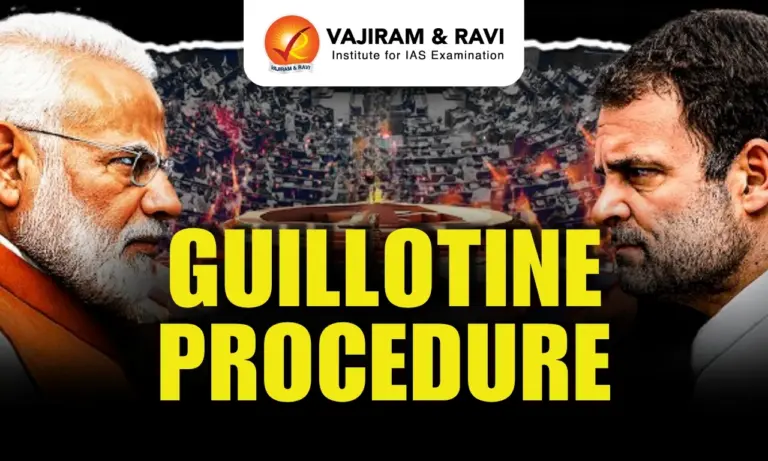
The Lok Sabha passed the Demands for Grants of various ministries for 2026-27 by approving an expenditure of over Rs 53 lakh crore without discussion by applying the guillotine.
Guillotine Procedure Meaning and Origin
The term “Guillotine” comes from the French Revolution, where it referred to a device used for execution, symbolising a quick and decisive end. In parliamentary language, the word is used in a similar sense to mean bringing a discussion to a sudden close.
In India’s parliamentary framework, the “guillotine procedure” is used to ensure the timely passage of financial business, particularly during the Budget session. It refers to the process of putting all remaining Demands for Grants to vote at once, without further discussion, on the last allotted day for their consideration.
It is widely used in the Lok Sabha and State Legislative assemblies during the Budget Session, typically on the last scheduled day for discussion on demands for grants.
Constitutional and Procedural Basis
The Guillotine procedure is not explicitly mentioned in the Constitution. At the Parliament level, it is derived from the Rules of Procedure and Conduct of Business in Lok Sabha, which are framed under the authority of Article 118(1) of the Constitution. In State Legislative Assemblies, it is governed by the Rules of Procedure of the respective State Legislature, framed under Article 208(1) of the Constitution.





Guillotine Procedure Process
- After the Union Budget is presented, Parliament usually goes into a three-week recess. During this period, Departmentally Related Standing Committees (DRSCs) scrutinize the Demands for Grants of various ministries and prepare reports.
- Once Parliament reassembles, the Business Advisory Committee (BAC) schedules discussions on the Demands for Grants, given the limitation of time. The House cannot take up the expenditure demands of all Ministries; thus, the BAC identifies important Ministries for discussions usually the Ministries of Home, Defence, External Affairs, Agriculture etc.
- Members move Cut Motions to reduce demands, these include policy cuts, economy cuts, and token cuts, as a means of controlling the executive.
- On the last day of the days allotted for discussion and voting on the demands for grants, the Speaker puts all the remaining demands to vote and disposes them whether they have been discussed by the members or not. This is known as the “Guillotine.”
- After the Guillotine is applied, the Finance Bill and Appropriation Bill are passed, authorizing expenditure from the Consolidated Fund of India.
Guillotine Procedure Purpose
Guillotine Procedure serves the following core purposes in Indian Parliament:
- To pass all undiscussed Demands for Grants on the last day of Budget discussion.
- To ensure timely Budget passage before March 31st deadline.
- To prevent financial paralysis of the government.
- To avoid filibustering and deliberate delays by opposition.
- Ensures timely completion of financial business and continuity of governance
Difference between Guillotine Procedure and Bill “in din”
Sometimes, the Lok Sabha or Rajya Sabha may pass a bill without discussion due to disruptions from legislators. This is called passing a Bll “in din”. While guillotine is a formal process to fast track voting, the “in din” is a call taken by the Chair when a discussion is not possible due to ruckus. Also, guillotine is specifically used in financial business.
Guillotine Procedure Critical Evaluation
The Guillotine Procedure has both functional strengths and democratic limitations.
Functional Strength:
- It is essential for fiscal efficiency. Without it, Parliament may fail to approve expenditure in time, leading to administrative paralysis.
- It provides certainty and stability to the budgetary process.
Democratic Limitations:
- It leads to curtailment of parliamentary scrutiny, as many Demands for Grants are passed without discussion.
- It weakens executive accountability, as Members of Parliament are denied adequate opportunity to examine and question government spending.
- It dilutes the deliberative character of Parliament, reducing financial control to a procedural formality rather than a substantive exercise of oversight.
Therefore, while the Guillotine enhances procedural efficiency and fiscal certainty, it also raises concerns about the quality of legislative oversight
Way Forward
There is a need to balancing efficiency with effective parliamentary oversight through:
- Better Time Allocation: Ensure more time for discussion of Demands for Grants so that more ministries are examined.
- Strengthening DRSCs: Enhance the role of Departmentally Related Standing Committees for detailed scrutiny of expenditure.
- Improving Parliamentary Functioning: Reduce disruptions and ensure focused debates on financial business.
- Prioritising Financial Oversight: Give greater importance to budget discussions to uphold Parliament’s control over public finances.

 Last updated on April, 2026
→ UPSC Final Result 2025 is now out.
→ UPSC has released UPSC Toppers List 2025 with the Civil Services final result on its official website.
→ Anuj Agnihotri secured AIR 1 in the UPSC Civil Services Examination 2025.
→ UPSC Marksheet 2025 is now out.
→ UPSC Notification 2026 & UPSC IFoS Notification 2026 is now out on the official website at upsconline.nic.in.
→ UPSC Calendar 2026 has been released.
→ Check out the latest UPSC Syllabus 2026 here.
→ UPSC Prelims 2026 will be conducted on 24th May, 2026 & UPSC Mains 2026 will be conducted on 21st August 2026.
→ The UPSC Selection Process is of 3 stages-Prelims, Mains and Interview.
→ Prepare effectively with Vajiram & Ravi’s UPSC Prelims Test Series 2026 featuring full-length mock tests, detailed solutions, and performance analysis.
→ Enroll in Vajiram & Ravi’s UPSC Mains Test Series 2026 for structured answer writing practice, expert evaluation, and exam-oriented feedback.
→ Join Vajiram & Ravi’s Best UPSC Mentorship Program for personalized guidance, strategy planning, and one-to-one support from experienced mentors.
→ Shakti Dubey secures AIR 1 in UPSC CSE Exam 2024.
→ Also check Best UPSC Coaching in India
Guillotine Procedure FAQs
Q1. What is the Guillotine Procedure?+
Q2. Is the Guillotine Procedure mentioned in the Constitution?+
Q3. How does the Guillotine Procedure work?+
Q4. What are the main purposes of the Guillotine Procedure?+
Q5. How is Guillotine Procedure different from passing a bill “in din”?+
Tags: guillotine procedure