About Gulf of Guinea:
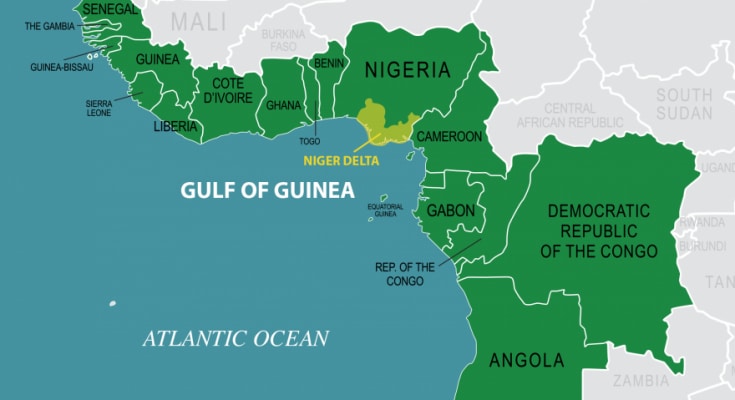
- It is the northeasternmost portion of the tropical Atlantic Ocean, located off the western coast of the African continent.
- It is found at the junction of the Prime Meridian and the Equator at 0°0’N and 0°0’E.
- The area covers 2.3 million square kilometers, with approximately 6,000 kilometers of coastline.
- It has a narrow continental shelf.
- It has warm tropical waters with relatively low salinity because of the rivers that drain into it and also due to the high rainfall in the region.
- Its major tributaries are the Volta and Niger rivers.
- Coastline:
- The 16 coastal countries that are situated along the Gulf of Guinea are Angola, Benin, Cameroon, Cote d’Ivoire, Democratic Republic of Congo, Republic of Congo, Guinea, Equatorial Guinea, Guinea-Bissau, Gabon, Nigeria, Ghana, São Tomé and Principe, Togo, and Sierra Leone.
- The coastal region of the Gulf is mostly low-lying and is interspersed with mangrove swamps, marshes, and lagoons.
- The coastline of the Gulf of Guinea is remarkably similar to the continental margin of South America (that runs from Brazil to the Guianas), thus establishing a clear confirmation of the theory of continental drift.
- The Gulf of Guinea region accounts for more than 35% of the world’s total petroleum reserves.
- It is one of the world’s most dangerous gulfs because of the widespread piracy that has severely affected many countries in West Africa, along with other international countries.
What is INS Sumedha?
- It is the third ship of the indigenously built Saryu-class Naval Offshore Patrol Vessels (NOPV).
- It was indigenously designed and built by Goa Shipyard Limited.
- It was commissioned into the Indian Navy on March 7, 2014.
- It is part of the Indian Navy’s Eastern Fleet, based in Visakhapatnam.
- Primary Functions: To undertake EEZ surveillance, anti-piracy patrols, fleet support operations, provide maritime security to offshore assets, and carry out escort operations for high-value assets.
- Features:
- It has a displacement of 2,230 tonnes and measures 105 metres in length and 12.9 metres in beam.
- It is fitted with a state-of-the-art weapon and sensor package.
- It can carry an Advanced Light Combat Helicopter onboard.
- The ship is propelled by two diesel engines, the largest of their kind ever deployed in the Indian Navy, which allow it to reach a top speed of 25 knots.
- With a range of 6,000 nautical miles (11,000 km) at 16 knots (30 km/h), the offshore patrol vessel is suitable for extended missions and operations.
Q1) What is continental shelf?
A continental shelf is the edge of a continent lying beneath the ocean. This shelf extends from the coastline of a continent to a drop off point called the shelf break. The shelf break is where the underwater edge of a continent shelf begins to rapidly slope downwards towards the ocean floor depths. From the break, the shelf descends into the deep ocean floor in the form of a continental slope.
Source: INS Sumedha strengthens diplomatic ties with port visit to Nigeria’s Lagos


 Last updated on July, 2026
→ UPSC Mains 2026 will be conducted on 21st, 22nd, 23rd, 29th and 30th August 2026.
→ UPSC Mains Admit Card 2026 is expected to be released in early August at upsc.gov.in or upsconline.nic.in
→ Enroll in Vajiram & Ravi’s UPSC Mains Test Series 2026 for structured answer writing practice, expert evaluation, and exam-oriented feedback.
→ Go through the UPSC Mains Previous Year Papers to enhance your preparation.
→ Download UPSC Mains Essay Paper 2025, UPSC Mains GS Paper-I 2025, UPSC Mains GS Paper-II 2025, UPSC Mains GS Paper-III 2025, UPSC Mains GS Paper-IV 2025, UPSC Mains English (Compulsory) Paper 2025, UPSC Mains Hindi (Qualifying) Paper 2025 here.
→ UPSC has released UPSC Toppers List 2025 with the Civil Services final result on its official website.
→ UPSC Calendar 2027 has been released.
→ Also check Best UPSC Coaching in India