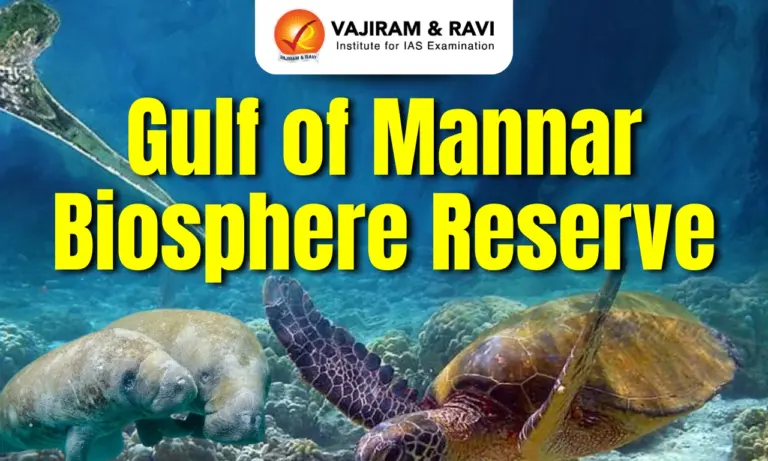
The Gulf of Mannar Biosphere Reserve is a coastal and marine ecosystem located along the southeastern coast of India. It is known for its rich biodiversity, including coral reefs, seagrass beds, and a wide variety of marine species. The area is protected to conserve its natural resources while also supporting the livelihoods of local communities. Overall, it represents a balance between environmental conservation and sustainable development.
About Gulf of Mannar Biosphere Reserve
- The Gulf of Mannar Biosphere Reserve is one of the most biologically rich marine regions in India, known for the presence of multiple ecosystems such as coral reefs, seagrass beds, and mangroves, all existing together in close interaction. This combination makes it ecologically very unique and globally significant.
- It supports an extremely high level of biodiversity, with over 4,000 species of plants and animals, ranging from microscopic organisms to large marine mammals, making it a storehouse of marine diversity.
- The region is often described as an “underwater tropical rainforest” because of its dense and diverse marine life, especially coral reef systems and ornamental fish populations.
Gulf of Mannar Biosphere Reserve Location
- The biosphere reserve is located along the southeastern coast of India in Tamil Nadu, stretching between Thoothukudi and Ramanathapuram districts, and includes a chain of 21 islands.
- It covers a large area of about 10.5 lakh hectares, including both terrestrial and marine ecosystems, with a significant coastal population depending on it.
- It was declared a biosphere reserve in 1989 and later recognized under UNESCO’s Man and Biosphere (MAB) Programme in 2001, highlighting its international ecological importance.


Gulf of Mannar Biosphere Reserve Ecological Features
- The islands in the region are formed mainly of sand, coral debris, and limestone, and are surrounded by diverse coastal landforms such as mudflats, lagoons, backwaters, and sand dunes, creating varied habitats.
- Seagrass beds are one of the most important features of this region, acting as nursery and breeding grounds for fish and other marine organisms, and supporting food chains in the ecosystem.
- The coral reefs found here are highly productive and support a wide variety of marine life, while also protecting the coastline from wave action and erosion.
- The region lies along the Central Asian Flyway, making it an important stopover for migratory birds, thereby increasing its ecological significance beyond marine biodiversity.
Gulf of Mannar Biosphere Reserve Flora and Fauna
- The vegetation includes mangroves (Rhizophora, Avicennia, Bruguiera), extensive seagrass meadows, and a large number of seaweed species, all of which play a crucial role in maintaining ecological balance.
- The biosphere reserve is famous for the Dugong (sea cow), an endangered herbivorous marine mammal that depends on seagrass for food, making this region one of its last important habitats in India.
- It also supports a wide range of fauna including corals, fishes, sea turtles, dolphins, whales, crustaceans, molluscs, and echinoderms, showing immense biological diversity.
- A unique feature is the presence of Balanoglossus, often called a “living fossil,” which is important for understanding evolutionary links between different animal groups.
Gulf of Mannar Biosphere Reserve Socio-Cultural Significance
- Socio-Economic Importance
- The biosphere reserve supports the livelihoods of lakhs of people living in coastal villages, most of whom depend on fishing and marine resources for their income and survival.
- The Gulf of Mannar Biosphere Reserve Trust plays a key role in managing the area through community participation, ensuring that conservation efforts also support local development.
- The region has strong potential for eco-tourism, research, and education, attracting scientists, students, and nature enthusiasts.
- Cultural and Historical Significance
- The area holds immense cultural importance as it includes Rameswaram, a major pilgrimage center associated with the Ramayana, attracting millions of visitors every year.
- This cultural connection adds to the importance of the region, making it not just an ecological hotspot but also a site of historical and religious value.
Gulf of Mannar Biosphere Reserve Environmental Challenges
- Destructive Fishing Practices (Bottom Trawling): Intensive fishing using bottom trawlers disturbs the seabed and destroys coral reefs and seagrass beds, which are crucial habitats. It also leads to the accidental capture of endangered species like dugongs and sea cucumbers, reducing biodiversity over time.
- Pollution (Plastic & Industrial Waste): Discharge of industrial effluents, untreated sewage, and plastic waste has caused increasing microplastic contamination in marine waters. This not only degrades ecosystems but also affects marine organisms through ingestion and toxicity.
- Coral Bleaching & Climate Change: Rising sea temperatures, ocean acidification, and sea-level rise are triggering frequent coral bleaching events, weakening reef systems. In some cases, coastal erosion and submergence of islands have also been observed.
- Habitat Destruction (Mangroves & Seagrass Loss): The degradation of mangroves and seagrass ecosystems reduces natural coastal protection and eliminates important breeding and feeding grounds, especially impacting species like the dugong.
- Ghost Nets & Marine Debris: Abandoned or lost fishing gear continues “ghost fishing”, trapping marine life and damaging coral habitats. Over time, these synthetic materials break down into microplastics, further polluting the ecosystem.
- Invasive Species & Overexploitation: The spread of invasive plants like Prosopis disturbs native biodiversity on islands, while overharvesting of marine resources (like ornamental fish and holothurians) puts additional pressure on already fragile ecosystems.
Gulf of Mannar Biosphere Reserve Importance & Conservation Value
- Maintains Ecological Balance & Biodiversity: The biosphere reserve plays a vital role in sustaining marine ecological balance by supporting diverse ecosystems like coral reefs, seagrass beds, and mangroves, which together host thousands of species and ensure ecosystem stability.
- Coastal Protection & Climate Regulation: Natural features such as mangroves and coral reefs act as protective barriers against cyclones, storm surges, and coastal erosion, while also contributing to carbon sequestration (blue carbon) and climate regulation.
- Supports Livelihoods & Food Security: The region provides direct livelihood support to coastal communities, especially through fisheries, while also ensuring food security by acting as a breeding and nursery ground for commercially important fish species.
- Centre for Research, Education & Biodiversity Conservation: It serves as a living laboratory for scientific research, environmental education, and conservation practices, helping in better understanding and protection of marine ecosystems.
- Model for Sustainable Development: Being the first marine biosphere reserve in South and Southeast Asia, it demonstrates how conservation and human development can coexist, promoting community-based and sustainable resource management.
- Global Ecological Significance & Eco-Tourism Potential: The region holds international importance due to its rich biodiversity and endangered species like the dugong, and also offers strong potential for eco-tourism, which can generate awareness and sustainable economic benefits.

 Last updated on Oct, 2026
→ UPSC 2027 Notification will be released on 13 January 2027 at upsconline.nic.in.
→ Check Nobel Prize 2026 Winners List here.
→ Download PIB PRiSM Monthly Magazine 2026 here.
→ Check UPSC Monthly Current Affairs Magazine The Recitals here.
→ Check out the latest UPSC Syllabus here.
→ Download UPSC Model Answers for Mains 2026
→ UPSC Mains Question Paper 2026 is out now for Essay & GS Paper 1, 2, 3 & 4.
→ UPSC Calendar 2027 has been released.
→ Enroll in Vajiram & Ravi’s UPSC Mains Test Series 2027 for structured answer writing practice, expert evaluation, and exam-oriented feedback.
→ Join Vajiram & Ravi’s UPSC Mentorship Program 2027 for personalized guidance, strategy planning, and one-to-one support from experienced mentors.
→ Go through the UPSC Mains Previous Year Papers to enhance your preparation.
→ UPSC has released UPSC Toppers List 2025 with the Civil Services final result on its official website.
→ Also check Best UPSC Coaching in India
Gulf of Mannar Biosphere Reserve FAQs
Q1. What is the Gulf of Mannar Biosphere Reserve?+
Q2. Where is the Gulf of Mannar Biosphere Reserve located?+
Q3. Why is the Gulf of Mannar called an “underwater tropical rainforest”?+
Q4. What makes the Gulf of Mannar ecologically important?+
Q5. Which endangered species is found in the Gulf of Mannar?+
Tags: environment environment notes gulf of mannar biosphere reserve