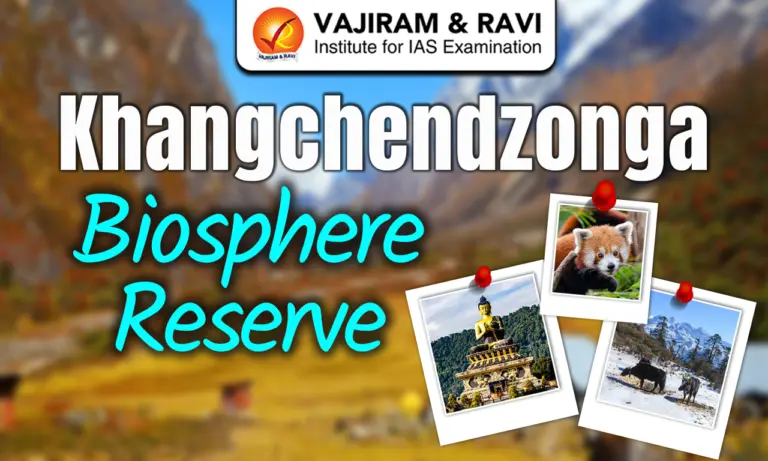
Khangchendzonga Biosphere Reserve is a well-known natural region in India, famous for its beautiful landscapes, rich biodiversity, and unique ecosystems. It is an important area for conservation of wildlife, forests, and natural resources while also supporting local communities. Overall, it represents a good example of the balance between nature conservation and sustainable living.
Khangchendzonga Biosphere Reserve Location and Extent
- Khangchendzonga Biosphere Reserve is located in the North, South, and West districts of Sikkim and covers a vast mountainous region of about 2655 sq. km.
- It is one of the highest ecosystems in the world, with altitude ranging from about 1,220 m to above 8,500 m, showing extreme geographical variation.
- The reserve is divided into core zones (1819.34 sq. km) and buffer zones (835.92 sq. km), following the biosphere reserve model where strict conservation and controlled human activities are balanced.
- It has a very wide altitudinal range from 1220 m to over 8550 m above sea level, making it one of the highest biosphere reserves in the world with extreme ecological diversity.
- It is also an internationally important biosphere reserve, included in the UNESCO World Network of Biosphere Reserves in 2018.
Also Read : Biosphere Reserves in India
Khangchendzonga Biosphere Reserve Geographical Features
- The reserve is bounded by Lungnak La ridge and Khangchendzonga National Park in the north, while the Teesta River forms its eastern boundary, adding to its hydrological importance.
- To the south, it is surrounded by reserved forests of South and West Sikkim, and to the west, the Singalila Range forms a natural boundary between India and Nepal.
- It also shares a small boundary with the Tibet Autonomous Region (China), making it a transboundary ecological region with international significance.
- The landscape includes high mountain peaks (up to 8550 m), glaciers, alpine lakes, valleys, and deep gorges, representing unique geomorphic features and one of the highest ecosystems globally.


Khangchendzonga Biosphere Reserve Physiography
- The region has a highly varied landscape, including deep valleys, steep gorges, ridges, glaciers, alpine meadows, and snow-covered mountain peaks, making it geographically unique.
- It contains several glacial lakes, river systems, and watersheds, which are important sources of water and ecological stability.
- Around 73 important lakes are found within the reserve, spread across different altitudinal zones and supporting diverse ecosystems.
- At lower altitudes, the terrain is rugged with ravines and river terraces, while higher areas consist of gentle alpine slopes and rocky outcrops.
- The presence of glacial moraines, scarps, and high peaks reflects the dynamic geological history of the Himalayan region.
Khangchendzonga Biosphere Reserve Climate
- The climate of the biosphere reserve varies significantly due to altitude, ranging from warm and humid conditions in the foothills to extremely cold and snowy conditions in high-altitude regions.
- Summers are relatively warm in lower areas, but temperatures decrease sharply with height, leading to freezing winters in mountainous regions.
- The area experiences high humidity levels, often ranging between 70% to over 90%, especially during the monsoon season.
- The region receives heavy rainfall, making it one of the most humid parts of the Himalayas and supporting dense vegetation.
- Seasons like spring and autumn are pleasant, promoting plant growth and attracting tourists and researchers.
Khangchendzonga Biosphere Reserve Ecological Features
- The reserve contains unique landforms such as glaciers, high-altitude lakes, rocky outcrops, and alpine meadows, which together create a highly diverse and fragile ecosystem.
- It shows a complete range of ecological zones (eco-clines) from sub-tropical to alpine and arctic conditions, allowing a wide variety of species to survive in different habitats.
- Several important watersheds and river systems originate here, making it crucial for water resources and downstream ecosystems.
- The area holds high religious and cultural significance, as mountains, lakes, caves, and rocks are considered sacred and are worshipped by local communities.
Khangchendzonga Biosphere Reserve People and Livelihood
- The core zone of the biosphere reserve has very limited human habitation, with only a few small eco-villages located within the protected area.
- Surrounding regions are inhabited by communities such as Lepchas, Bhotiyas, and various Nepalese groups, each having distinct cultural traditions.
- Most people depend on agriculture, horticulture, and animal husbandry for their livelihood, with limited involvement in business or service sectors.
- Many villages are remote and lack access to proper education and healthcare facilities, reflecting developmental challenges.
- The communities follow traditional and sustainable practices, maintaining a close relationship with nature and contributing to conservation efforts.
Khangchendzonga Biosphere Reserve Biodiversity
Khangchendzonga Biosphere Reserve is extremely rich in biodiversity, with a wide variety of flora and fauna due to its diverse altitudinal range. It supports numerous endemic and endangered species, making it an important conservation area. The detailed composition of its plant and animal life is discussed below.
Flora and Vegetation
- The biosphere reserve has extremely rich and diverse plant life, influenced by wide altitudinal variation and climatic conditions.
- Vegetation ranges from subtropical broad-leaved forests at lower levels to alpine and arctic vegetation at higher altitudes, showing clear ecological zones.
- It includes temperate forests, coniferous forests, sub-alpine forests, and alpine meadows, each supporting different plant species.
- The region is home to many rare, endemic, and medicinal plants, including several species of rhododendrons and other flowering plants.
- The diversity of vegetation provides important ecological services such as soil conservation, climate regulation, and habitat support.
Fauna (Wildlife)
- The reserve hosts a rich variety of wildlife, including important species such as Red Panda, Snow Leopard, Himalayan Black Bear, Musk Deer, Great Tibetan Sheep, Blue Sheep, Boral, and Barking Deer, representing both alpine and temperate ecosystems.
- It also supports diverse avian species like Monal Pheasant, Tragopan Pheasant, and Blood Pheasant, highlighting its importance as a bird habitat in the Eastern Himalayas.
- The fauna of the reserve is well-adapted to extreme altitudinal variations, ranging from subtropical forests in lower regions to alpine and cold desert conditions at higher elevations.
- The biosphere reserve serves as a safe habitat for several rare, endangered, and endemic species, making it a critical area for wildlife conservation in India.
- The rugged terrain, dense forests, and harsh climatic conditions act as natural barriers, reducing human interference and providing a secure refuge for wildlife populations.
- The presence of top predators like the Snow Leopard indicates a healthy and balanced ecosystem with intact food chains.
- Seasonal migration and movement of animals across altitudinal zones help maintain ecological balance and genetic diversity within species.
- The reserve also functions as part of a larger transboundary ecosystem, allowing wildlife movement across international borders and enhancing long-term species survival.
Significance of Khangchendzonga Biosphere Reserve
- Ecological Significance
-
- Khangchendzonga is part of a global biodiversity hotspot, with high levels of species richness and endemism.
- It includes a wide range of ecolines from subtropical to arctic, making it one of the most ecologically diverse regions in India.
- The biosphere reserve acts as a transboundary conservation area, supporting ecological continuity across national borders.
- It plays a crucial role in climate regulation, carbon storage, and water resource management, benefiting both local and downstream regions.
- The region also serves as a natural laboratory for scientific research, helping in understanding high-altitude ecosystems.
- Cultural and Religious Importance
-
- The biosphere reserve has deep cultural and religious significance, especially for local communities who consider nature sacred.
- Many natural features such as mountains, lakes, caves, rocks, and hot springs are worshipped and treated as pilgrimage sites.
- These beliefs promote environmental protection and conservation ethics among the people.
- The integration of culture and nature strengthens conservation efforts and helps preserve traditional knowledge.
- Festivals and rituals linked to nature reflect the spiritual connection between people and the environment.
Khangchendzonga Biosphere Reserve Conservation Status
- Khangchendzonga Biosphere Reserve was included in the UNESCO World Network of Biosphere Reserves in 2018, highlighting its global ecological importance.
- The core area (Khangchendzonga National Park) was declared a UNESCO World Heritage Site in 2016 under the mixed category (natural and cultural).
- Conservation efforts include eco-development programs, afforestation, soil conservation, and promotion of medicinal plant cultivation.
- Buffer and transition zones are managed to balance conservation with sustainable development, including eco-tourism and community participation.
Major Threats to Khangchendzonga Biosphere Reserve
- Climate change is leading to rising temperatures, which is accelerating glacier melting and disturbing the fragile high-altitude ecosystem of the biosphere reserve.
- Glacial Lake Outburst Floods (GLOFs) pose a serious threat as sudden release of water from glacial lakes can cause heavy destruction to ecosystems and nearby human settlements.
- Changing climatic conditions are forcing plants and animals to shift to higher altitudes, disrupting the natural ecological balance and threatening species survival.
- Increasing dependence of local communities on forest resources like fuelwood, fodder, and medicinal plants is putting continuous pressure on the reserve’s natural resources.
- Deforestation and land-use changes in buffer and transition zones are reducing forest cover and negatively affecting biodiversity.
- Livestock grazing and incursions into alpine pastures are degrading fragile vegetation and may also introduce diseases to wild animals.
- Unregulated tourism and trekking activities are resulting in waste accumulation and environmental degradation in ecologically sensitive areas.
- Excessive fuelwood collection by trekkers and locals is damaging slow-growing mountain vegetation such as juniper and rhododendron.
- Infrastructure development, including roads and hydroelectric projects, is fragmenting habitats and disturbing wildlife movement.
- Rising human–wildlife conflict due to habitat disturbance is creating risks for both animals and nearby human populations.
- Poaching and illegal hunting practices continue to threaten rare and endangered species in the reserve.
- Pollution and accumulation of non-biodegradable waste are adversely affecting soil, water, and overall ecosystem health.

 Last updated on Oct, 2026
→ UPSC 2027 Notification will be released on 13 January 2027 at upsconline.nic.in.
→ Check Nobel Prize 2026 Winners List here.
→ Download PIB PRiSM Monthly Magazine 2026 here.
→ Check UPSC Monthly Current Affairs Magazine The Recitals here.
→ Check out the latest UPSC Syllabus here.
→ Download UPSC Model Answers for Mains 2026
→ UPSC Mains Question Paper 2026 is out now for Essay & GS Paper 1, 2, 3 & 4.
→ UPSC Calendar 2027 has been released.
→ Enroll in Vajiram & Ravi’s UPSC Mains Test Series 2027 for structured answer writing practice, expert evaluation, and exam-oriented feedback.
→ Join Vajiram & Ravi’s UPSC Mentorship Program 2027 for personalized guidance, strategy planning, and one-to-one support from experienced mentors.
→ Go through the UPSC Mains Previous Year Papers to enhance your preparation.
→ UPSC has released UPSC Toppers List 2025 with the Civil Services final result on its official website.
→ Also check Best UPSC Coaching in India
Khangchendzonga Biosphere Reserve FAQs
Q1. Where is Khangchendzonga Biosphere Reserve located?+
Q2. When was Khangchendzonga Biosphere Reserve recognized by UNESCO?+
Q3. What type of biodiversity is found in Khangchendzonga Biosphere Reserve?+
Q4. What is the ecological importance of Khangchendzonga Biosphere Reserve?+
Q5. What types of ecosystems are found in Khangchendzonga Biosphere Reserve?+
Tags: environment environment notes khangchendzonga khangchendzonga biosphere reserve