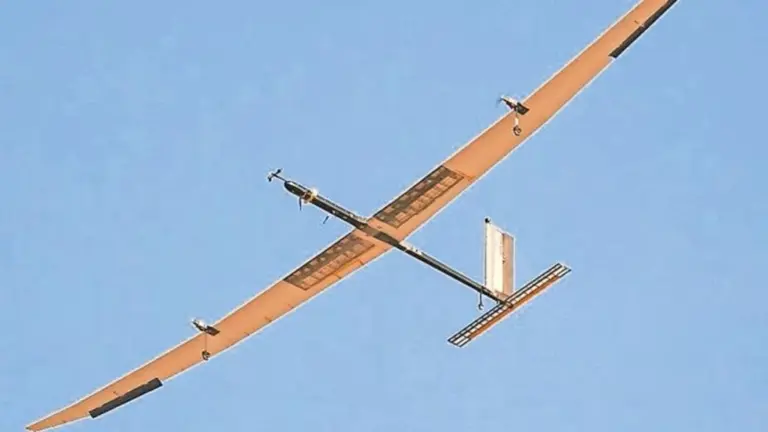
About High-Altitude Pseudo Satellite vehicle
- It is a new age unmanned aerial vehicle (UAV) that can significantly increase India’s surveillance and monitoring capabilities in the border areas.
- It is a still-developing technology, and the successful test flight last week puts India among a very small group of countries currently experimenting with this technology.
- Features
- It can fly at altitudes of 18-20 km from the ground, almost double the heights attained by commercial airplanes.
- It has the ability to generate solar power.
- It can remain in air for months, even years, offering it advantages of a satellite.
- It does not require a rocket to get into space.
- The cost of operating HAPS is several times lower than that of a satellite that is usually placed at least 200 km from the earth.
- Applications of HAPS
- It can be very useful in disaster situations.
- It can even be used to provide mobile communications networks in remote areas
- Even it can be used in continuous surveillance of border areas to detect changes or movements.
Q1) How does Solar Energy create?
Solar energy is any type of energy generated by the sun. Solar energy is created by nuclear fusion that takes place in the sun. Fusion occurs when protons of hydrogen atoms violently collide in the sun’s core and fuse to create a helium atom.
Source: Meet HAPS: India’s very own UAV that can fly 20 km high and float for months






 Last updated on March, 2026
→ UPSC Final Result 2025 is now out.
→ UPSC has released UPSC Toppers List 2025 with the Civil Services final result on its official website.
→ Anuj Agnihotri secured AIR 1 in the UPSC Civil Services Examination 2025.
→ UPSC Marksheet 2025 is now out.
→ UPSC Notification 2026 & UPSC IFoS Notification 2026 is now out on the official website at upsconline.nic.in.
→ UPSC Calendar 2026 has been released.
→ Check out the latest UPSC Syllabus 2026 here.
→ UPSC Prelims 2026 will be conducted on 24th May, 2026 & UPSC Mains 2026 will be conducted on 21st August 2026.
→ The UPSC Selection Process is of 3 stages-Prelims, Mains and Interview.
→ Prepare effectively with Vajiram & Ravi’s UPSC Prelims Test Series 2026 featuring full-length mock tests, detailed solutions, and performance analysis.
→ Enroll in Vajiram & Ravi’s UPSC Mains Test Series 2026 for structured answer writing practice, expert evaluation, and exam-oriented feedback.
→ Join Vajiram & Ravi’s Best UPSC Mentorship Program for personalized guidance, strategy planning, and one-to-one support from experienced mentors.
→ Shakti Dubey secures AIR 1 in UPSC CSE Exam 2024.
→ Also check Best UPSC Coaching in India