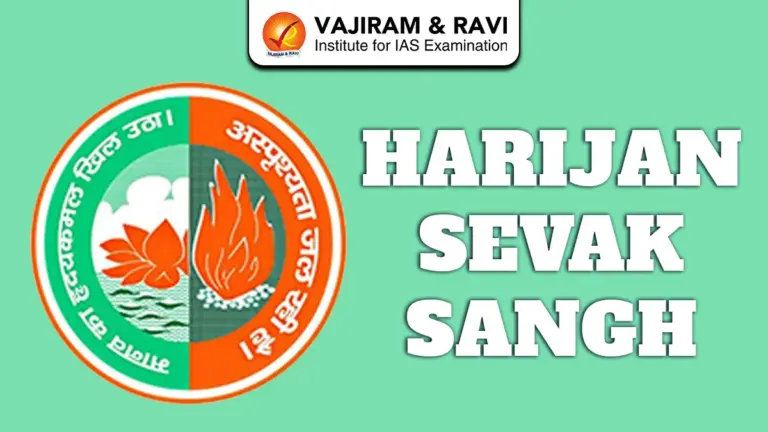
Harijan Sevak Sangh, formerly All India Anti Untouchability League, is a non-profit organisation founded by Mahatma Gandhi in 1932 to eradicate untouchability in India, working for Harijan or Dalit People and upliftment of the Depressed Class of India.
It is headquartered at Kingsway Camp in Delhi, with branches in 26 states across India.
Origin of the word “Harijans”
- Mahatma Gandhi referred to the Dalit community as “Harijans,” a term that means “Children of God.”
- By using this name, Gandhi wanted to remove the social stigma attached to words like “untouchables” or “depressed classes” and highlight the equal dignity of all human beings.
- His effort was aimed at improving the social status of Dalits and challenging the caste-based discrimination deeply rooted in Indian society.
- For Gandhi, the term Harijan was not just a new label but part of a larger social reform movement.
- He believed that changing the way people thought and spoke about Dalits was essential to ending untouchability and social exclusion.
About Harijan Sevak Sangh
- It was founded on September 30, 1932, after Gandhiji’s Epic Fast at Yervada Jail, Pune, resulting in the historic Poona Pact with Ambedkar.
- It helped to make public places accessible to Dalits and did several kinds of social work for them such as the establishment of schools, support of inter-caste marriages, etc.
- A seminal weekly newspaper, “Harijan” was launched to champion the cause against untouchability, promoting social reform and the upliftment of India’s marginalized communities.
- It served as a crucial platform for Gandhiji’s campaigns, covering social, economic, and political issues during India’s freedom struggle until the 1940s, continuing even after his death.





Harijan Sevak Sangh Objectives
The objectives of Harijan Sevak Sangh are:
- Eradication of untouchability through truth and non-violence.
- Removal of social disabilities and ensuring equal status for Dalits.
- Securing civil and human rights, including access to schools, temples, wells, and other public places.
- Improvement of the social conditions of women and children.
- Promotion of values such as equality, fraternity, cooperation, and social service for an inclusive society.
Harijan Sevak Sangh Contributions
Awareness and Social Reform
- It launched nationwide campaigns against untouchability and caste discrimination.
- Mahatma Gandhi led a Harijan campaign (1933–34), travelling across the country to promote Dalit upliftment, social equality, and welfare of marginalised communities.
- It was focused on changing social attitudes through public meetings, guidance, and direct interaction with Harijan colonies.
Ensuring Civil and Civic Rights
- Worked to secure equal access for Dalits to public spaces such as temples, wells, roads, crematoriums, river ghats, guest houses, and restaurants.
- Facilitated access to essential services like doctors, barbers, laundry services, etc., to remove everyday social exclusion.
Promotion of Education
- It established and managed schools, hostels, and Ashram schools for Dalit children across India.
- It runs institutions such as Kasturba Balika Vidyalayas and girls’ hostels, with a special focus on Dalit girls and children from marginalised regions.
- Operates a large network of primary schools, Ashram schools, and hostels with support from the Ministry of Social Justice and Empowerment.
Skill Development and Self-Reliance
- Set up Industrial Training Institutes (Udyogshalas) and vocational training centres to promote economic self-dependence among Dalits.
- Established Safai Vidyalaya (Ahmedabad) to train sanitation workers in modern tools, technology, and hygienic practices.
- Emphasised dignity of labour and skill-based empowerment.
Welfare of Women and Children
- Operates creche centres across the country with support from the Central Social Welfare Board.
- Focuses on education, nutrition, and care of women and children from vulnerable sections.

 Last updated on April, 2026
→ UPSC Final Result 2025 is now out.
→ UPSC has released UPSC Toppers List 2025 with the Civil Services final result on its official website.
→ Anuj Agnihotri secured AIR 1 in the UPSC Civil Services Examination 2025.
→ UPSC Marksheet 2025 is now out.
→ UPSC Notification 2026 & UPSC IFoS Notification 2026 is now out on the official website at upsconline.nic.in.
→ UPSC Calendar 2026 has been released.
→ Check out the latest UPSC Syllabus 2026 here.
→ UPSC Prelims 2026 will be conducted on 24th May, 2026 & UPSC Mains 2026 will be conducted on 21st August 2026.
→ The UPSC Selection Process is of 3 stages-Prelims, Mains and Interview.
→ Prepare effectively with Vajiram & Ravi’s UPSC Prelims Test Series 2026 featuring full-length mock tests, detailed solutions, and performance analysis.
→ Enroll in Vajiram & Ravi’s UPSC Mains Test Series 2026 for structured answer writing practice, expert evaluation, and exam-oriented feedback.
→ Join Vajiram & Ravi’s Best UPSC Mentorship Program for personalized guidance, strategy planning, and one-to-one support from experienced mentors.
→ Shakti Dubey secures AIR 1 in UPSC CSE Exam 2024.
→ Also check Best UPSC Coaching in India
Harijan Sevak Sangh FAQs
Q1. What is Harijan Sevak Sangh?+
Q2. Who founded the Harijan Sevak Sangh?+
Q3. What was the main objective of Harijan Sevak Sangh?+
Q4. Where is the headquarters of Harijan Sevak Sangh located?+
Q5. Why did Mahatma Gandhi start the Harijan Sevak Sangh?+
Tags: harijan sevak sangh