The Heat Budget of Earth, also called Energy or Radiation Budget, is the important balance between the incoming solar radiation (energy from the Sun) and the outgoing infrared radiation (heat energy leaving the Earth and Atmosphere). The dynamic equilibrium maintains the stability of the climate and average temperature of the earth (15° C). Without this balance, the earth would continuously heat or cool, making life difficult. Even a small imbalance of 0.5 to 1 W/m² can intensify global warming, as highlighted by IPCC AR6.
Heat Budget of Earth
The concept of the Heat Budget of Earth is governed by the First Law of Thermodynamics, which states that energy cannot be created or destroyed, only transformed. To maintain the thermal equilibrium of the Earth over a long duration, the total energy received must be equal to the total energy lost. The Sun is the primary source of energy for the Earth, supplying around 1,361 W/m² of solar radiation at the top of the atmosphere (Solar Constant). This energy undergoes reflection, scattering, absorption, and re-emission, creating this balance.
Heat Budget of Earth Components
The Heat Budget of Earth explains how incoming solar energy is balanced by outgoing heat, helping maintain the planet’s overall temperature and climatic stability. The major components are listed below:
- Insolation: Solar energy reaching Earth’s surface from the Sun, influencing heating patterns and driving atmospheric processes that keep the planet’s thermal system regulated.
- Reflection: A portion of sunlight bounces off clouds, land, or water back to space, preventing heat absorption and helping regulate Earth’s temperature naturally.
- Absorption: Land, water, and atmospheric gases take in solar radiation, convert it into heat, and warm the surface and lower atmosphere effectively.
- Scattering: Tiny particles and air molecules spread incoming sunlight in various directions, reducing direct solar intensity and affecting sky brightness and visibility.
- Terrestrial Radiation: Earth’s surface releases longwave infrared heat back toward the atmosphere and space, maintaining balance between absorbed solar energy and outgoing heat.
- Latent Heat Transfer: Heat energy moves during evaporation or condensation processes, carrying stored heat through atmospheric moisture and redistributing energy without temperature change.
- Sensible Heat Transfer: Heat shifts between Earth’s surface and air when temperatures differ, warming or cooling the atmosphere without any change in physical state.
- Emission by Vapour and Clouds: Water vapour and clouds release infrared radiation, contributing to Earth’s outgoing heat and helping moderate atmospheric temperatures day and night.





Heat Budget of Earth Mechanism
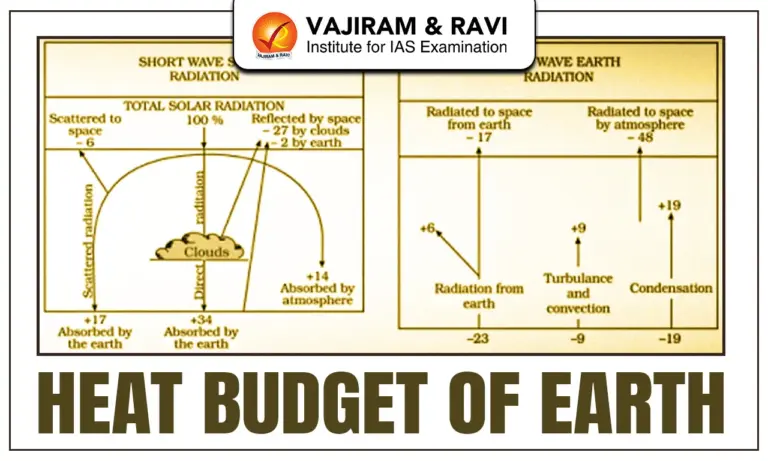
The balance is often expressed in terms of 100 units (as 100%) of incoming solar radiation to track how this energy is distributed. The total 100 units of incoming shortwave solar radiation are processed by the Earth and its atmosphere in the following manner:
-
Incoming Solar Radiation (Insolation)
The total solar radiation is 35 (reflected) + 14 (atmospheric absorption) + 51 (surface absorption) = 100 units.
- Scattering and Reflection: Around 35 units of the Sun’s energy is lost to space due to reflection and scattering, forming the Earth’s overall albedo.
-
-
- Nearly 27 units are bounced back by cloud tops.
- Close to 2 units are reflected from bright surfaces such as ice sheets, snowfields, and land.
- About 6 units are scattered in different directions by atmospheric dust, aerosols, and air molecules.
-
- Absorption: The remaining 65 units enter and warm the Earth system.
-
- Roughly 14 units are taken up by atmospheric gases including water vapour, ozone, and clouds.
- About 51 units are absorbed by the planet’s surface, mainly by oceans and landmasses.
-
Outgoing Terrestrial Radiation
The 51 units gained by the surface and 14 units absorbed by the atmosphere must eventually exit as longwave radiation to keep thermal balance. Overall Outgoing Budget:
35 (reflected solar) + 17 (surface radiation) + 48 (atmospheric radiation) = 100 units. Globally, the polar ice caps and fresh snow have the highest albedo (80-90%), while the ocean surface has the lowest (2-10%), making the oceans the primary heat sink.
- Direct Radiation to Space: Roughly 17 units of heat from the surface escape straight to space through the atmospheric window.
- Transfer from Surface to Atmosphere: The remaining 34 units held by the surface move upward to the atmosphere through:
- 19 units of sensible heat carried upward by convection and turbulence.
- 9 units of latent heat released when water vapour condenses into droplets.
- 6 units of longwave radiation absorbed by greenhouse gases.
- Transfer from Radiation to Space: The atmosphere releases 48 units of longwave energy to space after absorbing 14 units from sunlight and 34 units from the surface.
Heat Budget of Earth Calculation
The Heat Budget of Earth is calculated by observing how much solar energy enters the planet and how much heat leaves it. Satellites equipped with radiometers, such as those used in the ERBE mission and later programs, track incoming sunlight and outgoing infrared radiation. Scientists compare these energy flows to check whether Earth is gaining or losing heat. The Global Energy balance equation is:
Net Energy Flow = Incoming Solar Energy – Reflected Solar Energy – Outgoing Terrestrial Radiation
For a balanced budget, the Net Energy Flow should be zero. However, modern measurements show a small positive net energy flow, suggesting the Earth system is currently accumulating heat (evidence of global warming).
Heat Budget of Earth Significance
The significances of the heat budget of earth can be discussed below:
- Climate Regulation: The heat budget controls global temperatures, influencing weather patterns, rainfall, and seasonal variations.
- Ocean Currents: Imbalances in heat absorption and radiation drive ocean circulation, affecting marine ecosystems and coastal climates.
- Glacial Melting: Excess heat accumulation leads to polar ice melting, causing sea-level rise and altering Earth’s albedo.
- Extreme Weather: Changes in energy distribution can intensify storms, heatwaves, and other extreme weather events.
- Ecosystem Balance: Proper heat distribution maintains habitats, plant growth, and animal survival across different regions.
Heat Budget of Earth Variations
The Earth’s heat budget varies regionally and seasonally due to factors like latitude, surface type, cloud cover, and solar angle:
- Equatorial regions receive more solar energy, creating warmer climates than polar areas.
- Seasonal changes shift sunlight intensity, affecting temperature and rainfall patterns.
- Snow and ice increase reflection, reducing local heat absorption (high albedo).
- Oceans store heat differently than land, causing regional temperature differences.
- Volcanic eruptions or dust storms temporarily reduce incoming solar radiation, altering heat balance.
- Greenhouse gases trap outgoing infrared radiation, disrupting the natural heat budget and causing global warming effects worldwide.
Heat Budget of Earth Impact on Climate
The Earth’s energy balance directly influences climate systems, regulating weather patterns, atmospheric circulation, and ocean currents globally.
- Heat imbalances drive winds and jet streams across continents.
- Ocean currents transport heat, stabilizing coastal climates and influencing monsoon systems.
- Polar warming accelerates ice melting, altering global sea levels.
- Regional energy variations affect precipitation patterns and drought frequency.
- Persistent heat accumulation can intensify storms, hurricanes, and cyclones.

 Last updated on April, 2026
→ UPSC Final Result 2025 is now out.
→ UPSC has released UPSC Toppers List 2025 with the Civil Services final result on its official website.
→ Anuj Agnihotri secured AIR 1 in the UPSC Civil Services Examination 2025.
→ UPSC Marksheet 2025 is now out.
→ UPSC Notification 2026 & UPSC IFoS Notification 2026 is now out on the official website at upsconline.nic.in.
→ UPSC Calendar 2026 has been released.
→ Check out the latest UPSC Syllabus 2026 here.
→ UPSC Prelims 2026 will be conducted on 24th May, 2026 & UPSC Mains 2026 will be conducted on 21st August 2026.
→ The UPSC Selection Process is of 3 stages-Prelims, Mains and Interview.
→ Prepare effectively with Vajiram & Ravi’s UPSC Prelims Test Series 2026 featuring full-length mock tests, detailed solutions, and performance analysis.
→ Enroll in Vajiram & Ravi’s UPSC Mains Test Series 2026 for structured answer writing practice, expert evaluation, and exam-oriented feedback.
→ Join Vajiram & Ravi’s Best UPSC Mentorship Program for personalized guidance, strategy planning, and one-to-one support from experienced mentors.
→ Shakti Dubey secures AIR 1 in UPSC CSE Exam 2024.
→ Also check Best UPSC Coaching in India
Heat Budget of Earth FAQs
Q1. What is the Heat Budget of Earth?+
Q2. Why is the Earth’s Heat Budget important?+
Q3. How is the Heat Budget calculated?+
Q4. What are the main components of the Heat Budget?+
Q5. How do greenhouse gases affect the Heat Budget?+
Tags: heat budget of earth