What’s in today’s article?
- Why in News?
- What is the phenomenon of Heatwaves?
- What are HAPs?
- What are the Findings of the CPR Report?
- What are the CPR’s Report Recommendations?
- What are the Indian Government’s Initiatives to Deal with Impact of Heatwaves?
Why in News?
- According to a new report titled “How is India Adapting to Heatwaves?” by the think-tank Centre for Policy Research, the country is ill-prepared to face the heat.
- The report analysed all the 37 heat action plans (HAPs) across 18 States, to evaluate how policy action is keeping up with the warming weather in India.
What is the phenomenon of Heatwaves?
- Qualitatively, a heat wave is a condition of air temperature which becomes fatal to the human body when exposed.
- Quantitatively, it is defined based on the temperature thresholds over a region in terms of actual temperature or its departure from normal.
- Heat wave is considered if the maximum temperature of a station reaches at least 40 degree Celsius or more for Plains and at least 30 degree Celsius or more for Hilly regions (37 degree Celsius or more for coastal stations).
- Based on Departure from Normal:
- Heat Wave: Departure from normal is 4.5 – 6.4 degree Celsius.
- Severe Heat Wave: Departure from normal is > 6.4 degree Celsius.
- Based on Actual Maximum Temperature:
- Heat Wave: When actual maximum temperature ≥ 45 degree Celsius.
- Severe Heat Wave: When actual maximum temperature ≥ 47 degree Celsius.
- Based on Departure from Normal:
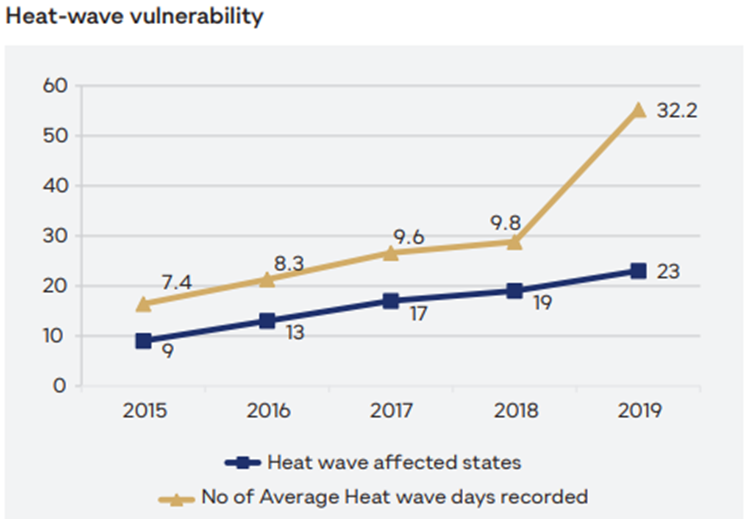
Image Caption: Heat-wave vulnerability in India





What are HAPs?
- Landmark heatwaves (1998, 2002, 2010, 2015, 2022) have each led to large death tolls and extensive economic damage by reducing labour productivity and affecting water availability, agriculture, and energy systems.
- Governments across India at the State, district, and municipal levels have responded by creating heat action plans (HAPs).
- HAPs prescribe a variety of preparatory activities and post-heatwave response measures across government departments to decrease the impact of heatwaves.
What are the Findings of the CPR Report?
- HAPs are not built for local contexts and nearly all HAPs fail to identify and target vulnerable groups and are underfunded with weak legal foundations and are insufficiently transparent.
- Only two HAPs carry out and present vulnerability assessments (systematic studies to locate where the people most likely to be affected are in a city, district, or State).
- Only three of 37 HAPs identify funding sources and eight HAPs ask implementing departments to self-allocate resources, indicating a serious funding constraint.
- None of the HAPs indicate the legal sources of their authority – reducing bureaucratic incentives to prioritise and comply with HAPs instructions.
- There is no national repository of HAPs and very few HAPs are listed online.
What are the CPR’s Report Recommendations?
- The HAPs must identify sources of financing either from new funds or by combining actions with existing national and State policies.
- The HAPs must set up rigorous independent evaluations as a basis for constant improvement.
- Implementation-oriented HAPs so that India’s poorest will no longer continue to suffer from extreme heat, paying with both their health and incomes.
What are the Indian Government’s Initiatives to Deal with Impact of Heatwaves?
- India Meteorological Department (IMD) issues colour coded impact based heat wave warning for public benefit through mass media.
- Mission LiFE (Lifestyle for Environment) seeks to promote sustainable lifestyles and practices that conserve the environment and have climate co-benefits.
- Environment Education Programme (EEP) sensitises children/youth on issues related to the environment and to motivate them to adopt sustainable lifestyles.
- Water Technology Initiative (WTI) aims to develop research based solutions to deal with challenges in the areas of water quality, quantity, water reuse and recycling.
- The National Disaster Management Authority (NDMA) and IMD are working with 23 States prone to high temperatures leading to heat-wave conditions for supporting HAPs.
Q1) Why is India’s population highly vulnerable to heatwaves?
In India, heatwaves caused 22,562 deaths between 1992 and 2015. A large proportion of India’s population is highly vulnerable to heat waves due to the possession of fewer household amenities as well as lower rates of literacy and access to water and sanitation.
Q2) What is the Water Technology Initiative (WTI)?
Water Technology Initiative, initiated in August 2007 aims to promote R&D activities aimed at providing safe drinking water at affordable cost and in adequate quantity using appropriate Science and Technology interventions evolved through indigenous efforts.
Source: Without action plans, India’s poorest will continue to bear brunt of heatwaves | PIB | NDMA.gov.in

 Last updated on March, 2026
→ UPSC Final Result 2025 is now out.
→ UPSC has released UPSC Toppers List 2025 with the Civil Services final result on its official website.
→ Anuj Agnihotri secured AIR 1 in the UPSC Civil Services Examination 2025.
→ UPSC Marksheet 2025 is now out.
→ UPSC Notification 2026 & UPSC IFoS Notification 2026 is now out on the official website at upsconline.nic.in.
→ UPSC Calendar 2026 has been released.
→ Check out the latest UPSC Syllabus 2026 here.
→ UPSC Prelims 2026 will be conducted on 24th May, 2026 & UPSC Mains 2026 will be conducted on 21st August 2026.
→ The UPSC Selection Process is of 3 stages-Prelims, Mains and Interview.
→ Prepare effectively with Vajiram & Ravi’s UPSC Prelims Test Series 2026 featuring full-length mock tests, detailed solutions, and performance analysis.
→ Enroll in Vajiram & Ravi’s UPSC Mains Test Series 2026 for structured answer writing practice, expert evaluation, and exam-oriented feedback.
→ Join Vajiram & Ravi’s Best UPSC Mentorship Program for personalized guidance, strategy planning, and one-to-one support from experienced mentors.
→ Shakti Dubey secures AIR 1 in UPSC CSE Exam 2024.
→ Also check Best UPSC Coaching in India