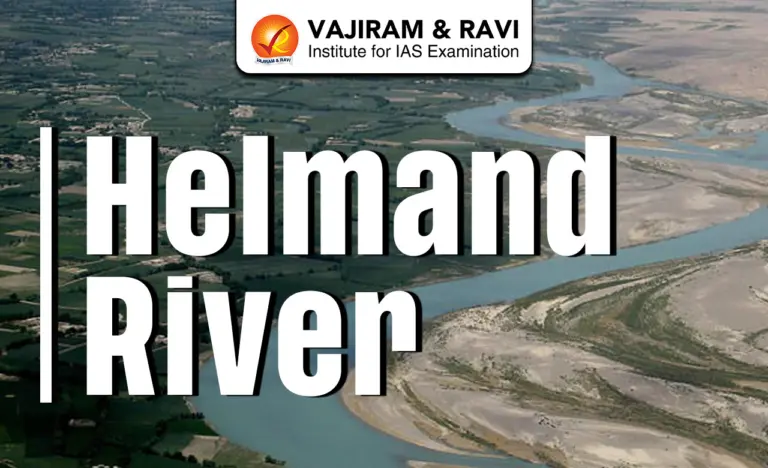
The Helmand River was historically known as the Etymandros River. It is the longest river in Afghanistan and the main water source for the endorheic Sistan Basin. It originates in the Hindu Kush mountains and flows southwest across arid and semi-arid regions before draining into Hamun Lake on the Afghanistan-Iran border. The river supports agriculture, livelihoods and ecosystems for millions of people and has remained central to regional geography, history and transboundary water relations.
Helmand River Features
The Helmand River is a vital transboundary river system with significant geographical, hydrological and economic importance in Afghanistan and Iran.
- Origin: The river originates in the Sanglakh Range of the Hindu Kush in Maidan Wardak Province, about 40 km west of Kabul.
- Course: It flows southwest through Daykundi, Uruzgan and Helmand provinces before entering desert regions and draining into the Sistan Basin.
- Length: The Helmand stretches about 1,150 km (710 miles), making it Afghanistan’s longest river.
- River Basin: Its basin covers over 100,000 square miles (around 260,000 sq km), supporting millions dependent on it for irrigation and drinking water.
- Tributaries: Major tributaries include the Arghandab and Tarnak rivers. The Arghandab River, joining near Kandahar, is the most significant tributary and also has a major dam contributing to irrigation and water regulation.
- Drainage System: The river forms the primary watershed of the endorheic Sistan Basin, meaning it does not flow into the sea. Instead, it drains into inland lakes, marshes and wetlands around the Afghanistan-Iran border.
- Landscapes: The river flows through diverse terrains including mountainous regions, fertile valleys and arid deserts like Dasht-e Margo. This variation influences water availability, agricultural productivity and settlement patterns along its course.
Helmand River Significance
The Helmand River is highly significant based on the below mentioned applications and usage:
- Irrigation: Managed by the Helmand Arghandab Valley Authority, the river irrigates nearly one-third of Afghanistan’s cultivated land. However, mineral salt accumulation in water has reduced its agricultural efficiency in some regions.
- Hydroelectric Projects: The Kajaki Dam, built in the early 1950s, is a major infrastructure project providing irrigation, flood control and hydroelectric power. Several reservoirs have been developed to manage seasonal water flow.
- Role in Iran: Although not a major national source for Iran, the river is crucial for the Sistan and Baluchistan province. It supplies most of the surface water required for agriculture and drinking purposes in the region.
- Connection to Hamun Lake: The river feeds Hamun Lake, the largest freshwater lake in Iran. Once covering about 4,000 sq km, the lake has significantly shrunk due to drought and upstream water control measures.
- Environmental Significance: The Helmand supports wetlands in the Sistan Basin, which act as biodiversity hotspots and habitats for migratory birds. These wetlands also help reduce desertification and maintain ecological balance.





Helmand River Dispute
The Helmand River dispute is a long standing transboundary conflict between Afghanistan and Iran over water sharing, rooted in historical, geographical and political factors.
- Historical Origins: The dispute dates back to the 1870s when British authorities demarcated the Afghanistan-Iran border. Most upstream areas fell in Afghanistan, leaving Iran’s Sistan region dependent on downstream water flow.
- Changing River Course: Natural changes in the river’s course due to floods altered water distribution over time. This created uncertainty and tensions regarding access and control of water resources between both countries.
- Early Negotiation Attempts: Several attempts were made in the early 20th century to resolve the issue, but none were successful due to lack of consensus and changing political situations in both countries.
- Helmand River Treaty 1973: Afghanistan and Iran signed a water sharing agreement guaranteeing Iran about 780 cubic feet (22 cubic meters) per second. However, the treaty was neither fully ratified nor effectively implemented.
- Impact of Political Instability: Events like the 1973 Afghanistan coup, the Iranian Revolution (1978-79) and the Soviet invasion of Afghanistan disrupted cooperation, preventing proper enforcement of the treaty provisions.
- Role of Dams and Irrigation: Afghanistan’s construction of dams, reservoirs and irrigation systems along the Helmand has raised concerns in Iran, which fears reduced downstream water availability.
- Iran’s Allegations: Iran claims it receives far less water than agreed under the 1973 treaty. Officials have stated that water inflow has significantly declined, affecting agriculture and livelihoods in Sistan and Baluchistan.
- Afghanistan’s Position: Afghanistan denies violating water rights and attributes reduced flow to climatic factors such as drought and low rainfall. It also asserts its right to utilize water resources for domestic development.
- Environmental and Social Impact: Water shortages have severely affected the Sistan region. Reports suggest 25% to 30% of the population has migrated over the past two decades due to declining water availability and economic hardships.
- Recent Tensions (2023): Disputes escalated in May 2023 when accusations over water obstruction led to border clashes between Iranian and Taliban forces. These incidents highlighted the fragile nature of bilateral relations.
- Strategic Importance: The river is essential for agriculture, ecosystems and regional stability. Both countries rely on it for sustaining rural livelihoods and managing environmental challenges like desertification.
- Current Situation: Despite tensions, both sides have shown willingness to engage in dialogue. A joint commission has been proposed to investigate clashes and improve cooperation on water sharing and management.
- Need for Cooperation: Sustainable resolution requires data sharing, better water management and mutual trust. Preservation of Hamun Lake and regional ecological balance depends on coordinated action by both nations.

 Last updated on April, 2026
→ UPSC Final Result 2025 is now out.
→ UPSC has released UPSC Toppers List 2025 with the Civil Services final result on its official website.
→ Anuj Agnihotri secured AIR 1 in the UPSC Civil Services Examination 2025.
→ UPSC Marksheet 2025 is now out.
→ UPSC Notification 2026 & UPSC IFoS Notification 2026 is now out on the official website at upsconline.nic.in.
→ UPSC Calendar 2026 has been released.
→ Check out the latest UPSC Syllabus 2026 here.
→ UPSC Prelims 2026 will be conducted on 24th May, 2026 & UPSC Mains 2026 will be conducted on 21st August 2026.
→ The UPSC Selection Process is of 3 stages-Prelims, Mains and Interview.
→ Prepare effectively with Vajiram & Ravi’s UPSC Prelims Test Series 2026 featuring full-length mock tests, detailed solutions, and performance analysis.
→ Enroll in Vajiram & Ravi’s UPSC Mains Test Series 2026 for structured answer writing practice, expert evaluation, and exam-oriented feedback.
→ Join Vajiram & Ravi’s Best UPSC Mentorship Program for personalized guidance, strategy planning, and one-to-one support from experienced mentors.
→ Shakti Dubey secures AIR 1 in UPSC CSE Exam 2024.
→ Also check Best UPSC Coaching in India
Helmand River FAQs
Q1. Where does the Helmand River originate?+
Q2. Why is the Helmand River important for Afghanistan?+
Q3. Which countries are involved in the Helmand River dispute?+
Q4. What is the Helmand River Treaty of 1973?+
Q5. Why has the Helmand River dispute intensified recently?+
Tags: geography geography notes helmand river