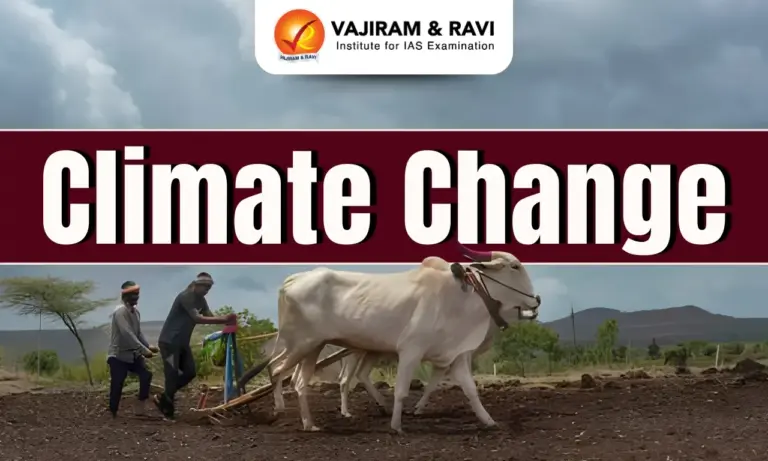
Climate Change Latest News
- Recent analyses and World Bank projections have highlighted how climate change is increasingly contributing to higher household expenses through rising food, energy, water, and healthcare costs in India.
Climate Change and Cost of Living
- Climate change is often discussed as a long-term environmental challenge. However, its effects are already being felt through higher living costs.
- Rising temperatures, erratic rainfall, extreme weather events, and increasing climate variability are affecting essential services and commodities that households depend upon every day.
- The World Bank has warned that rising temperatures and changing monsoon patterns could reduce India’s GDP by up to 2.8% by 2050 and adversely affect living standards for nearly half of the country’s population.
- Climate change therefore, represents not only an environmental challenge but also an emerging economic and social issue.


Impact on Food Prices
- Agriculture remains highly dependent on weather conditions, making food prices particularly vulnerable to climate shocks.
- A delayed or weak monsoon can reduce crop yields, disrupt sowing activities, and lower agricultural output. Similarly, extreme heat can damage crops even when rainfall remains adequate.
- In 2023, India experienced a 6% rainfall deficit, which reduced the sown area under pulses and oilseeds.
- Farmers in several states reported crop losses, while retail prices of rice, wheat, and pulses increased by 6-15% year-on-year by early October.
- This is particularly significant because food and beverages account for 45.86% of India’s Consumer Price Index (CPI) basket.
- Consequently, climate-induced disruptions quickly translate into higher food inflation and increased household expenditure.
- Repeated heatwaves, floods, and erratic rainfall patterns are also contributing to persistent food inflation by creating supply bottlenecks and market uncertainty.
Impact on Energy Costs
- Climate change is also increasing household energy expenditure.
- As temperatures rise, demand for cooling appliances such as fans, coolers, and air conditioners grows rapidly.
- This places additional pressure on electricity grids and increases power generation costs.
- During the May 2026 heatwave, India’s electricity demand reached a record 270.8 gigawatts, driven largely by cooling requirements. Utilities often meet this surge through expensive coal-based generation and imported fuels, costs that may eventually be passed on to consumers through higher tariffs and surcharges.
- For low-income households, rising electricity bills often result in reduced spending on other essential needs such as food and education.
Impact on Water Security
- Water is emerging as another major channel through which climate change affects household finances.
- Erratic rainfall patterns and groundwater depletion are causing wells and local water sources to dry up more frequently in several regions. As a result, rural households often spend more time and money securing water.
- Urban areas are witnessing the growth of a parallel “tanker economy”, where households without reliable municipal water supplies purchase water from private vendors. This significantly increases monthly household expenditure.
- The burden is particularly severe for vulnerable communities living in informal settlements and water-stressed regions.
Impact on Health Expenditure
- Climate change is also increasing healthcare costs.
- Heat stress, poor air quality, changing disease patterns, and climate-sensitive illnesses are contributing to higher out-of-pocket medical expenditures.
- Rural women often bear a disproportionate burden because they spend longer hours collecting water, working under extreme temperatures, and caring for family members affected by climate-related illnesses.
- For households living close to the poverty line, even minor increases in healthcare expenditure can significantly affect financial stability and consumption patterns.
Climate Change and Inequality
- The economic burden of climate change is not distributed equally.
- According to studies cited in the analysis, marginalised communities often have lower access to climate-adaptation technologies such as irrigation systems and resilient farming practices. Consequently, they face greater vulnerability to climate shocks.
- States such as Chhattisgarh, Madhya Pradesh, Rajasthan, Uttar Pradesh, and Maharashtra are projected to witness significant declines in living standards because of their high climate vulnerability and dependence on agriculture.
- As a result, climate change increasingly functions like a regressive economic burden, disproportionately affecting those who possess the fewest resources to adapt.
Economic Implications for India
- The long-term implications extend beyond household budgets.
- The Indian Institute for Human Settlements (IIHS) has noted that a large section of India’s population remains vulnerable to even small economic shocks despite improvements in incomes over recent decades. Climate change is making such shocks more frequent and persistent.
- If climate-related disruptions continue to intensify, they could lead to:
- Higher inflation
- Reduced agricultural productivity
- Increased health expenditure
- Greater rural distress
- Slower economic growth
- These outcomes could undermine progress toward inclusive and sustainable development.
Way Forward
- Addressing climate change requires moving beyond short-term crisis management.
- Policy priorities should include:
- Promoting climate-resilient agriculture, including initiatives such as Andhra Pradesh Community Natural Farming (APCNF)
- Strengthening urban heat action plans
- Improving water conservation and groundwater management
- Expanding affordable healthcare and social protection systems
- Investing in climate-resilient infrastructure and public services
- Recognising climate change as a cost-of-living issue can help integrate adaptation measures into broader economic policymaking.
Source: TH

 Last updated on Oct, 2026
→ UPSC 2027 Notification will be released on 13 January 2027 at upsconline.nic.in.
→ Check Nobel Prize 2026 Winners List here.
→ Download PIB PRiSM Monthly Magazine 2026 here.
→ Check UPSC Monthly Current Affairs Magazine The Recitals here.
→ Check out the latest UPSC Syllabus here.
→ Download UPSC Model Answers for Mains 2026
→ UPSC Mains Question Paper 2026 is out now for Essay & GS Paper 1, 2, 3 & 4.
→ UPSC Calendar 2027 has been released.
→ Enroll in Vajiram & Ravi’s UPSC Mains Test Series 2027 for structured answer writing practice, expert evaluation, and exam-oriented feedback.
→ Join Vajiram & Ravi’s UPSC Mentorship Program 2027 for personalized guidance, strategy planning, and one-to-one support from experienced mentors.
→ Go through the UPSC Mains Previous Year Papers to enhance your preparation.
→ UPSC has released UPSC Toppers List 2025 with the Civil Services final result on its official website.
→ Also check Best UPSC Coaching in India
Climate Change FAQs
Q1. How can climate change increase food inflation in India?+
Q2. What percentage of India's CPI basket is accounted for by food and beverages?+
Q3. What was India's peak electricity demand during the May 2026 heatwave?+
Q4. Which states are projected to be major climate vulnerability hotspots?+
Q5. According to the World Bank, how much could climate change reduce India's GDP by 2050?+
Tags: climate change mains articles upsc current affairs upsc mains current affairs