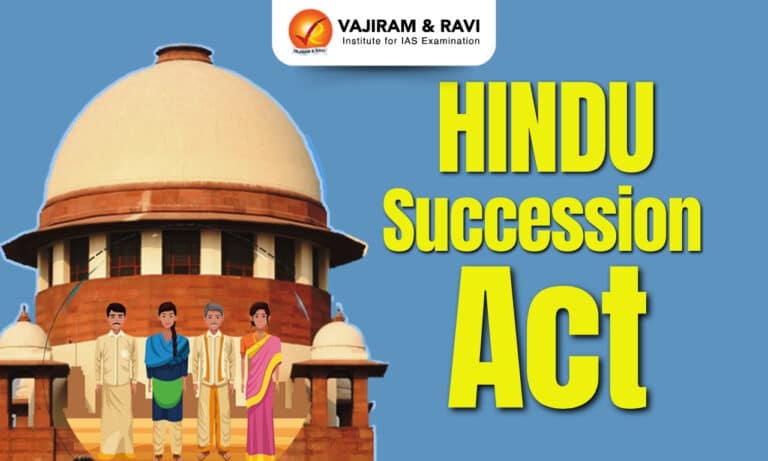
The Hindu Succession Act 1956 created a single legal system for property inheritance among Hindus in India. It established clear rules for who inherits property when a person dies (including without will). Recent Supreme Court observations emphasized that inheritance under the Act is shaped by cultural practices, lineage rules, and legislative intent. The Court highlighted that succession is not only about gender justice but about the broader Hindu social structure, where inheritance follows traditional family-based norms.
Hindu Succession Act 1956
The Hindu Succession Act 1956 defines how a Hindu’s property is distributed when they die. It applies to Hindus, Sikhs, Jains, and Buddhists, and creates uniform succession rules across regions. The Act recognizes Class I and Class II heirs and a system of agnates and cognates. The Supreme Court recently upheld its inheritance rules, noting that inherited property often returns to the source family to preserve lineage. The Court stressed that reforms must come from Parliament because inheritance affects the entire society and changes require broad agreement.
Hindu Succession Act Provisions
The Hindu Succession Act provides rules for inheritance classification, rights of heirs, distribution order, and property return to source families based on lineage principles.
- Class I heirs inherit equally: sons, daughters, widow, and mother.
- Class II heirs inherit only when no Class I heirs exist.
- Property goes to agnates and then cognates when no Class I or II heirs survive.
- Recognizes both separate property and ancestral property.
- Upholds cultural lineage, ensuring inherited property without heirs returns to the source family.
- A woman may distribute property freely through a will.
- Reform responsibility lies with Parliament, not courts.





Hindu Succession Act Intestate Provisions
The Hindu Succession Act specifies different rules for intestate succession for Hindu men and Hindu women, with clear lineage based prioritization.
- A Hindu woman’s property first devolves on her husband and children.
- If no husband or children survive, the husband’s heirs inherit.
- Only if no husband’s heirs exist does the property pass to her parents.
- Property inherited from parents or in-laws returns to that side if she dies without direct heirs.
- A Hindu man’s property goes equally to wife, children, and mother.
- If these do not exist, the father inherits.
- Self-acquired property devolves by statutory order.
- Ancestral property follows customary lineage-based principles.
Hindu Succession Act Features
The Hindu Succession Act governs Hindus nationwide, integrates traditional schools of law, and lays out uniform rules for inheritance and devolution.
- Applies to Hindus, Sikhs, Jains, and Buddhists
- Does not automatically apply to Scheduled Tribes unless notified.
- Covers both Mitakshara and Dayabhaga schools; creates uniform inheritance rules.
- In Mitakshara, property rights arise at birth; in Dayabhaga, after the father’s death.
- Dayabhaga allows male and female coparceners; Mitakshara originally allowed only male coparceners.
- Defines coparcenary rights and ancestral property rules.
- Creates equality in Class I heir inheritance.
- Establishes priority among heirs based on relationship.
Hindu Succession Act Criticism
Despite its progressive design, the Act faces criticism for unequal lineage rules and limited rights for women in certain family structures.
- Critics argue inheritance rules reinforce cultural norms over gender equality.
- Married women’s property returning to husband’s family is contested.
- Unequal treatment in source-based property return is debated.
- Scheduled Tribe women remain excluded under Section 2(2).
- Practical barriers restrict women’s use of coparcenary rights.
- Social pressure prevents equal exercise of inheritance claims.
- Courts stress that major changes must come through Parliament.
- Reform proposals from the Law Commission and NCW remain pending.
Hindu Succession Act Amendments
The amendments under Hindu Succession Act strengthened women’s property rights, modernized coparcenary rules, and aligned inheritance with contemporary constitutional principles. The Hindu Succession Act Amendment 2005 brought changes as:
- Granted daughters equal coparcenary rights by birth.
- Allowed daughters to demand partition and hold ancestral property as full owners.
- Applied to Mitakshara families across India.
- Eliminated earlier restrictions on daughters’ property claims.
- Recognized daughters’ rights irrespective of marital status.
- Reinforced equal inheritance within the joint family system.
Hindu Succession Act UPSC
The Hindu Succession Act 1956 continues to evolve, with judicial and legislative attention focused on balancing cultural norms and gender-sensitive inheritance rules.
- Recent Supreme Court rulings reaffirmed cultural lineage as central to inheritance.
- The Court noted that property flow must reflect family structure traditions.
- Amendments should come legislatively because inheritance affects millions.
- Women retain full autonomy through wills despite structural limitations.
- Discussions continue on Scheduled Tribe women’s inheritance inclusion (2023).
- The 174th Law Commission and National Commission for Women supported equal rights reforms.
- Debates focus on balancing gender equity and Hindu family systems.
- Future changes must reflect broad social consensus and constitutional values.

 Last updated on April, 2026
→ UPSC Final Result 2025 is now out.
→ UPSC has released UPSC Toppers List 2025 with the Civil Services final result on its official website.
→ Anuj Agnihotri secured AIR 1 in the UPSC Civil Services Examination 2025.
→ UPSC Marksheet 2025 is now out.
→ UPSC Notification 2026 & UPSC IFoS Notification 2026 is now out on the official website at upsconline.nic.in.
→ UPSC Calendar 2026 has been released.
→ Check out the latest UPSC Syllabus 2026 here.
→ UPSC Prelims 2026 will be conducted on 24th May, 2026 & UPSC Mains 2026 will be conducted on 21st August 2026.
→ The UPSC Selection Process is of 3 stages-Prelims, Mains and Interview.
→ Prepare effectively with Vajiram & Ravi’s UPSC Prelims Test Series 2026 featuring full-length mock tests, detailed solutions, and performance analysis.
→ Enroll in Vajiram & Ravi’s UPSC Mains Test Series 2026 for structured answer writing practice, expert evaluation, and exam-oriented feedback.
→ Join Vajiram & Ravi’s Best UPSC Mentorship Program for personalized guidance, strategy planning, and one-to-one support from experienced mentors.
→ Shakti Dubey secures AIR 1 in UPSC CSE Exam 2024.
→ Also check Best UPSC Coaching in India
Hindu Succession Act FAQs
Q1. What is the Hindu Succession Act?+
Q2. What did the 2005 amendment change in the Hindu Succession Act?+
Q3. How does property devolve when a Hindu woman dies intestate?+
Q4. Are Scheduled Tribes covered under the Hindu Succession Act?+
Q5. What were the Supreme Court’s recent observations on inheritance under Hindu Succession Act?+
Tags: hindu succession act