Ho Tribe Latest News
The Ho Samaj Yuva Mahasabha (AHSYM) recently called upon tribal people not to celebrate picnics but to observe ‘Black Day’ on January 1 and 2.
About Ho Tribe
- The Ho, or Kolha, people are an Austroasiatic Munda ethnic group of India.
- They call themselves the Ho, Hodoko, and Horo, which mean ‘human’ in their own language.
- Distribution:
- They are mostly concentrated in the Kolhan region of Jharkhand and Odisha, where they constitute around 10.7% and 7.3% of the total Scheduled Tribe population, respectively, as of 2011.
- Ho also inhabit adjacent areas in the neighboring states of Odisha, West Bengal, and Bihar.
- They also live in Bangladesh and Nepal.
- Language: Ho people speak the Ho language, an Austroasiatic language closely related to Mundari.
- Occupation: The majority of the Ho tribe is involved in agriculture, either as landowners or labourers, while others are engaged in mining.
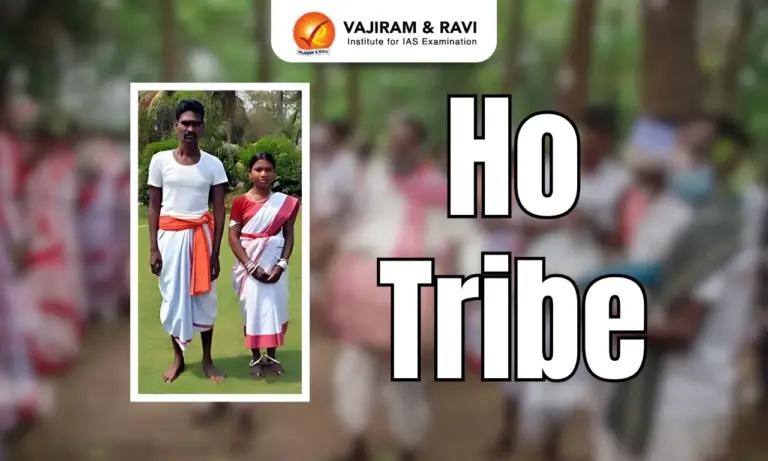
- The men and women of this community wear very minimal dress. The women prefer to wear tribal jewelleries.
- Women have higher status among the Ho than they do in most tribes.
- Dance is very important in Ho culture. Most villages have a dedicated dancing ground, called akhra, usually consisting of a cleared space of hard ground under a spreading tree.
- Traditional Ho music incorporates native instruments, including a dama (drum), dholak, dumeng (mandar), and the rutu (flute).
- Religion:
- The majority of the Ho have their own nature-based religion (Sarnaism) that doesn’t fit in with Hinduism.
- They have a village priest called a deuri.
Source: HT






 Last updated on April, 2026
→ UPSC Final Result 2025 is now out.
→ UPSC has released UPSC Toppers List 2025 with the Civil Services final result on its official website.
→ Anuj Agnihotri secured AIR 1 in the UPSC Civil Services Examination 2025.
→ UPSC Marksheet 2025 is now out.
→ UPSC Notification 2026 & UPSC IFoS Notification 2026 is now out on the official website at upsconline.nic.in.
→ UPSC Calendar 2026 has been released.
→ Check out the latest UPSC Syllabus 2026 here.
→ UPSC Prelims 2026 will be conducted on 24th May, 2026 & UPSC Mains 2026 will be conducted on 21st August 2026.
→ The UPSC Selection Process is of 3 stages-Prelims, Mains and Interview.
→ Prepare effectively with Vajiram & Ravi’s UPSC Prelims Test Series 2026 featuring full-length mock tests, detailed solutions, and performance analysis.
→ Enroll in Vajiram & Ravi’s UPSC Mains Test Series 2026 for structured answer writing practice, expert evaluation, and exam-oriented feedback.
→ Join Vajiram & Ravi’s Best UPSC Mentorship Program for personalized guidance, strategy planning, and one-to-one support from experienced mentors.
→ Shakti Dubey secures AIR 1 in UPSC CSE Exam 2024.
→ Also check Best UPSC Coaching in India
Ho Tribe FAQs
Q1. The Ho people belong to which major ethnic linguistic group?+
Q2. In which Indian region are the Ho people mainly concentrated?+
Q3. Apart from Jharkhand and Odisha, in which other Indian states are the Ho also found?+
Q4. What is the language spoken by the Ho people?+
Q5. What is the primary occupation of the Ho tribe?+
Tags: ho tribe prelims pointers upsc current affairs upsc prelims current affairs