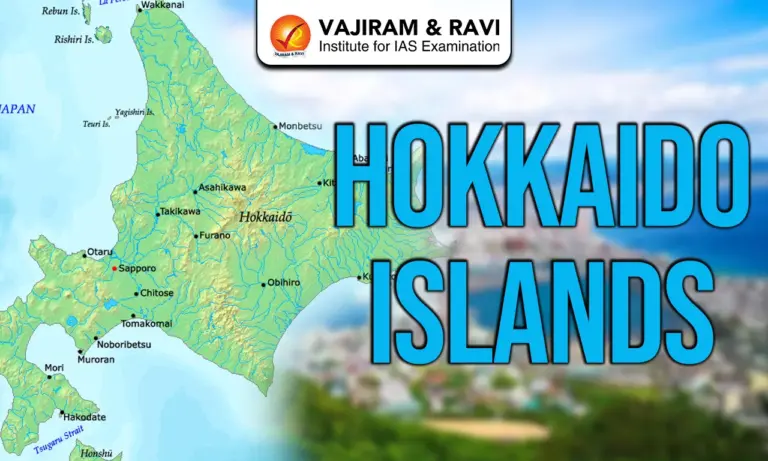
Hokkaido Islands are Japan’s northernmost and second largest island, covering 83,423.84 km² and ranking 21st globally by area. It lies north of Honshu, separated by the Tsugaru Strait and close to Russia across the La Pérouse Strait. The island is bordered by the Sea of Japan to the west, the Sea of Okhotsk to the north and the Pacific Ocean to the east and south. Sapporo City is located on the Ishikari River and serves as the administrative headquarters. Hokkaido forms a key part of the Japanese Archipelago.
Also Read: Lakshadweep Islands
Hokkaido Islands Features
The major highlighting features of the Hokkaido Islands have been listed below:
- Position in Japanese Archipelago: Hokkaido is the northernmost of Japan’s five main islands within the 14,125 Islands of the Japanese Archipelago.
- Location: It lies near Russia’s Sakhalin Oblast and forms the northern arc of Japan’s island chain stretching over 3,000 km.
- Surrounding Water Bodies: The island is bordered by the Sea of Japan in the west, the Sea of Okhotsk in the north and the Pacific Ocean in the east and south. Key straits include Tsugaru Strait, La Pérouse Strait and Nemuro Strait.
- Area and Relief: With 83,423.84 km² area, it is Japan’s second largest island. The interior is mountainous with volcanic plateaux. Major plains include Ishikari 3,800 km², Tokachi 3,600 km², Kushiro 2,510 km² and Sarobetsu 200 km².
- Rivers: The Ishikari River flows through Sapporo city of Hokkaido.
- Wetlands: Kushiro Wetland is Japan’s largest wetland and a Ramsar site since 1980. Other wetlands include Lake Utonai and Lake Akkeshi.
- Climate: Hokkaido has a sub arctic climate with 8°C annual average temperature and 1,150 mm rainfall. January averages -9°C in Asahikawa; August averages 21°C. Snowfall reaches 11 metres in western mountains.
- Recent Climate Change: In April 2024, Sapporo recorded 26°C, its earliest summer day. Japan’s temperature has risen 1.28°C per century since 1898. Sea ice in the Sea of Okhotsk has reduced thickness by 30% in 30 years.
- Biodiversity: The island has three lineages of Ussuri brown bear, Asia’s largest population outside Russia. Species include Steller’s sea eagle, Yezo sika deer, Ezo red fox and Sakhalin fir.
- Geological Activity: Major earthquakes include 7.7 magnitude in 1993, 8.3 in 2003, 6.6 in 2018 and 6.1 in 2021.
- Volcano: Active volcanoes include Mount Usu, Mount Tokachi and Mount Meakan.
Also Read: Indian Islands






 Last updated on March, 2026
→ UPSC Final Result 2025 is now out.
→ UPSC has released UPSC Toppers List 2025 with the Civil Services final result on its official website.
→ Anuj Agnihotri secured AIR 1 in the UPSC Civil Services Examination 2025.
→ UPSC Marksheet 2025 is now out.
→ UPSC Notification 2026 & UPSC IFoS Notification 2026 is now out on the official website at upsconline.nic.in.
→ UPSC Calendar 2026 has been released.
→ Check out the latest UPSC Syllabus 2026 here.
→ UPSC Prelims 2026 will be conducted on 24th May, 2026 & UPSC Mains 2026 will be conducted on 21st August 2026.
→ The UPSC Selection Process is of 3 stages-Prelims, Mains and Interview.
→ Prepare effectively with Vajiram & Ravi’s UPSC Prelims Test Series 2026 featuring full-length mock tests, detailed solutions, and performance analysis.
→ Enroll in Vajiram & Ravi’s UPSC Mains Test Series 2026 for structured answer writing practice, expert evaluation, and exam-oriented feedback.
→ Join Vajiram & Ravi’s Best UPSC Mentorship Program for personalized guidance, strategy planning, and one-to-one support from experienced mentors.
→ Shakti Dubey secures AIR 1 in UPSC CSE Exam 2024.
→ Also check Best UPSC Coaching in India
Hokkaido Islands FAQs
Q1. Where are the Hokkaido Islands located?+
Q2. What is the total area of the Hokkaido Islands?+
Q3. What type of climate does the Hokkaido Islands have?+
Q4. Why is the Hokkaido Islands important for biodiversity?+
Q5. What recent climate change trend has been observed in the Hokkaido Islands?+
Tags: geography hokkaido islands