Hollongapar Gibbon Wildlife Sanctuary Latest News
Recently, a male gibbon was found electrocuted to death at Hollongapar Gibbon Wildlife Sanctuary (HGWS) in Jorhat.
About Hollongapar Gibbon Wildlife Sanctuary
- Location: It is located in the Jorhat district of Assam, India.
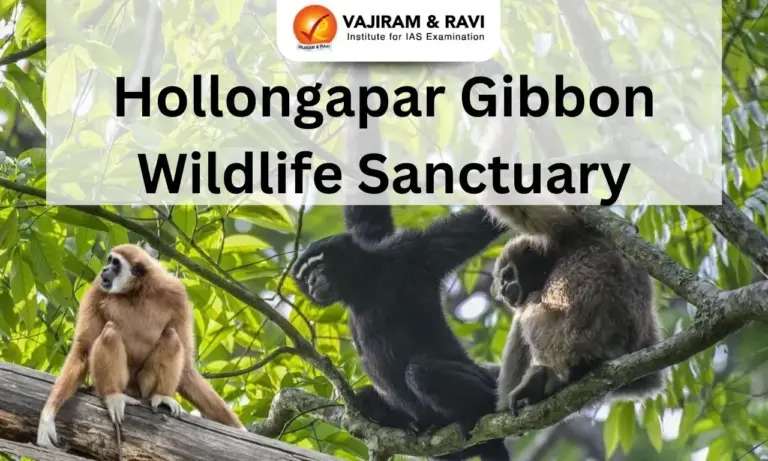
- It is the only sanctuary in India named after a gibbon due to its distinction for containing the densest gibbon populations in Assam.
- Terrain: It is situated at an altitude between 100 and 120 m (330 and 390 ft), the topography gently slopes downward from southeast to northwest.
- River: The Bhogdoi River creates a waterlogged region dominated by semi-hydrophytic plants along the border of the sanctuary.
- Flora:
-
- The upper canopy of the forest is dominated by the Hollong tree, while the Nahar dominates the middle canopy.
- The lower canopy consists of evergreen shrubs and herbs.
- Fauna: It contains India’s only gibbons–the hoolock gibbons, and Northeastern India’s only nocturnal primate–the Bengal slow loris, Indian elephants, tigers, leopards, jungle cats, wild boar, three types of civet, four types of squirrels, stump-tailed macaque, northern pig-tailed macaque, etc.
Source: DTE






 Last updated on March, 2026
→ UPSC Final Result 2025 is now out.
→ UPSC has released UPSC Toppers List 2025 with the Civil Services final result on its official website.
→ Anuj Agnihotri secured AIR 1 in the UPSC Civil Services Examination 2025.
→ UPSC Marksheet 2025 is now out.
→ UPSC Notification 2026 & UPSC IFoS Notification 2026 is now out on the official website at upsconline.nic.in.
→ UPSC Calendar 2026 has been released.
→ Check out the latest UPSC Syllabus 2026 here.
→ UPSC Prelims 2026 will be conducted on 24th May, 2026 & UPSC Mains 2026 will be conducted on 21st August 2026.
→ The UPSC Selection Process is of 3 stages-Prelims, Mains and Interview.
→ Prepare effectively with Vajiram & Ravi’s UPSC Prelims Test Series 2026 featuring full-length mock tests, detailed solutions, and performance analysis.
→ Enroll in Vajiram & Ravi’s UPSC Mains Test Series 2026 for structured answer writing practice, expert evaluation, and exam-oriented feedback.
→ Join Vajiram & Ravi’s Best UPSC Mentorship Program for personalized guidance, strategy planning, and one-to-one support from experienced mentors.
→ Shakti Dubey secures AIR 1 in UPSC CSE Exam 2024.
→ Also check Best UPSC Coaching in India
Hollongapar Gibbon Wildlife Sanctuary FAQs
Q1. Where is Hollongapar Gibbon Wildlife Sanctuary located?+
Q2. What is Hollongapar Gibbon Wildlife Sanctuary famous for?+
Tags: hollongapar gibbon wildlife sanctuary prelims pointers upsc current affairs upsc prelims current affairs