What’s in today’s article?
- Why in News?
- What is the History of the Voting Process?
- What are the International Voting Practices?
- What are the Features of EVMs?
- Way Forward to Make Process of Voting More Robust
Why in News?
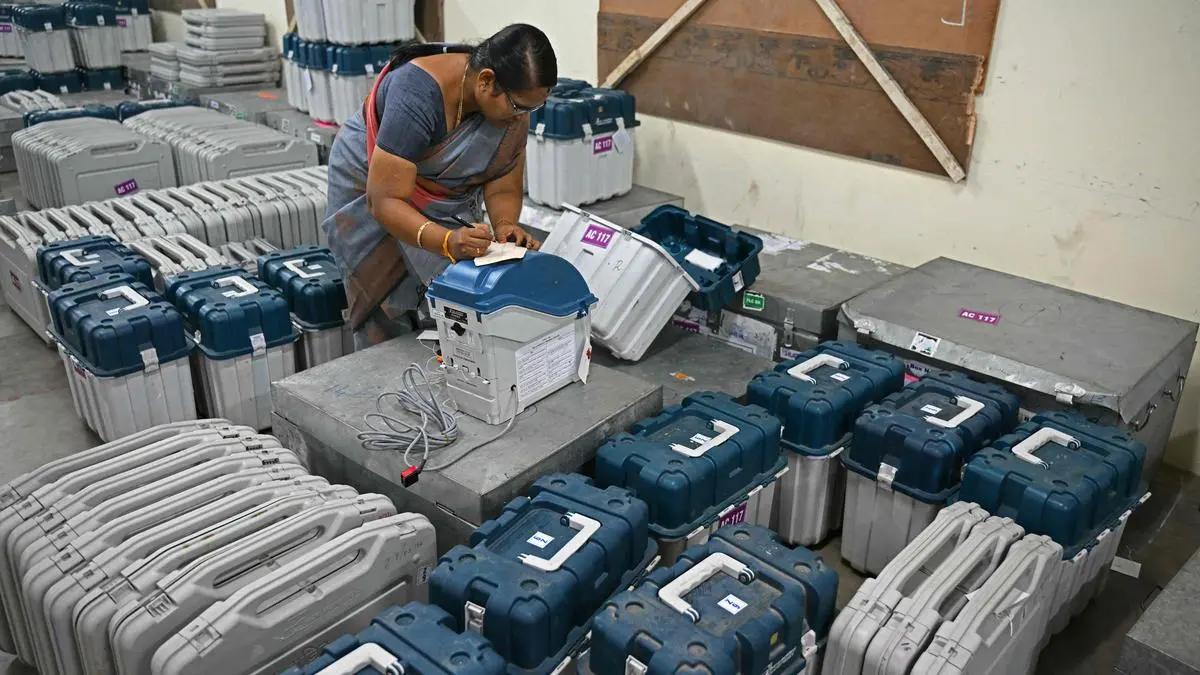
The Supreme Court has decided to hear petitions seeking 100% cross-verification of the Voter Verifiable Paper Audit Trail (VVPAT) slips with the vote count as per Electronic Voting Machines (EVMs).


What is the History of the Voting Process?
- First two general elections of 1952 and 1957: A separate box was placed for each candidate with their election symbol. Voters had to drop a blank ballot paper into the box of the candidate whom they wanted to vote for.
- Third general elections: From the third election, the ballot paper with names of candidates and their symbols was introduced with voters putting a stamp on the candidate of their choice.
- Introduction of the EVM: It was introduced on a trial basis in 1982 in the Assembly constituency of Paravur in Kerala.
- They were deployed in all booths during the Assembly elections of Tamil Nadu, Kerala, Puducherry and West Bengal in 2001.
- In the 2004 general elections to the Lok Sabha, EVMs were used in all 543 constituencies.
- Introduction of the VVPAT: In Subramanian Swamy versus Election Commission of India (2013), the SC ruled that a paper trail is an indispensable requirement for free and fair elections.
- The 2019 general elections had EVMs backed with 100% VVPAT in all constituencies.
What are the International Voting Practices?
- Many western democracies continue to have paper ballots for their elections.
- Countries like England, France, The Netherlands and the U.S. have discontinued the use of EVMs, for national or federal elections, after trials in the last two decades.
- In Germany, the Supreme Court of the country declared the use of EVMs in elections as unconstitutional in 2009.
- Some countries like Brazil, however, use EVMs for their elections. Among India’s neighbours,
- Pakistan does not use EVMs.
- Bangladesh experimented in a few constituencies in 2018 but reverted to paper ballots for the general elections in 2024.
What are the Features of EVMs?
- Benefits:
- The EVM has virtually eradicated booth capturing by limiting the rate of vote casting to four votes a minute and thus significantly increasing the time required for stuffing false votes.
- Invalid votes that were a bane of paper ballots and also a bone of contention during the counting process have been eliminated through EVMs.
- Considering the size of the electorate in India which is close to one billion, the use of EVMs is eco-friendly as it reduces the consumption of paper.
- It provides administrative convenience for the polling officers on the day of the poll and has made the counting process faster and error-free.
- Mechanisms to uphold the integrity of EVM and VVPAT process: These include –
- Random allocation of EVMs to booths before polls;
- Conduct of a mock poll to display the correctness of EVMs and VVPAT before commencement of the actual poll; and
- The serial number of EVMs along with total votes polled was shared with agents of candidates to verify the same at the time of counting of votes.
- Doubts raised about the functioning of EVMs:
- The most repeated allegation is that EVMs are susceptible to hacking as it is an electronic device.
- The sample size for matching of the EVM count with VVPAT slips at present is 5 per assembly constituency/segment. This is not based on any scientific criteria and may fail to detect defective EVMs during counting.
- The present process also allows for booth-wise polling behaviour to be identified by various parties that can result in profiling and intimidation.
- Clarification given by the ECI: EVMs are standalone devices like a calculator with no connectivity to any external device and hence free from any kind of external hack.
Way Forward to Make Process of Voting More Robust
- The sample for matching of EVM count and VVPAT slips should be decided in a scientific manner. 100% match of EVM count with VVPAT slips would be unscientific and cumbersome.
- In case of even a single error, the VVPAT slips should be counted fully for the concerned region and form the basis for results.
- This would instil a statistically significant confidence in the counting process.
In order to provide a degree of cover for voters at the booth level, ‘totaliser’ machines can be introduced that would aggregate votes in 15-20 EVMs before revealing the candidate-wise count.
Q.1. What is a VVPAT and how does it work in an election?
VVPAT stands for Voter Verifiable Paper Audit Trail. It is a ballotless system that prints a paper slip with the name of the candidate, his/her serial number and the symbol of the party he/she is standing for.
Q.2. What is a totaliser machine?
A totaliser is a mechanism which allows votes from 14 booths to be counted together so that voters are saved from pre-poll intimidation and post-poll harassment. Currently, the votes cast via EVMs are counted on an individual booth basis.

 Last updated on Oct, 2026
→ UPSC 2027 Notification will be released on 13 January 2027 at upsconline.nic.in.
→ Check Nobel Prize 2026 Winners List here.
→ Download PIB PRiSM Monthly Magazine 2026 here.
→ Check UPSC Monthly Current Affairs Magazine The Recitals here.
→ Check out the latest UPSC Syllabus here.
→ Download UPSC Model Answers for Mains 2026
→ UPSC Mains Question Paper 2026 is out now for Essay & GS Paper 1, 2, 3 & 4.
→ UPSC Calendar 2027 has been released.
→ Enroll in Vajiram & Ravi’s UPSC Mains Test Series 2027 for structured answer writing practice, expert evaluation, and exam-oriented feedback.
→ Join Vajiram & Ravi’s UPSC Mentorship Program 2027 for personalized guidance, strategy planning, and one-to-one support from experienced mentors.
→ Go through the UPSC Mains Previous Year Papers to enhance your preparation.
→ UPSC has released UPSC Toppers List 2025 with the Civil Services final result on its official website.
→ Also check Best UPSC Coaching in India