US Tariffs 15% Latest News
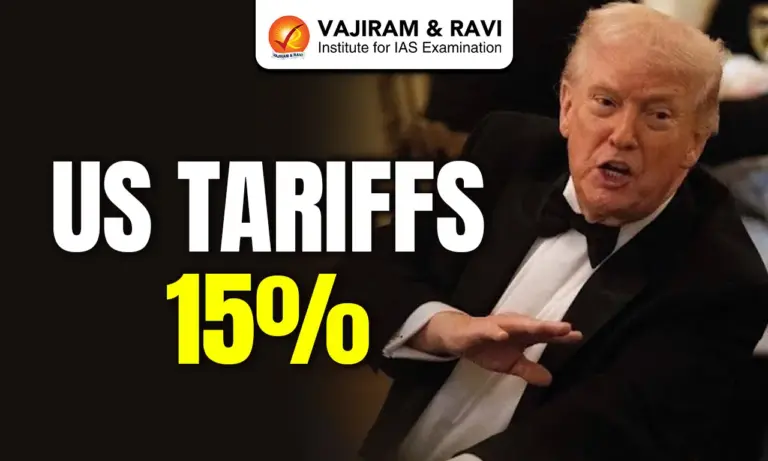
- After the US Supreme Court struck down tariffs imposed by the Trump administration, President Donald Trump invoked a different legal provision — Section 122 of the 1974 Trade Act — to reimpose trade levies.
- He first announced a 10% tariff on all imports, later raising it to 15%, the maximum allowed under this rarely used law. However, the measure is temporary and can remain in force for only about five months unless approved by the US Congress.
Impact of the New 15% US Tariff
- Countries Better Off Under Flat Rate – With the temporary flat 15% tariff, several major economies — including India, China, Japan, South Korea, ASEAN nations, Brazil, Mexico, and Canada — now face lower duties compared to the earlier, higher differential tariffs.
- Countries Facing Higher Tariffs – Conversely, countries such as Russia, Australia, the UK, Saudi Arabia, the UAE, Qatar, Argentina, Colombia, and many in North and Central Africa are now subject to higher tariff rates.
- India’s Position – India had been facing cumulative tariffs of up to 50% since August 2025 due to reciprocal tariffs and penalties linked to Russian oil imports.
- After a recent trade deal framework and removal of the oil penalty, Indian goods are currently taxed at 25%, with expectations of falling to 18%.
- China’s Position – China had been subject to cumulative tariffs of around 45%, including reciprocal and fentanyl-related levies under IEEPA. With IEEPA struck down, a flat 15% tariff could temporarily put India and China on similar footing — unless new measures are introduced.





Supreme Court Ruling Curtails Trump’s Tariff Powers
- The US Supreme Court’s decision striking down the use of International Emergency Economic Powers Act (IEEPA) has significantly limited President Trump’s ability to impose tariffs unilaterally through executive orders.
- Future tariff actions now require detailed justifications from government agencies and face stricter legal constraints.
- The ruling weakens Trump’s leverage in trade negotiations, as other countries may adopt a tougher stance knowing his tariff powers are curtailed.
- Additionally, the administration may have to refund previously collected tariff revenues, further diminishing its bargaining position.
Mounting Legal and Political Challenges for Trump
- More Court Battles Ahead – The administration faces additional Supreme Court cases, including efforts to end birthright citizenship and remove a Federal Reserve Board member — both seen as difficult to win.
- Limited Congressional Path – To restore broad tariff powers, Trump would need explicit Congressional approval. With slim Republican majorities and midterm elections approaching, securing such backing appears unlikely.
- Political Risks and Party Divisions – Tariffs have contributed to inflationary pressures, potentially alienating voters.
- Revenue Impact and Alternative Tools – The scrapping of IEEPA tariffs could halve America’s effective tariff rate. The administration plans to rely on Section 122, Section 232 (national security), and Section 301 (unfair trade practices) to offset losses, though these provisions come with tighter legal checks and procedural requirements.
Shifting Trade Dynamics After IEEPA Ruling
- With IEEPA-based reciprocal tariffs struck down, around 55% of India’s exports to the US could revert to standard MFN rates, easing duty burdens.
- However, Section 232 tariffs — 50% on steel and aluminium and 25% on certain auto parts — remain in force, while about 40% of exports such as smartphones, petroleum products, and medicines continue to be exempt.
Trade Leverage Weakens
- Experts argue that the removal of reciprocal tariffs erodes US leverage in ongoing trade negotiations.
- The ruling signals a shift from executive-driven tariff policy to one constrained by legal and legislative oversight.
- Amid uncertainty, India has postponed a planned visit by its chief trade negotiator to Washington, allowing both sides time to assess the legal and policy implications before resuming discussions.
- Despite the setback, New Delhi anticipates that the US administration may deploy other legal mechanisms to impose tariffs, as trade measures remain central to President Trump’s foreign policy strategy.
Source: IE

 Last updated on March, 2026
→ UPSC Final Result 2025 is now out.
→ UPSC has released UPSC Toppers List 2025 with the Civil Services final result on its official website.
→ Anuj Agnihotri secured AIR 1 in the UPSC Civil Services Examination 2025.
→ UPSC Marksheet 2025 is now out.
→ UPSC Notification 2026 & UPSC IFoS Notification 2026 is now out on the official website at upsconline.nic.in.
→ UPSC Calendar 2026 has been released.
→ Check out the latest UPSC Syllabus 2026 here.
→ UPSC Prelims 2026 will be conducted on 24th May, 2026 & UPSC Mains 2026 will be conducted on 21st August 2026.
→ The UPSC Selection Process is of 3 stages-Prelims, Mains and Interview.
→ Prepare effectively with Vajiram & Ravi’s UPSC Prelims Test Series 2026 featuring full-length mock tests, detailed solutions, and performance analysis.
→ Enroll in Vajiram & Ravi’s UPSC Mains Test Series 2026 for structured answer writing practice, expert evaluation, and exam-oriented feedback.
→ Join Vajiram & Ravi’s Best UPSC Mentorship Program for personalized guidance, strategy planning, and one-to-one support from experienced mentors.
→ Shakti Dubey secures AIR 1 in UPSC CSE Exam 2024.
→ Also check Best UPSC Coaching in India
US Tariffs 15% FAQs
Q1. What are US tariffs 15% under Section 122?+
Q2. How do US tariffs 15% affect India?+
Q3. Why did the Supreme Court weaken tariff powers?+
Q4. Which countries benefit from US tariffs 15%?+
Q5. What happens after the five-month US tariffs 15% period?+
Tags: mains articles upsc current affairs upsc mains current affairs US Tariffs 15%