The Human Development Index (HDI) is a key measure developed by the United Nations Development Programme (UNDP) that shifts the focus of development from purely economic output to people’s capacities and lives. It provides a more holistic view of how countries are doing in terms of health, education and standard of living.
Human Development Index (HDI)
The Human Development Index is a summary measure of average achievement in three basic dimensions of human development:
- A long and healthy life (measured by life expectancy at birth)
- Access to knowledge (measured by expected years of schooling for children and mean years of schooling for adults)
- A decent standard of living (measured by Gross National Income (GNI) per capita, adjusted for purchasing-power parity)
In effect, the HDI uses the geometric mean of these three dimension-indices to compute a composite score between 0 and 1, where a higher number indicates higher human development.
Human Development Index Calculation
The Human Development Index 2025 is calculated in three steps:
- Compute Dimension Indices
- Health Index = (Life Expectancy – 20) / (85 -20)
- Education Index = (Mean Years of Schooling Index + Expected Years of Schooling Index) / 2
- Income Index = (log(GNI per capita) – log(100)) / (log(75,000) – log(100))
- Combine Indices
- HDI = (Health Index × Education Index × Income Index)^(1/3)
- Rank Countries
- Countries are ranked based on their HDI score and grouped into development categories.





Human Development Index Historical Background
The idea of measuring development through people’s well-being, rather than only economic output, gained importance in the late 20th century. The United Nations Development Programme (UNDP) introduced the Human Development Index (HDI) in 1990, inspired by the works of Dr. Mahbub ul Haq and Amartya Sen. Dr. Haq argued that development should expand people’s choices and freedoms, not just increase national income. The first Human Development Report published in 1990 introduced HDI as a new approach to understanding development, focusing on health, knowledge, and income as key pillars.
Since then, the HDI has become a central feature of UNDP’s annual Human Development Reports (HDRs) and is used by governments, economists, and researchers worldwide to evaluate progress and inequalities among countries.
Human Development Index Classification of Countries
The United Nations Development Programme (UNDP) categorizes countries into four groups based on HDI values:
- Very High Human Development: HDI of 0.800 and above
- High Human Development: HDI between 0.700 and 0.799
- Medium Human Development: HDI between 0.550 and 0.699
- Low Human Development: HDI below 0.550
Human Development Index Components
The major dimensions of the Human Development Index is distributed into three components as given below:
- Health Dimension
- Represented by life expectancy at birth, which reflects the average number of years a person is expected to live under current conditions.
- Higher life expectancy indicates better health services, nutrition, and living conditions.
- Education Dimension
- Measured using mean years of schooling (average years of education received by adults aged 25 and above) and expected years of schooling (years of schooling a child entering the education system can expect).
- Education enhances human capabilities and contributes to individual and national growth.
- Standard of Living
- Measured by Gross National Income (GNI) per capita (PPP), adjusted for purchasing power parity to reflect real living standards.
- This captures the economic capacity and access to resources available to citizens.
Inequality Adjusted Human Development Index (IHDI)
The Inequality-Adjusted Human Development Index (IHDI) shows how unequal access to opportunities lowers overall development. For India, the IHDI shows nearly 31% loss in HDI value due to inequality in income, health, and education. The Gender Development Index (GDI) and Gender Inequality Index (GII) highlight gender-based disparities:
- India ranked 108th on GII (UNDP 2024).
- Women’s labor participation rate is below 30%.
- Access to higher education and political representation still needs improvement.
Human Development Index India’s Performance
India’s experience with the Human Development Index offers interesting insights:
- According to UNDP, India’s HDI value rose from 0.676 in 2022 to 0.685 in 2023, placing the country at 130th out of 193 countries in the 2025 Human Development Report.
- Between 1990 and 2022, India’s HDI value increased from 0.434 to 0.644, a rise of about 48.4%.
- The improvement has been driven by gains in life expectancy (from 58.6 years in 1990 to around 72 years in 2023), education (schooling years increasing) and income (GNI per capita rising).
- Life expectancy: Increased from 58.6 years (1990) to 72 years (2023).
- Education: Mean years of schooling rose from 3.0 years to 6.2 years.
- Income: GNI per capita (PPP) increased from US$2,000 in 1990 to about US$9,000 in 2023.
- Despite these gains, India still falls under the Medium Human Development category.
- States like Kerala, Goa, and Himachal Pradesh show higher HDI, while Bihar, Uttar Pradesh, and Jharkhand lag behind.
Government Policies to Improve HDI in India
India has introduced several national programs to improve its HDI indicators. Together, these schemes aim to raise living standards and human capital, both essential for improving the Human Development Index.
- Ayushman Bharat Yojana (2018): Provides free healthcare coverage to over 10 crore families.
- National Education Policy (2020): Focuses on inclusive, skill-based, and flexible education.
- Skill India Mission (2015): Aims to provide vocational training to millions of youth.
- PM-KISAN and PM Awas Yojana: Support rural income and housing.
- Beti Bachao Beti Padhao (2015): Promotes education and safety of girls.
- Digital India Mission: Expands access to technology and e-governance, improving service delivery.
UNDP Indices
To overcome Human Development Index’s limitations, UNDP introduced related indices:
- Inequality-adjusted HDI (IHDI)- Adjusts HDI based on inequality levels in each dimension.
- Gender Development Index (GDI)- Compares HDI values for men and women.
- Gender Inequality Index (GII)- Measures gender-based disadvantages in health, empowerment, and labor.
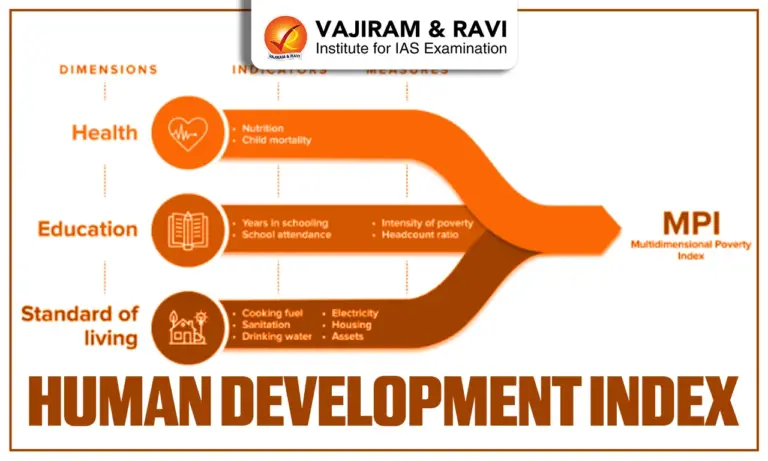
- Multidimensional Poverty Index (MPI)- Measures overlapping deprivations in health, education, and living standards.
Human Development Index Challenges
While the HDI is a powerful tool, there are well-recognised limitations:
- Simplification: It condenses complex realities into a single number, which can mask internal disparities and context.
- Data Lag and Quality: Some critics argue that HDI data may be outdated or not fully represent the current situation, particularly in countries with rapid change.
- Exclusion of Important Dimensions: HDI does not directly capture environmental sustainability, governance quality, informal work, and the distribution of development. Although complementary indices exist, they are not always emphasised.
- Comparability Issues: Methodological changes over time, and differing national circumstances, complicate direct comparisons across years or countries.
Way Forward:
- Focus on Quality Education: Mere enrolment is not sufficient; improving learning outcomes and mean years of schooling should be a priority.
- Health Equity: Strengthening primary health-care networks, reducing malnutrition, and improving maternal and child health will push life-expectancy gains further.
- Growth with Inclusivity: Economic growth must translate into improved living standards for marginalised communities for the standard-of-living dimension to keep rising.
- Addressing Inequality: Losses in HDI due to inequality suggest that targeted programmes for vulnerable groups (women, rural, SC/ST, minorities) will deliver better human development.
- State-Level Variation: Sub-national HDI shows vast gaps between Indian states (for example, Goa or Kerala perform much better than others), policy must recognise regional diversity.
- Beyond HDI: Integrate sustainability and climate resilience into human development planning, as climate change increasingly threatens human life and well-being.
Human Development Index Significance
While Gross Domestic Product (GDP) and per capita income remain important, they don’t tell the full story about human welfare. The HDI matters because:
- It highlights people’s opportunities, not just their income or output.
- It allows cross-country comparison and shows broader social progress.
- It directs attention to education, health and standard of living as core development components.
- It enables policy makers to identify weak areas (for example schooling or income) and design targeted interventions.
Human Development Index Future Aspects
As India and the world navigate 21st-century challenges, the Human Development Index remains relevant but requires evolution:
- Technological Change: The UNDP’s 2025 Report emphasises how AI and digital inclusion can shape future human development opportunities.
- Climate and Environment: Human development must increasingly account for environmental resilience, because climate vulnerabilities affect health, livelihood and education.
- Data Disaggregation: More granularity at district and city-level HDI, and inclusion of informal work and technology access, will improve relevance.
- Inclusive Growth: The focus will shift to not just raising HDI values but ensuring equitable and sustainable human development.
- Global Interdependence: India’s progress in HDI ties into global goals like the Sustainable Development Goal 10 (reduced inequalities) and SDG 3, 4 (health and education).
Human Development Index UPSC
The Human Development Index reveals important global trends:
- Worldwide, HDI values have steadily increased since its introduction in 1990.
- The HDI emphasises that human well-being is more than economic growth—it encompasses health, education and living standards.
- The index has also been complemented by related measures such as the Inequality-adjusted HDI (IHDI), Gender Development Index (GDI) and Multidimensional Poverty Index (MPI) to account for uneven distribution of development.
- In policy discourse, the HDI has shifted the paradigm from “how much economy grows” to “how well people live”.

 Last updated on March, 2026
→ UPSC Final Result 2025 is now out.
→ UPSC has released UPSC Toppers List 2025 with the Civil Services final result on its official website.
→ Anuj Agnihotri secured AIR 1 in the UPSC Civil Services Examination 2025.
→ UPSC Marksheet 2025 is now out.
→ UPSC Notification 2026 & UPSC IFoS Notification 2026 is now out on the official website at upsconline.nic.in.
→ UPSC Calendar 2026 has been released.
→ Check out the latest UPSC Syllabus 2026 here.
→ UPSC Prelims 2026 will be conducted on 24th May, 2026 & UPSC Mains 2026 will be conducted on 21st August 2026.
→ The UPSC Selection Process is of 3 stages-Prelims, Mains and Interview.
→ Prepare effectively with Vajiram & Ravi’s UPSC Prelims Test Series 2026 featuring full-length mock tests, detailed solutions, and performance analysis.
→ Enroll in Vajiram & Ravi’s UPSC Mains Test Series 2026 for structured answer writing practice, expert evaluation, and exam-oriented feedback.
→ Join Vajiram & Ravi’s Best UPSC Mentorship Program for personalized guidance, strategy planning, and one-to-one support from experienced mentors.
→ Shakti Dubey secures AIR 1 in UPSC CSE Exam 2024.
→ Also check Best UPSC Coaching in India
Human Development Index FAQs
Q1. What is the Human Development Index (HDI)? +
Q2. Who introduced the Human Development Index? +
Q3. What is India’s rank in the Human Development Index 2024? +
Q4. What are the three main components of Human Development Index? +
Q5. How is the Human Development Index different from GDP? +
Tags: human development index