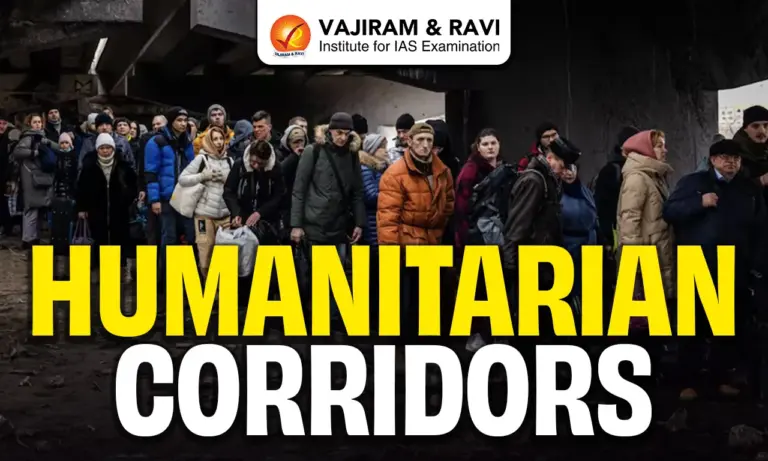
There is no standard definition of a Humanitarian Corridor, nor are corridors specifically defined under international humanitarian law. Humanitarian Corridors can be defined as temporary, demilitarised routes established during armed conflicts to allow the safe movement of civilians, the wounded, and humanitarian aid. They are usually created when normal humanitarian access becomes impossible due to intense hostilities, sieges, or blockades.
Humanitarian Corridors Meaning
According to the International Committee of the Red Cross (ICRC), Humanitarian Corridors or safe passages are agreements between parties to a conflict that allow safe passage for a limited time and in a specific geographical area. They are generally used for:
- Allowing civilians to leave active conflict zones safely.
- Enabling humanitarian assistance to enter affected areas.
- Evacuating the wounded, sick, or dead.
Examples: In the Russia-Ukraine War, humanitarian corridors were established to evacuate civilians from cities such as Mariupol. Humanitarian access arrangements were also seen during the Gaza conflict involving Hamas and Israel.
Humanitarian Corridors are often confused with humanitarian pauses, but the two differ in scope and purpose. Corridors are narrow, route-specific arrangements designed to facilitate safe passage, whereas humanitarian pauses generally involve a wider suspension of hostilities over a broader area to allow for multiple humanitarian activities
Humanitarian Corridors Key Features
Core features of humanitarian corridors:
- They are temporary arrangements.
- They are limited to a specific route and time period.
- They require agreement from all relevant parties to the conflict.
- They involve a temporary suspension of hostilities along the designated route.
Corridors declared unilaterally by one side do not offer the same level of protection because the other party may not recognize or respect them.





Humanitarian Corridors Objectives
The primary objectives of Humanitarian Corridors are:
- To enable safe evacuation of civilians from conflict zones.
- To allow delivery of food, water, and medical supplies.
- To facilitate medical evacuations and rescue operations.
- To reduce civilian casualties.
Humanitarian Corridors Legal Basis
Humanitarian Corridors are usually negotiated between conflicting parties and are often supervised by international organizations.
- Humanitarian Corridors derive their legal basis primarily from International Humanitarian Law (IHL), especially the Geneva Conventions and their Additional Protocols.
- The Fourth Geneva Convention obligates parties to allow the free passage of essential supplies such as food, medicines, and clothing for civilians, while its provisions on occupied territories require facilitation of relief operations.
- Additional Protocol I (1977) mandates that parties permit and facilitate rapid, unimpeded humanitarian assistance and supports the evacuation of civilians from besieged areas.
- Additional Protocol II extends similar principles to non-international armed conflicts.
These treaty rules are reinforced by customary IHL, as identified by the International Committee of the Red Cross, which requires parties to allow humanitarian relief and prohibits starvation of civilians as a method of warfare.
In addition, the United Nations Security Council has often called for humanitarian pauses, safe zones, and corridors through its resolutions.
Humanitarian Corridors Limitations
Despite their humanitarian intent, corridors carry significant risks and limitations.
- Limited area and time: Humanitarian corridors work only on a specific route and for a short period. They do not protect civilians or aid workers outside that route or after the time limit ends.
- Difficult to reach safely: Civilians and aid workers may not be able to reach the corridor because fighting may still be happening in nearby areas. This makes the corridor less useful.
- No guarantee of safety: If all sides in the conflict do not fully respect the agreement, the corridor can be attacked. This creates a false sense of security for civilians using it.
- Used for political or propaganda purposes: Some parties may announce corridors to show the world that they are helping civilians, even if the corridors are poorly planned or unsafe.
- May lead to forced displacement: Corridors can sometimes be used to push civilians out of an area permanently.
During the Russia–Ukraine conflict in 2022, the parties agreed to establish corridors for civilian evacuation and aid delivery. However, in practice, many corridors were poorly communicated, limited in number, and affected by security risks. Civilians often faced long waits at checkpoints, and in some cases, evacuation convoys were attacked, demonstrating that corridors are only effective when they are properly negotiated, coordinated, and respected by all parties.
Humanitarian Corridors and India
India has supported humanitarian assistance in conflict zones and has conducted evacuation operations such as Operation Ganga during the Ukraine crisis, Operation Rahat during the Yemen conflict.

 Last updated on March, 2026
→ UPSC Final Result 2025 is now out.
→ UPSC has released UPSC Toppers List 2025 with the Civil Services final result on its official website.
→ Anuj Agnihotri secured AIR 1 in the UPSC Civil Services Examination 2025.
→ UPSC Marksheet 2025 is now out.
→ UPSC Notification 2026 & UPSC IFoS Notification 2026 is now out on the official website at upsconline.nic.in.
→ UPSC Calendar 2026 has been released.
→ Check out the latest UPSC Syllabus 2026 here.
→ UPSC Prelims 2026 will be conducted on 24th May, 2026 & UPSC Mains 2026 will be conducted on 21st August 2026.
→ The UPSC Selection Process is of 3 stages-Prelims, Mains and Interview.
→ Prepare effectively with Vajiram & Ravi’s UPSC Prelims Test Series 2026 featuring full-length mock tests, detailed solutions, and performance analysis.
→ Enroll in Vajiram & Ravi’s UPSC Mains Test Series 2026 for structured answer writing practice, expert evaluation, and exam-oriented feedback.
→ Join Vajiram & Ravi’s Best UPSC Mentorship Program for personalized guidance, strategy planning, and one-to-one support from experienced mentors.
→ Shakti Dubey secures AIR 1 in UPSC CSE Exam 2024.
→ Also check Best UPSC Coaching in India
Humanitarian Corridors FAQs
Q1. What is a Humanitarian Corridor?+
Q2. What is the legal basis of Humanitarian Corridors?+
Q3. How are Humanitarian Corridors different from Humanitarian Pauses?+
Q4. What are the main limitations of Humanitarian Corridors?+
Q5. What is India’s role related to Humanitarian Corridors?+
Tags: humanitarian corridors international relations international relations notes