Hunga Tonga–Hunga Haʻapai Volcano Latest News
A collaborative research team recently returned from a major 54-day voyage on CSIRO research vessel (RV) Investigator to explore the impacts of the devastating 2022 eruption of Tonga’s underwater Hunga Volcano.
About Hunga Tonga–Hunga Haʻapai Volcano
- It is a submarine stratovolcano in the Tongan archipelago in the southern Pacific Ocean.
- The HTHH volcano includes the small islands of Hunga Tonga and Hunga Ha’apai, along with shallow reefs along the caldera rim of a much larger submarine edifice in the western South Pacific Ocean, west of the main inhabited islands in the Kingdom of Tonga.
- It is located about 30 km south of the submarine volcano of Fonuafoʻou and 65 km north of Tongatapu, the country’s main island.
- The volcano is part of the highly active Tonga–Kermadec Islands volcanic arc, a subduction zone extending from New Zealand north-northeast to Fiji.
- The Tonga-Kermadec arc was formed as a result of the subduction of the Pacific Plate beneath the Indo-Australian Plate.
- It has erupted regularly over the past few decades.
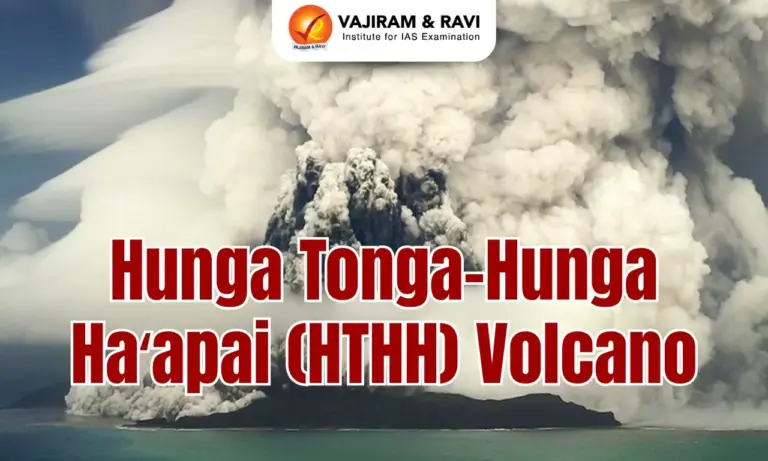
- On January 15, 2022, the HTHH volcano experienced an explosive eruption, considered one of the largest volcanic eruptions of the 21st century.
- The eruption caused a plume of volcanic materials and gasses to be pushed into the stratosphere and sent shock waves through the atmosphere and tsunami waves across ocean basins.




What is a Stratovolcano?
- It is a tall, steep, and cone-shaped type of volcano.
- Unlike flat shield volcanoes, they have higher peaks.
- They are typically found above subduction zones, and they are often part of large volcanically active regions, such as the Ring of Fire that frames much of the Pacific Ocean.
- Strato Volcanoes comprise the largest percentage (~60%) of the Earth’s individual volcanoes, and most are characterized by eruptions of andesite and dacite, lavas that are cooler and more viscous than basalt.
- These more viscous lavas allow gas pressures to build up to high levels. Therefore, these volcanoes often suffer explosive eruptions.
- They are usually about half-half lava and pyroclastic material, and the layering of these products gives them their other common name, composite volcanoes.
- At their peak, they usually have a small crater. The crater may be filled with water or ice, or it may contain a volcanic dome during a period of relative inactivity.
Source: PHYS

 Last updated on March, 2026
→ UPSC Final Result 2025 is now out.
→ UPSC has released UPSC Toppers List 2025 with the Civil Services final result on its official website.
→ Anuj Agnihotri secured AIR 1 in the UPSC Civil Services Examination 2025.
→ UPSC Marksheet 2025 is now out.
→ UPSC Notification 2026 & UPSC IFoS Notification 2026 is now out on the official website at upsconline.nic.in.
→ UPSC Calendar 2026 has been released.
→ Check out the latest UPSC Syllabus 2026 here.
→ UPSC Prelims 2026 will be conducted on 24th May, 2026 & UPSC Mains 2026 will be conducted on 21st August 2026.
→ The UPSC Selection Process is of 3 stages-Prelims, Mains and Interview.
→ Prepare effectively with Vajiram & Ravi’s UPSC Prelims Test Series 2026 featuring full-length mock tests, detailed solutions, and performance analysis.
→ Enroll in Vajiram & Ravi’s UPSC Mains Test Series 2026 for structured answer writing practice, expert evaluation, and exam-oriented feedback.
→ Join Vajiram & Ravi’s Best UPSC Mentorship Program for personalized guidance, strategy planning, and one-to-one support from experienced mentors.
→ Shakti Dubey secures AIR 1 in UPSC CSE Exam 2024.
→ Also check Best UPSC Coaching in India
Hunga Tonga–Hunga Haʻapai (HTHH) Volcano FAQs
Q1. The Hunga Tonga–Hunga Haʻapai (HTHH) Volcano is located in which ocean?+
Q2. Hunga Tonga–Hunga Haʻapai (HTHH) is classified as which type of volcano?+
Q3. To which country does the HTHH volcano belong?+
Tags: Hunga Tonga–Hunga Haʻapai (hthh) volcano