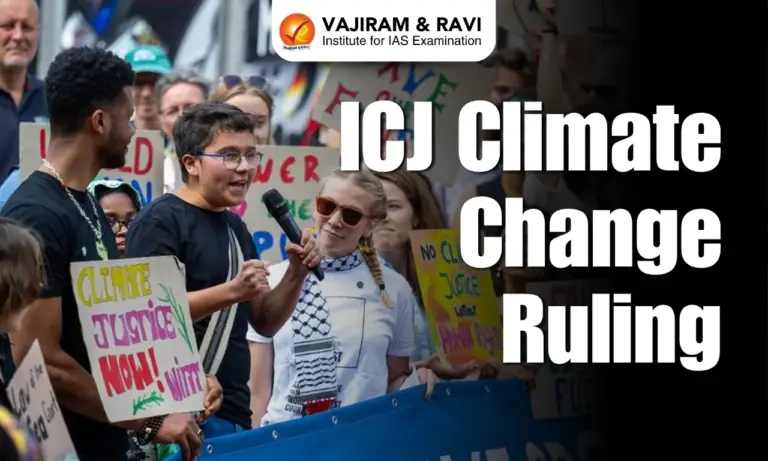
ICJ Climate Change Ruling Latest News
- The International Court of Justice (ICJ) has issued a landmark advisory opinion declaring that countries have a legal obligation under international law to reduce greenhouse gas emissions.
- While not legally enforceable, the ruling can strengthen climate litigation globally and hold nations accountable for failing to act, including possible compensation.
- Prompted by a 2023 UN General Assembly resolution, the opinion underscores that climate action is not just policy but a binding duty—bolstering the demands of developing countries and climate advocates seeking stronger commitments from industrialised nations.
Case Background: Vanuatu’s Climate Justice Initiative at the ICJ
Origin of the Initiative
- In September 2021, the Pacific Island nation of Vanuatu launched a campaign to seek an advisory opinion from the ICJ on climate change.
- The move highlighted the urgency for stronger legal action, especially for vulnerable small island nations threatened by rising sea levels.
- UN General Assembly Resolution
- Following extensive lobbying by Vanuatu, the UN General Assembly adopted a resolution in March 2023, requesting the ICJ to provide legal clarity on two questions:
- What are the obligations of States under international law to protect the environment?
- What legal consequences do States face when they fail to meet these obligations and cause environmental harm?
- Following extensive lobbying by Vanuatu, the UN General Assembly adopted a resolution in March 2023, requesting the ICJ to provide legal clarity on two questions:
- Legal Framework and Importance
- Under the UN Charter, both the General Assembly and the Security Council have the authority to request advisory opinions from the ICJ.
- Although these opinions are not legally binding, they carry significant legal and moral weight, serving to clarify and advance the development of international law.





ICJ Declares Climate Action a Legal Obligation
- In a landmark advisory opinion, the International Court of Justice (ICJ) ruled that climate action is not optional but a binding legal duty under international law.
- Drawing on key climate treaties such as the UNFCCC, Kyoto Protocol, and Paris Agreement, along with environmental agreements like UNCLOS and the Montreal Protocol, the court stated that all countries are legally obligated to reduce greenhouse gas emissions.
- It emphasised that industrialised nations (Annex I countries) must lead in emission cuts and support developing countries through technology and financial aid.
- The court also warned that failing to meet these obligations constitutes an “internationally wrongful act,” making countries liable for compensation to those affected by climate-related disasters.
- Furthermore, nations may be held accountable for harmful actions by private businesses if they fail to regulate or prevent such behaviour through appropriate laws and oversight.
Significance of ICJ’s Advisory Opinion on Climate Change
- A Moral and Legal Turning Point
- Although not legally binding, the ICJ’s advisory opinion is the most authoritative interpretation of international law on climate obligations.
- It is expected to influence courts globally and could shape future litigation against countries and corporations for inadequate climate action.
- Reinforcing Global Climate Responsibility
- The ruling comes at a time when progress on climate change is faltering.
- Many countries, particularly in the developed world, are falling short of their 2030 emission targets.
- The ICJ’s opinion reaffirms that countries have legal obligations—not just voluntary commitments—to take meaningful climate action.
- This strengthens the voice of vulnerable nations demanding accountability.
- Loss and Damage: A New Legal Avenue
- In a significant shift, the court recognised the right of climate-impacted nations—termed “injured states”—to not just compensation but full reparations.
- This legal validation of the “loss and damage” principle could pave the way for lawsuits against rich countries and corporate polluters, especially those historically responsible for emissions.
- Challenges and Future Implications
- While groundbreaking, the opinion also raises questions.
- For instance, the ICJ stated that merely initiating climate action isn’t enough—its adequacy can be challenged.
- However, under the Paris Agreement, countries define their own targets, with no provision to judge whether their actions are sufficient.
- These contradictions could lead to legal disputes and pushback, even from developing countries.
Conclusion
- The ICJ’s ruling does not impose penalties or obligations immediately, but it sets a powerful precedent.
- Its real impact will emerge as national courts begin referencing it in climate-related disputes and as countries respond politically and legally to its interpretation of their duties under international law.

 Last updated on March, 2026
→ UPSC Final Result 2025 is now out.
→ UPSC has released UPSC Toppers List 2025 with the Civil Services final result on its official website.
→ Anuj Agnihotri secured AIR 1 in the UPSC Civil Services Examination 2025.
→ UPSC Marksheet 2025 is now out.
→ UPSC Notification 2026 & UPSC IFoS Notification 2026 is now out on the official website at upsconline.nic.in.
→ UPSC Calendar 2026 has been released.
→ Check out the latest UPSC Syllabus 2026 here.
→ UPSC Prelims 2026 will be conducted on 24th May, 2026 & UPSC Mains 2026 will be conducted on 21st August 2026.
→ The UPSC Selection Process is of 3 stages-Prelims, Mains and Interview.
→ Prepare effectively with Vajiram & Ravi’s UPSC Prelims Test Series 2026 featuring full-length mock tests, detailed solutions, and performance analysis.
→ Enroll in Vajiram & Ravi’s UPSC Mains Test Series 2026 for structured answer writing practice, expert evaluation, and exam-oriented feedback.
→ Join Vajiram & Ravi’s Best UPSC Mentorship Program for personalized guidance, strategy planning, and one-to-one support from experienced mentors.
→ Shakti Dubey secures AIR 1 in UPSC CSE Exam 2024.
→ Also check Best UPSC Coaching in India
ICJ Climate Change Ruling FAQs
Q1. What is the ICJ’s climate change ruling about?+
Q2. Who initiated the ICJ advisory opinion on climate?+
Q3. Are countries legally bound by the ICJ ruling?+
Q4. What is the impact on developed countries?+
Q5. How does the ruling address corporate pollution?+
Tags: ICJ climate change ruling mains articles upsc current affairs upsc mains current affairs