The Ikshavaku Dynasty (c. 225-340 CE) ruled the eastern Krishna River valley in present-day Andhra Pradesh. Their capital was Vijayapuri, identified with modern Nagarjunakonda. To distinguish them from the legendary Ikshvakus of Ayodhya, historians refer to them as the Andhra Ikshvakus or Ikshvakus of Vijayapuri.
The Ikshvaku rulers were Shaivites who followed Vedic rituals, yet they actively supported Buddhism. This period is especially known for the growth of Buddhist art, architecture, and monastic institutions, largely due to the patronage of Ikshvaku queens and princes. The dynasty played a key role in the political and cultural transition of the Deccan after the decline of the Satavahanas.
Ikshavaku Dynasty Historical Background
The Ikshavaku Dynasty (c. 225–340 CE) emerged in the Krishna River valley of Andhra Pradesh after the decline of the Satavahanas, with Vijayapuri (Nagarjunakonda) as its capital. The dynasty played a key role in shaping early Deccan polity while promoting both Vedic traditions and Buddhism.
- They are also known as the Andhra Ikshvakus to distinguish them from the legendary Ikshvakus of Ayodhya.
- Information about the dynasty comes mainly from inscriptions found at Nagarjunakonda, Jaggayyapetta, Amaravati, and Bhattiprolu.
- The Puranas refer to them as Andhrabhrityas and Sriparvatiyas, indicating their regional identity.
- The rulers claimed descent from the Solar dynasty (Suryavansha) to strengthen their legitimacy.
- Although the kings followed Shaivism and Vedic rituals, Buddhism flourished under their rule due to royal patronage, especially by queens and princes.
- The Ikshavaku period marks an important transition from Satavahana rule to regional powers in the Deccan.
Ikshavaku Dynasty Administration and Political Structure
The Ikshavaku Dynasty followed a monarchical system of governance, with the king as the supreme authority ruling from Vijayapuri (Nagarjunakonda). Their administration combined centralized royal control with support from local officials and feudatories, ensuring stability in the Krishna valley.
- The king was the head of the state, and kingship was hereditary in nature.
- Rulers claimed Kshatriya status and Solar lineage to legitimize their political authority.
- The kingdom was likely divided into administrative units such as provinces and districts for effective governance.
- Local administration was managed by officials and village heads, who handled revenue collection and law and order.
Land grants were made to Brahmanas and Buddhist monasteries, indicating a well-organized revenue system. - Royal inscriptions recorded administrative orders, donations, and religious endowments.
- The Ikshvakus maintained a standing army, including infantry and cavalry, for defense and expansion.
- Fortifications, ramparts, and military-related structures at Nagarjunakonda highlight the importance of internal security.
- The rulers performed Vedic rituals and sacrifices, reinforcing the religious basis of political power.
- Overall, the Ikshavaku administrative system reflects a transition from imperial Satavahana governance to regional rule in the Deccan.




Ikshavaku Dynasty Art and Architecture
The Ikshavaku Dynasty made significant contributions to art and architecture, especially in the Krishna–Guntur region, with Nagarjunakonda (Vijayapuri) emerging as a major centre. Their monuments reflect religious tolerance, as both Brahmanical temples and Buddhist structures were actively patronized.
- Nagarjunakonda was the principal architectural centre of the Ikshavakus and witnessed extensive construction activity.
- The dynasty supported the building of Buddhist stupas, chaityas, and viharas, making the region an important Buddhist hub.
- At the same time, Brahmanical temples were constructed, showing royal support for Vedic religion.
- Inscriptions record donations by kings, queens, and royal women, with many queens acting as major patrons of Buddhist monuments.
- Architectural remains include Mahachaityas, monasteries with courtyards, and well-planned religious complexes.
- The Ikshavaku capital had a fortified citadel with strong rampart walls for defense.
- Excavations reveal residential buildings, barracks, stables, baths, and cisterns, indicating advanced urban planning.
- A stepped tank with an overflow system reflects their knowledge of water management.
- Brick was the main construction material, often combined with stone decorative elements.
- Overall, Ikshavaku architecture represents a transition phase between Satavahana and later Deccan architectural styles, combining simplicity with structural grandeur.
Ikshavaku Dynasty Sculpture
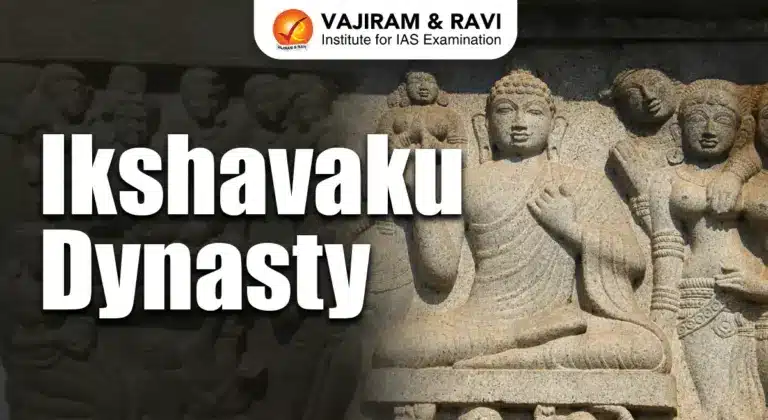
Ikshavaku Dynasty Sculpture represents the final phase of the Amaravati-Satavahana artistic tradition. Early sculptures were simple and symbolic, with no human images of Buddha, who was represented through symbols like the wheel, footprints, and throne.
As the style matured:
- Sculptures became more detailed and expressive
- Themes from Jataka stories such as Mandhatu, Sasa, Vessantara, and Mahahamsa appeared
- Scenes from Buddha’s life, including Mara’s attack, Muchalinda protecting Buddha, and episodes from Lalitavistara were carved
Later sculptures show bold relief work, emotional expressions, and human figures carved in the round. Brahmanical sculptures of Sati and Karttikeya and secular themes like battle scenes also emerged, reflecting artistic diversity.
Decline of the Ikshvaku Dynasty
The decline of the Ikshavaku Dynasty began in the mid-4th century CE. Political instability, internal weaknesses, and external pressure from rising powers weakened their control. The dynasty lost its supremacy during the reign of Rudrapurushadatta.
The last known Ikshavaku ruler, Purushadatta II, was eventually defeated by the Pallava ruler Simhavarman I, bringing an end to Ikshavaku rule in the Krishna valley.

 Last updated on March, 2026
→ UPSC Final Result 2025 is now out.
→ UPSC has released UPSC Toppers List 2025 with the Civil Services final result on its official website.
→ Anuj Agnihotri secured AIR 1 in the UPSC Civil Services Examination 2025.
→ UPSC Marksheet 2025 is now out.
→ UPSC Notification 2026 & UPSC IFoS Notification 2026 is now out on the official website at upsconline.nic.in.
→ UPSC Calendar 2026 has been released.
→ Check out the latest UPSC Syllabus 2026 here.
→ UPSC Prelims 2026 will be conducted on 24th May, 2026 & UPSC Mains 2026 will be conducted on 21st August 2026.
→ The UPSC Selection Process is of 3 stages-Prelims, Mains and Interview.
→ Prepare effectively with Vajiram & Ravi’s UPSC Prelims Test Series 2026 featuring full-length mock tests, detailed solutions, and performance analysis.
→ Enroll in Vajiram & Ravi’s UPSC Mains Test Series 2026 for structured answer writing practice, expert evaluation, and exam-oriented feedback.
→ Join Vajiram & Ravi’s Best UPSC Mentorship Program for personalized guidance, strategy planning, and one-to-one support from experienced mentors.
→ Shakti Dubey secures AIR 1 in UPSC CSE Exam 2024.
→ Also check Best UPSC Coaching in India
Ikshavaku Dynasty FAQs
Q1. Where was the capital of the Ikshavaku Dynasty?+
Q2. Which religion did the Ikshavaku kings follow?+
Q3. Why is Nagarjunakonda important?+
Q4. Which art school influenced Ikshavaku sculpture?+
Q5. Who ended the Ikshavaku rule?+
Tags: ikshavaku dynasty