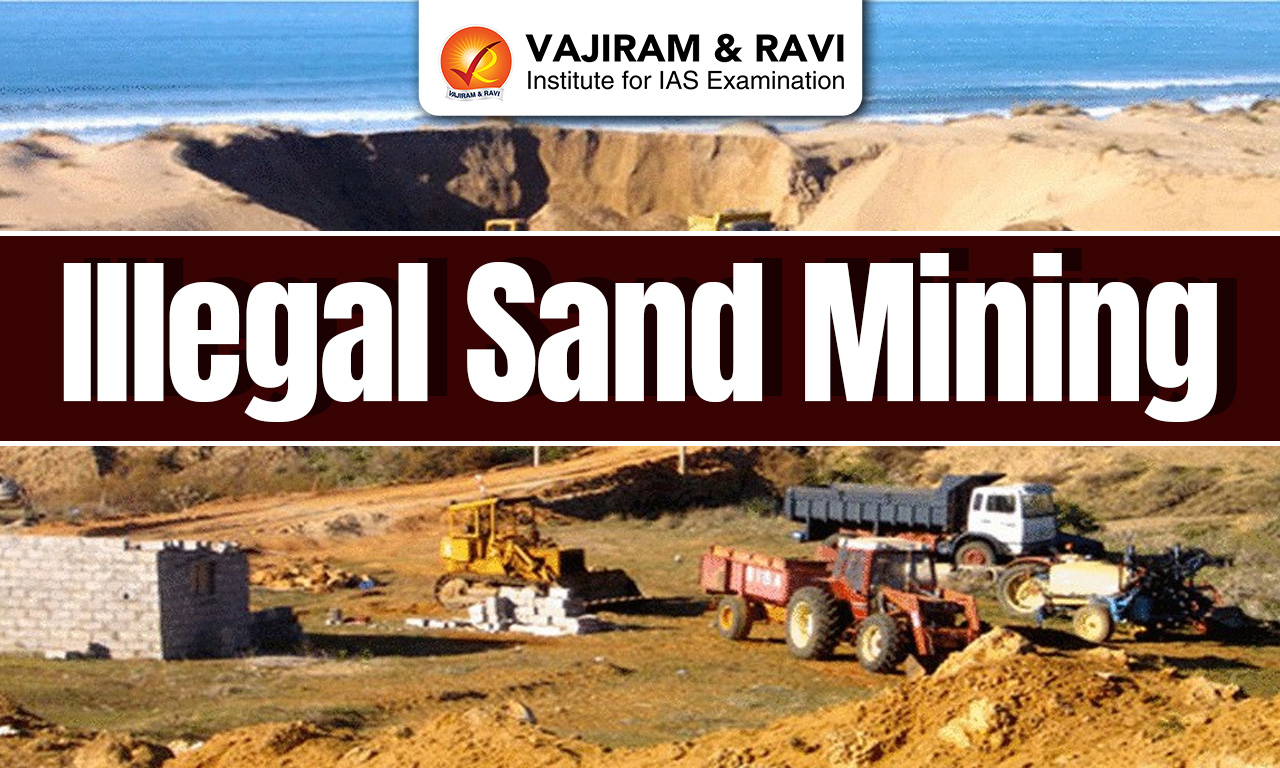
Sand is a naturally occurring granular material formed from weathered rocks and minerals and it is the second most used natural resource after water globally. Sand Mining refers to the extraction of sand from rivers, lakes, coastal areas and other environments for construction and industrial use. Illegal Sand Mining is the unauthorized extraction of sand without permits, often driven by high demand, weak enforcement and organized criminal networks, leading to severe environmental and economic consequences.
Illegal Sand Mining Reasons
Illegal Sand Mining is driven by economic demand, governance gaps and lack of sustainable alternatives, making it a widespread environmental and administrative issue.
- High Construction Demand: India’s construction sector contributes about 9% of GDP and requires nearly 700 million tonnes of sand annually, while legal supply is around 400 million tonnes, creating a deficit filled through illegal mining activities.
- Rapid Urbanization: Increasing population and urban expansion significantly raise infrastructure demand, including housing, roads and bridges, which directly increases dependence on sand as a primary raw material.
- Weak Enforcement Mechanisms: Inadequate regulatory monitoring and weak implementation of laws allow illegal mining operations to continue unchecked, especially in remote riverine and coastal regions.
- Sand Mafia Networks: Organized criminal groups control illegal mining operations, operating as parallel economies worth ₹40,000-₹50,000 crore annually, often involving violence, corruption and political patronage.
- Complex Approval Processes: Lengthy and bureaucratic procedures for legal mining approvals discourage compliance, pushing operators toward illegal extraction to save time and costs.
- Lack of Alternatives: Limited adoption of substitutes like manufactured sand (M sand), fly ash and recycled materials maintains high dependence on natural river sand.
- Corruption and Nexus: Collusion between local authorities, politicians and illegal miners weakens governance, enabling illegal operations to flourish without fear of strict penalties.
- Poor EIA Implementation: Weak enforcement of Environmental Impact Assessment norms allows small scale mining activities to bypass regulatory scrutiny and operate illegally.
Sand Mining Legal Framework
Legal Sand Mining refers to regulated extraction carried out under government approval with environmental safeguards, licensing and scientific limits to ensure sustainability and ecological balance.
- Legal Definition and Nature: Sand is classified as a minor mineral under the Mines and Minerals (Development and Regulation) Act 1957 and its regulation is primarily under State Governments through rules framed under Section 15 of the Act.
- Environmental Clearance Requirement: Legal mining requires Environmental Clearance under the Environment Impact Assessment Notification 2006, even for areas below 5 hectares, ensuring ecological considerations before extraction activities begin.
- Role of SEIAA and SEAC: The State Environment Impact Assessment Authority and State Expert Appraisal Committee evaluate mining proposals based on river flow, replenishment capacity and ecological sensitivity before granting approvals.
- Sustainable Sand Mining Guidelines 2016: Issued by MoEFCC, these guidelines focus on maintaining river equilibrium, preventing groundwater depletion and ensuring environmentally sustainable mining practices across India.
- Enforcement and Monitoring Guidelines for Sand Mining 2020: These guidelines provide a standardized protocol for tracking sand extraction, transportation and usage using technologies like drones, GPS and satellite monitoring systems.
- District Survey Report: The government mandates preparation of District Survey Reports as a scientific basis for granting mining leases, which are updated every five years to reflect resource availability and ecological conditions.
- Legal vs Illegal Sand Mining: Legal mining involves permits, royalty payments and monitoring, while illegal mining operates without authorization, causing revenue loss and environmental degradation with no accountability.
- Illegal Sand Mining Punishments: MMDR Act amendments (2015) increased penalties to ₹5 lakh per hectare and imprisonment up to 5 years, with Special Courts for speedy trials and State Governments empowered under Section 23C to enforce strict action.
- Illegal Sand Mining Complaint: Complaints regarding illegal mining can be reported to district authorities, police or mining departments, as State Governments under Section 23C of the MMDR Act are responsible for enforcement, investigation and necessary legal action.


Illegal Sand Mining Cases in India
Illegal Sand Mining in India has grown due to rising demand, weak enforcement and organized networks, creating a large parallel economy and environmental crisis.
- Economic Scale of Illegal Trade: The Illegal Sand Mining economy in India is estimated to be about ₹50,000 crore annually, indicating the scale of unregulated extraction and associated black market activities.
- Major Affected Regions: States like Uttar Pradesh, Madhya Pradesh, Maharashtra, Tamil Nadu, Bihar and Odisha face severe illegal mining along rivers such as Yamuna, Narmada, Godavari, Cauvery and Son.
- Bihar Crackdown: Bihar Police conducted a major operation near the Sone River, arresting sand smugglers, highlighting the presence of organized criminal syndicates controlling illegal mining activities.
- River System Impact: Rivers such as the Ganga, Brahmaputra and their tributaries experience excessive extraction, altering sediment balance and affecting long term river stability and water systems.
- Sand Mafia: Illegal mining is often controlled by organized groups with political patronage, leading to violence, intimidation and even killings of officials, journalists and activists.
- Global Context: Studies indicate that 40 to 50 billion tonnes of sand are extracted annually worldwide, with illegal mining contributing significantly due to lack of global regulatory frameworks.
Illegal Sand Mining Impacts
Illegal Sand Mining has serious environmental, economic and social consequences, affecting river ecosystems, biodiversity and local livelihoods significantly.
- River Ecology Degradation: According to the Geological Survey of India, excessive sand removal alters riverbeds, disrupts natural flow and destroys aquatic habitats, affecting fish breeding and ecological balance.
- Erosion and Land Loss: Unregulated mining causes riverbank erosion, leading to loss of agricultural land and displacement of communities living near rivers and coastal areas.
- Groundwater Depletion: Deep pits created by sand extraction lower groundwater levels, affecting drinking water availability and causing water scarcity in nearby villages.
- Flood Risk Increase: Removal of sand weakens natural barriers like sandbanks and dunes, increasing vulnerability to floods in riverine and coastal regions.
- Biodiversity Loss: Habitat destruction impacts species like fish, turtles and birds. Regions like Chambal Sanctuary facing threats to endangered gharials due to illegal mining.
- Water Quality Decline: Increased sediment imbalance and turbidity reduce water quality, affecting both human consumption and aquatic ecosystems.
- Social and Economic Consequences: Illegal mining leads to violence, livelihood loss for fishermen and farmers and significant revenue loss to the government due to tax evasion.
Illegal Sand Mining Government Initiatives
The government has introduced policies, laws and technological tools to regulate Sand Mining and curb illegal activities across India.
- MMDR Act 1957: This Act provides the legal framework for mining regulation, with provisions to prevent illegal mining and empower states to take enforcement actions.
- National Mineral Policy 2019: It emphasizes transparency, sustainable mining practices and scientific resource management to reduce illegal extraction and promote accountability.
- Sustainable Sand Mining Guidelines 2016: These guidelines aim to ensure environmentally sustainable mining while protecting river ecosystems and maintaining natural sediment balance.
- Enforcement and Monitoring Guidelines 2020: Introduces modern monitoring systems including drones, satellite imagery and real time tracking of sand transportation.
- Mining Surveillance System: Developed using space technology in coordination with BISAG and MeitY, it helps detect illegal mining activities through satellite based monitoring.
- Digital Tracking Systems: Initiatives like e-Green Watch and digital sand tracking ensure end to end monitoring of mining activities and reduce illegal transportation.
- State Level Actions: States like Bihar have set up check posts and conducted enforcement drives, while Odisha uses integrated digital systems to regulate mining operations effectively.
Illegal Sand Mining Case Laws
Judicial interventions have played a crucial role in regulating Illegal Sand Mining and addressing environmental concerns arising from illegal extraction.
- Chambal Sand Mining Case (2026): The Court described Sand Mining cartels as “modern dacoits.” It flagged an “environmental crisis” in National Chambal Sanctuary, ordering CCTV surveillance, GPS tracking, vehicle seizure, joint patrols and warning of complete mining ban or central force deployment for non compliance.
- UP Sand Mining PIL (2022): The court directed adoption of e-licensing systems to ensure transparency and reduce corruption in Sand Mining processes.
- NGT v. Tamil Nadu Sand Mining Case (2018): National Green Tribunal directed implementation of digital monitoring systems to track sand transportation and curb illegal activities.
- Deepak Kumar v. State of Haryana (2013): The Supreme Court mandated environmental clearance for all Sand Mining activities, even below 5 hectares, to prevent ecological damage.
Sustainable Sand Mining Challenges
Despite policies and awareness, achieving eradication of Illegal Sand Mining remains difficult due to multiple structural, economic and governance related challenges.
- High Construction Demand: Rapid urbanization and infrastructure growth continuously increase demand for sand, making it difficult to reduce dependency on natural sources.
- Weak Enforcement Mechanisms: Lack of effective monitoring, limited manpower and corruption reduce the effectiveness of laws and guidelines on the ground.
- Limited Alternatives Adoption: Manufactured sand and recycled materials are not widely adopted due to cost, awareness gaps and market preferences for natural sand.
- Governance and Coordination Issues: Overlapping responsibilities between central and state authorities create gaps in policy implementation and enforcement.
- Sand Mafia Influence: Organized criminal networks with political support hinder strict action, making enforcement risky and challenging for authorities.
- Environmental Assessment Gaps: Weak implementation of Environmental Impact Assessments allows illegal activities to continue without proper ecological evaluation.
- Data and Monitoring Limitations: Lack of real time data and comprehensive surveys makes it difficult to track extraction levels and ensure sustainable mining practices.
Illegal Sand Mining Measures
Addressing Illegal Sand Mining requires a combination of regulatory reforms, technological solutions and sustainable alternatives to ensure long term environmental protection.
- Promote Manufactured Sand (M Sand): Encouraging use of crushed stone sand as an alternative can significantly reduce dependence on riverbed sand and lower environmental damage.
- Strengthen Monitoring Technology: Use of drones, satellite imagery, GPS tracking and remote sensing can help detect illegal mining activities in real time and improve enforcement.
- Centralized Regulatory Framework: Bringing uniform national level regulation can reduce inconsistencies across states and ensure better control over illegal mining operations.
- Community Participation: Involving local communities and Gram Panchayats in monitoring can improve reporting of illegal activities and enhance accountability at the grassroots level.
- Strict Law Enforcement: Strengthening penalties and ensuring swift legal action against offenders can deter illegal mining and reduce the influence of Sand Mafias.
- Reduce Sand Consumption: Promoting green construction practices using fly ash, recycled materials and alternative technologies can lower overall demand for natural sand.
- Scientific Mining Practices: Implementing replenishment based extraction limits and periodic audits ensures sustainable use of sand resources while maintaining ecological balance.

 Last updated on Oct, 2026
→ UPSC 2027 Notification will be released on 13 January 2027 at upsconline.nic.in.
→ Check Nobel Prize 2026 Winners List here.
→ Download PIB PRiSM Monthly Magazine 2026 here.
→ Check UPSC Monthly Current Affairs Magazine The Recitals here.
→ Check out the latest UPSC Syllabus here.
→ Download UPSC Model Answers for Mains 2026
→ UPSC Mains Question Paper 2026 is out now for Essay & GS Paper 1, 2, 3 & 4.
→ UPSC Calendar 2027 has been released.
→ Enroll in Vajiram & Ravi’s UPSC Mains Test Series 2027 for structured answer writing practice, expert evaluation, and exam-oriented feedback.
→ Join Vajiram & Ravi’s UPSC Mentorship Program 2027 for personalized guidance, strategy planning, and one-to-one support from experienced mentors.
→ Go through the UPSC Mains Previous Year Papers to enhance your preparation.
→ UPSC has released UPSC Toppers List 2025 with the Civil Services final result on its official website.
→ Also check Best UPSC Coaching in India
Illegal Sand Mining FAQs
Q1. What is Illegal Sand Mining?+
Q2. Why is Sand Mining important?+
Q3. What are the major impacts of Illegal Sand Mining?+
Q4. Which law regulates Sand Mining in India?+
Q5. What is the role of Sand Mafias in illegal mining?+
Tags: geography geography notes lllegal sand mining