Economic Corridor Latest News
- The India–Middle East–Europe Economic Corridor is in focus as geopolitical tensions in West Asia and Red Sea disruptions have raised concerns over its future viability and strategic implementation.
About India-Middle East-Europe Economic Corridor (IMEC)
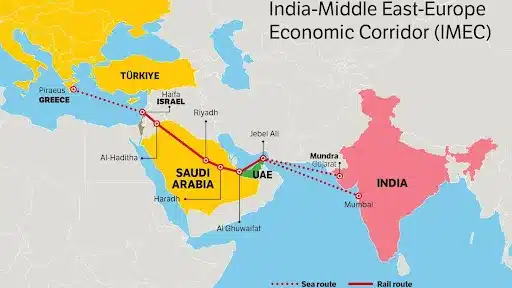
- The India-Middle East-Europe Economic Corridor (IMEC) is a major connectivity initiative designed to strengthen trade and transport linkages between India, the Arabian Peninsula, and Europe.
- Conceived as part of the G20 Summit in New Delhi in 2023, IMEC aims to provide a seamless multimodal network combining maritime and railway infrastructure to enhance economic integration and reduce logistical costs.
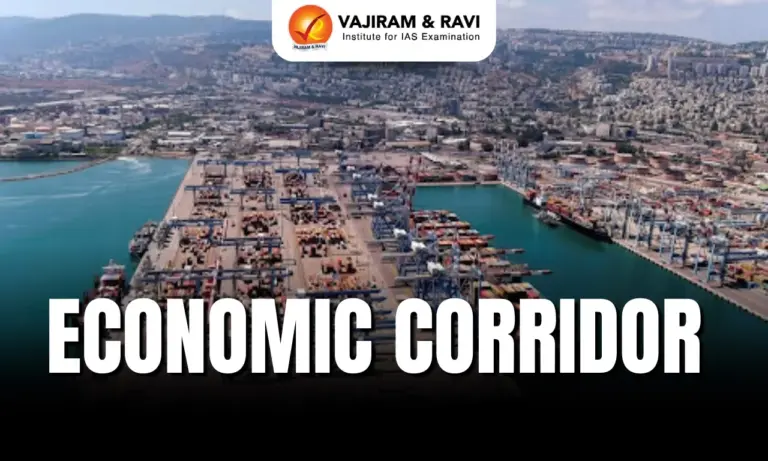
- The corridor envisions a maritime route connecting Indian ports to those in the UAE, followed by a high-speed rail network stretching across Saudi Arabia, Jordan, and Israel to reach the Haifa Port, from where goods would be transported onward to European destinations.
- Apart from transportation, IMEC also plans to establish an electricity grid, hydrogen pipeline, and undersea digital connectivity, making it a comprehensive economic corridor integrating energy, technology, and trade systems.





Historical and Geopolitical Background
- The geopolitical atmosphere in 2023 was favourable for the launch of IMEC. The Abraham Accords, agreements normalising relations between Israel and several Arab nations, had created optimism about stability in West Asia.
- Building upon these developments, discussions began on creating a railway network linking Haifa in Israel to Jordan and the Gulf region.
- At the same time, India’s relations with the UAE and Saudi Arabia reached unprecedented levels of strategic trust, strengthened by growing energy trade, defence cooperation, and investment partnerships.
- Moreover, the formation of the I2U2 grouping (India, Israel, the UAE, and the U.S.) further consolidated regional cooperation on trade, technology, and infrastructure.
- In this context, the IMEC was announced during the G20 Leaders’ Summit in New Delhi (September 2023) with the endorsement of the U.S., European Union, France, Germany, Italy, Saudi Arabia, and the UAE.
- The project was widely seen as a strategic counter to China’s Belt and Road Initiative (BRI) and as a step toward creating resilient global supply chains.
Challenges and Geopolitical Complexities
- Within weeks of IMEC’s announcement, the October 7, 2023, Hamas attacks on Israel and the ensuing conflict in Gaza dramatically altered the regional geopolitical landscape.
- The escalation of violence between Israel and Hamas strained diplomatic relations between Israel and several Arab states, disrupting the fragile regional cooperation that had initially made IMEC feasible.
- The security situation in West Asia remains volatile, with maritime threats in the Red Sea posed by Houthi groups disrupting global trade routes.
- Many shipping companies have diverted vessels around the Cape of Good Hope, increasing transit times and costs. These uncertainties underscore the vulnerability of regional logistics and the importance of alternative trade routes like IMEC.
- Moreover, climate-induced developments such as the opening of Arctic shipping lanes due to melting ice are also influencing global trade.
- Countries like Russia, the U.S., and China are now exploring the Northern Sea Route as a faster, cheaper path between Asia and Europe.
- For Mediterranean economies such as Italy and France, both IMEC signatories, this presents a challenge, making the success of IMEC even more critical to maintain their relevance in maritime trade.
Strategic and Economic Importance for India
- For India, IMEC represents a strategic opportunity to diversify trade routes and reduce dependence on chokepoints such as the Suez Canal.
- The corridor enhances India’s ability to access European markets via the Mediterranean, offering an alternative to China-dominated trade networks under the BRI.
- Currently, the European Union (EU) is India’s largest trading partner, with bilateral trade crossing $136 billion in 2024.
- Given Europe’s high per capita income and technological advancements, building stronger connectivity through IMEC could significantly expand India’s export competitiveness.
- IMEC also complements India’s ‘Act West’ policy, deepening its engagement with the Middle East, a region crucial for India’s energy security, remittances, and diaspora.
- Moreover, enhanced economic interaction through IMEC could help counterbalance Pakistan’s efforts to forge strategic alliances in the region, particularly with Gulf countries.
Infrastructure and Technological Vision
- IMEC goes beyond a physical transport network. It integrates multiple domains, energy, technology, and sustainability, through the establishment of:
- A clean hydrogen pipeline connecting India and Europe via the Middle East, supporting global energy transition goals.
- An electricity grid to facilitate cross-border power trade, particularly renewable energy.
- A digital connectivity network, including high-speed undersea cables, to boost digital trade and data infrastructure.
- Upgraded logistics and ports to ensure seamless cargo movement between maritime and rail networks.
- Such multidimensional infrastructure makes IMEC a 21st-century corridor, aligning with India’s green growth and digital transformation objectives.
Way Forward
- While the political and security challenges are significant, India and partner nations must view IMEC as a long-term strategic project rather than a short-term commercial venture. The corridor’s flexibility allows for expansion, including potential integration of Saudi and Egyptian ports, which could make it more resilient to regional disruptions.
- For IMEC to succeed, member countries need to:
- Establish a permanent joint coordination mechanism to ensure implementation continuity.
- Attract public-private partnerships and multilateral financing for infrastructure projects.
- Build consensus on security guarantees for trade routes.
- Synchronise with global frameworks like the EU’s Global Gateway and the U.S.-led Partnership for Global Infrastructure and Investment (PGII).
Source: TH

 Last updated on March, 2026
→ UPSC Final Result 2025 is now out.
→ UPSC has released UPSC Toppers List 2025 with the Civil Services final result on its official website.
→ Anuj Agnihotri secured AIR 1 in the UPSC Civil Services Examination 2025.
→ UPSC Marksheet 2025 is now out.
→ UPSC Notification 2026 & UPSC IFoS Notification 2026 is now out on the official website at upsconline.nic.in.
→ UPSC Calendar 2026 has been released.
→ Check out the latest UPSC Syllabus 2026 here.
→ UPSC Prelims 2026 will be conducted on 24th May, 2026 & UPSC Mains 2026 will be conducted on 21st August 2026.
→ The UPSC Selection Process is of 3 stages-Prelims, Mains and Interview.
→ Prepare effectively with Vajiram & Ravi’s UPSC Prelims Test Series 2026 featuring full-length mock tests, detailed solutions, and performance analysis.
→ Enroll in Vajiram & Ravi’s UPSC Mains Test Series 2026 for structured answer writing practice, expert evaluation, and exam-oriented feedback.
→ Join Vajiram & Ravi’s Best UPSC Mentorship Program for personalized guidance, strategy planning, and one-to-one support from experienced mentors.
→ Shakti Dubey secures AIR 1 in UPSC CSE Exam 2024.
→ Also check Best UPSC Coaching in India
Economic Corridor FAQs
Q1. What is the India–Middle East–Europe Economic Corridor (IMEC)?+
Q2. When was IMEC announced?+
Q3. What countries are part of the IMEC initiative?+
Q4. What are the main objectives of IMEC?+
Q5. What are the current challenges facing IMEC?+
Tags: economic corridor mains articles upsc current affairs upsc mains current affairs