Trump’s Tariffs on India Latest News
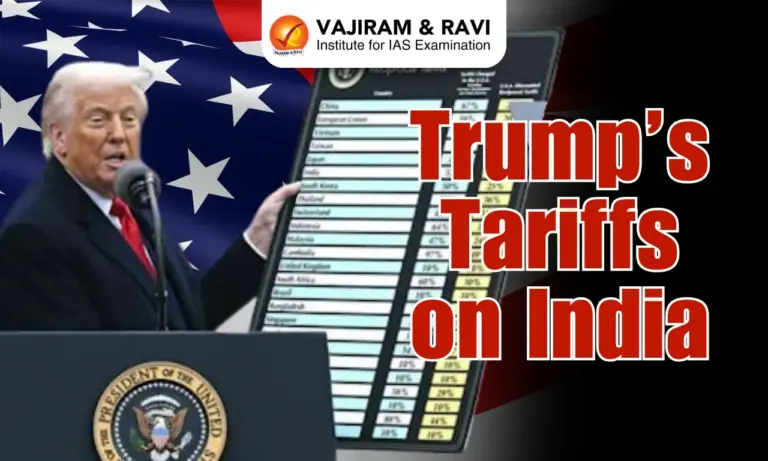
- U.S. President Donald Trump announced a 25% tariff plus an additional penalty on Indian imports, ending months of speculation.
- However, this move has introduced fresh uncertainty over the prospects of a bilateral trade agreement between India and the U.S., complicating future trade negotiations.
Trump Imposes Tariffs on India
- U.S. President Donald Trump announced a 25% tariff on Indian imports, citing India’s tariff and non-tariff barriers and its energy and defense dealings with Russia as key reasons.
- While details of the additional penalty remain unclear, Trump has previously threatened a 10% extra tariff on BRICS nations, which could raise India’s effective tariff rate to 35%.
- Additionally, pending U.S. legislation proposes a 500% tariff on India, China, and Brazil for their continued engagements with Russia, adding further uncertainty to India-U.S. trade relations.





Impact of Trump’s Tariffs on Indian Economy and Key Export Sectors
- While U.S. importers will bear the direct cost of the new tariffs, Indian goods will become less competitive and more expensive in the U.S. market.
- On a macroeconomic level, the tariffs are expected to reduce India’s GDP growth by 0.2%, lowering forecasts from 6.6% to 6.4%, according to Bank of Baroda research.
- However, the real impact will be sector-specific, hitting industries like garments, precious stones, auto parts, leather goods, and possibly electronics.
- These sectors may face pricing disadvantages compared to competitors from Vietnam, South Korea, and Indonesia, who benefit from lower tariffs.
- Exporters in these sectors will need to rework their strategies to stay competitive.
The Breakdown of India-U.S. Trade Talks Leading to Tariffs
- In February 2025, Prime Minister Narendra Modi and President Donald Trump announced plans to finalise the first tranche of a bilateral trade deal by fall, a move seen as a positive commitment to strengthening ties.
- This announcement came ahead of Trump’s broader reciprocal tariffs strategy, which pressured other countries to enter negotiations with the U.S.
- However, on April 2, Trump launched his Liberation Day tariffs, imposing a 10% baseline tariff globally and additional country-specific tariffs, with India facing a 26% total tariff.
- Following backlash, Trump announced a 90-day pause to allow for bilateral negotiations aimed at reducing trade deficits.
- The pause, initially set to expire in July, was extended until August 1, but no breakthrough was reached, leading to the imposition of tariffs.
Multiple Frictions Strain India-U.S. Trade Relations
- While no single incident has soured India-U.S. ties, several points of friction have built up in recent months.
- President Trump has consistently criticised India’s tariff and non-tariff barriers and has also raised concerns about India’s continued energy and defense dealings with Russia, accusing it of indirectly financing the Ukraine war.
- India, however, has defended its energy security strategy, with Russia supplying 35-40% of its oil imports.
- Additionally, India’s refusal to open its agriculture and dairy sectors to foreign competition remains a major sticking point, as it protects vulnerable domestic farmers.
- Tensions escalated further when Trump claimed credit for the India-Pakistan ceasefire (Operation Sindoor), a claim firmly rejected by India.
- In response to U.S. tariffs on Indian goods like steel and aluminium, India has informed the WTO of its right to impose retaliatory tariffs.
- These cumulative issues have set the stage for Trump’s recent tariff imposition, reflecting the growing strains in bilateral ties.
India Faces Imminent Tariffs Amid Uncertain Trade Deal Prospects
- Despite discussions of a potential “mini-deal” to ease reciprocal tariffs, U.S. President Donald Trump’s recent tariff announcement signals that such a deal is unlikely in the near term.
- Both India and the U.S. remain committed to finalising a broader trade agreement by fall 2025, but progress has been complicated by Trump’s decision to link India’s Russia engagements to trade negotiations.
- So far, five rounds of talks have been held, with the next U.S. delegation visit scheduled for late August.
- Meanwhile, Trump’s Executive Order, dated July 31, mandates that tariffs on Indian imports will take effect within 7 days, making the imposition of duties imminent and unavoidable for now.
Source: TH

 Last updated on March, 2026
→ UPSC Final Result 2025 is now out.
→ UPSC has released UPSC Toppers List 2025 with the Civil Services final result on its official website.
→ Anuj Agnihotri secured AIR 1 in the UPSC Civil Services Examination 2025.
→ UPSC Marksheet 2025 is now out.
→ UPSC Notification 2026 & UPSC IFoS Notification 2026 is now out on the official website at upsconline.nic.in.
→ UPSC Calendar 2026 has been released.
→ Check out the latest UPSC Syllabus 2026 here.
→ UPSC Prelims 2026 will be conducted on 24th May, 2026 & UPSC Mains 2026 will be conducted on 21st August 2026.
→ The UPSC Selection Process is of 3 stages-Prelims, Mains and Interview.
→ Prepare effectively with Vajiram & Ravi’s UPSC Prelims Test Series 2026 featuring full-length mock tests, detailed solutions, and performance analysis.
→ Enroll in Vajiram & Ravi’s UPSC Mains Test Series 2026 for structured answer writing practice, expert evaluation, and exam-oriented feedback.
→ Join Vajiram & Ravi’s Best UPSC Mentorship Program for personalized guidance, strategy planning, and one-to-one support from experienced mentors.
→ Shakti Dubey secures AIR 1 in UPSC CSE Exam 2024.
→ Also check Best UPSC Coaching in India
Trump’s tariffs on India FAQs
Q1. Why did Trump impose tariffs on India?+
Q2. Which Indian sectors will be hit hardest by tariffs?+
Q3. Will these tariffs significantly impact India’s GDP?+
Q4. Can India and the U.S. still reach a trade deal?+
Q5. How is India preparing to counter U.S. tariffs?+
Tags: mains articles Trump’s tariffs on India upsc current affairs upsc mains current affairs