India–Bangladesh Relations Latest News
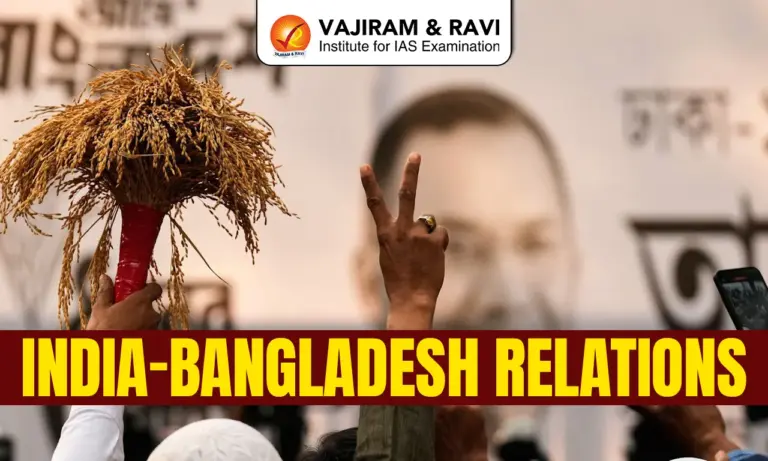
- The Bangladesh Nationalist Party (BNP), led by Tarique Rahman, secured a decisive victory in the recent elections, emerging on course for a two-thirds majority in the 300-member Parliament.
- The polls, the first since Sheikh Hasina’s ouster in August 2024, also saw a significant rise in seats for the Jamaat-e-Islami.
- Prime Minister Narendra Modi congratulated Rahman on his “decisive victory.”
- The outcome marks a turning point for India–Bangladesh relations, which have faced uncertainty since Hasina’s removal, and will shape the trajectory of bilateral ties in the coming years.
India and the BNP: A Complex Political Legacy
- India’s engagement with the Bangladesh Nationalist Party (BNP) dates back to its founding in 1978 by General Ziaur Rahman.
- After his assassination, Khaleda Zia led the party for decades, shaping its ideology.
- Tarique Rahman assumed leadership after her death and returned to Bangladesh following 17 years in self-exile.
Strained Ties During 2001–2006
- Relations between India and Bangladesh were tense during the BNP-Jamaat coalition government (2001–2006).
- India raised concerns over insurgent and terror groups operating from Bangladeshi soil, allegedly with protection from Jamaat leaders, posing security challenges for India’s Northeast.
- When Sheikh Hasina returned to power in 2008, her government launched a crackdown on insurgent groups, strengthening counter-terror cooperation with India.
- While New Delhi welcomed the improved security environment, Hasina also used anti-terror measures to target political opponents, including BNP and Jamaat leaders.
Post-Hasina Political Realignment
- Following Hasina’s removal amid protests in 2024, the political landscape shifted rapidly.
- With the Awami League barred from contesting and Hasina in India, the BNP and Jamaat-e-Islami have emerged as dominant forces in Bangladesh’s current political environment.




India’s Diplomatic Pivot After BNP’s Victory
- PM Modi quickly congratulated Tarique Rahman on his victory, even before official results were declared.
- The prompt message signalled India’s readiness to engage constructively with the incoming BNP government.
- India had earlier extended diplomatic outreach after Khaleda Zia’s death, with EAM S. Jaishankar visiting Dhaka in December to convey condolences—helping stabilise bilateral ties.
Conciliatory Tone from BNP
- During the campaign and after his return from exile, Rahman avoided anti-India rhetoric and adopted an inclusive tone, emphasising safety and unity across religious communities.
- This moderation has been positively received in both Delhi and Dhaka.
- The BNP’s manifesto outlines a foreign policy centred on “Bangladesh Before All” and stresses equality and self-dignity in external relations—phrased as “Friend Yes, Master No,” an indirect assertion of balanced ties with India.
- The BNP manifesto also emphasises non-interference in internal matters—interpreted as a signal of zero tolerance for anti-India activities within Bangladesh, while also safeguarding its sovereignty.
Jamaat’s Position and Regional Focus
- Jamaat-e-Islami has similarly adopted conciliatory language, advocating peaceful and cooperative relations with neighbouring countries, including India.
- Notably, neither party’s manifesto mentions Pakistan, despite recent diplomatic engagement during the interim government.
- However, both BNP and Jamaat stress strengthening ties with the “Muslim world,” signalling a broader strategic orientation alongside regional diplomacy.
Key Challenges for India in the Post-Hasina Era
- The Hasina Extradition Question – Sheikh Hasina’s continued presence in India is politically sensitive. The BNP leadership may face pressure, especially from Jamaat, to seek her extradition and prevent politically provocative statements from Indian soil.
- Preserving Economic Interdependence – Bangladesh is India’s largest trading partner in South Asia, with strong ties in textiles, energy, and other sectors. Sustaining stable trade relations is vital for economic and political stability on both sides.
- Preventing Security Deterioration – India remains concerned about any resurgence of anti-India insurgent or extremist activity reminiscent of earlier BNP tenures. Maintaining security cooperation is a priority, with communication channels open even with Jamaat leaders.
- Connectivity and Development Projects – Delhi seeks continuity in infrastructure and connectivity projects linking Northeast India to Bangladesh. However, anti-India sentiment in Bangladesh requires sensitive handling of these initiatives.
- Strengthening People-to-People Ties – Bangladeshis frequently travel to India for healthcare and tourism. Expanding long-term and multiple-entry visa systems and improving service infrastructure can deepen goodwill.
- Managing Migration Sensitively – Economic migration from Bangladesh remains politically charged in several Indian states. The issue requires cooperative, non-confrontational management to avoid bilateral strain.
- Preventing Extremist and Anti-Minority Trends – India is wary of any extremist or anti-minority shift in Bangladesh. Ultimately, safeguarding pluralism depends on domestic leadership in Bangladesh, beyond external statements of concern.
- Avoiding Strategic Realignment – Strong bilateral cooperation can help prevent Bangladesh from drifting towards Pakistan or China, preserving regional stability.

 Last updated on March, 2026
→ UPSC Final Result 2025 is now out.
→ UPSC has released UPSC Toppers List 2025 with the Civil Services final result on its official website.
→ Anuj Agnihotri secured AIR 1 in the UPSC Civil Services Examination 2025.
→ UPSC Marksheet 2025 Will be out soon.
→ UPSC Notification 2026 & UPSC IFoS Notification 2026 is now out on the official website at upsconline.nic.in.
→ UPSC Calendar 2026 has been released.
→ Check out the latest UPSC Syllabus 2026 here.
→ UPSC Prelims 2026 will be conducted on 24th May, 2026 & UPSC Mains 2026 will be conducted on 21st August 2026.
→ The UPSC Selection Process is of 3 stages-Prelims, Mains and Interview.
→ Prepare effectively with Vajiram & Ravi’s UPSC Prelims Test Series 2026 featuring full-length mock tests, detailed solutions, and performance analysis.
→ Enroll in Vajiram & Ravi’s UPSC Mains Test Series 2026 for structured answer writing practice, expert evaluation, and exam-oriented feedback.
→ Join Vajiram & Ravi’s Best UPSC Mentorship Program for personalized guidance, strategy planning, and one-to-one support from experienced mentors.
→ Shakti Dubey secures AIR 1 in UPSC CSE Exam 2024.
→ Also check Best UPSC Coaching in India
India–Bangladesh Relations FAQs
Q1. Why is BNP’s victory significant for India–Bangladesh relations?+
Q2. How did India–Bangladesh relations differ under Hasina and BNP?+
Q3. What economic factors influence India–Bangladesh relations?+
Q4. Why is Hasina’s presence in India politically sensitive?+
Q5. How can India prevent strategic realignment in Bangladesh?+
Tags: India–Bangladesh relations mains articles upsc current affairs upsc mains current affairs