Why in News?
- Recently, the 17th round of the corps-commander-level meeting was held at the Chushul-Moldo border meeting point on the Chinese side.
- The meeting saw India pressing China for early and complete disengagement at the remaining friction points, including in Demchok and Depsang.
What’s in Today’s Article:
- Previous rounds of talks (background, corps commander level talks, outcome of the previous rounds)
- News summary
Background of Indian and China Clash

Image Caption: Location of Indian and Chinese troops clash
- In May 2020, Indian and Chinese troops clashed at various points along the Line of Actual Control (LAC).
- These points included:
- Pangong Tso, Galwan Nalah and Demchok in Ladakh and at Naku La (a mountain pass at an altitude of over 5000 metres) in Sikkim.
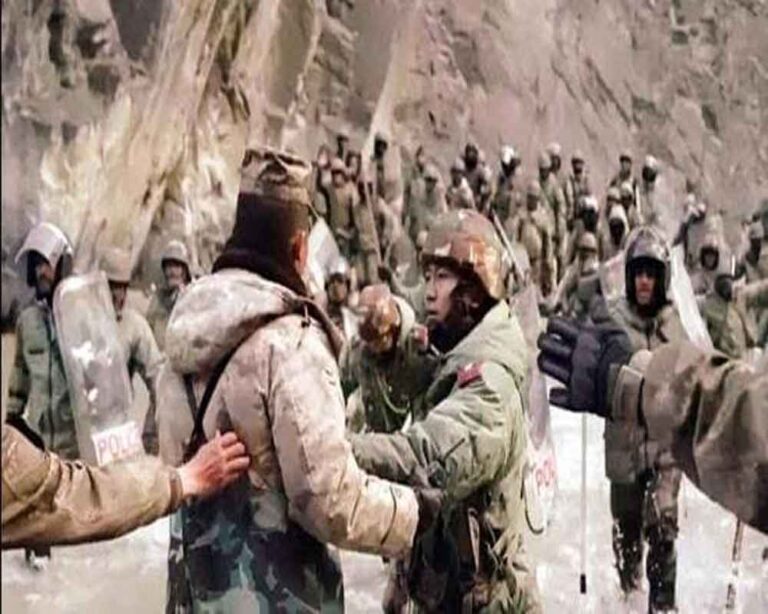
- Later, a violent clash at Galwan Valley started between Indian troops and soldiers of the People’s Liberation Army (PLA) on the night of June 15, 2020.
- It was the first deadly clash between India and China in at least 45 years. 20 Indian soldiers lost their lives.
- After this incident, both sides deployed a large number of troops in the area along with heavy weaponry.
- The infrastructure build-up has also been very heavy and the standoff between the two forces is continuing.




The Corps Commander level talks
- India and China have been holding the talks on the Line of Actual Control (LAC) in Eastern Ladakh area to resolve the standoff.
- Earlier to the current talk, the 16 round of Corps Commander-level talks had been held between the two countries.
- The 16th round took place in July 2022.
- Earlier to the current talk, the 16 round of Corps Commander-level talks had been held between the two countries.
Outcomes of the previous rounds of talks
- Troops were disengaged on the north and south banks of Pangong Tso and Gogra Post.
- However, at Hot Springs they continue to face each other.
- China had refused to complete the stalled troop disengagement at the Patrolling Point (PP) – 15 in the Hot Springs-Gogra-Kongka La area.
- However, at Hot Springs they continue to face each other.
- The Chinese have also been preventing Indian troops from accessing five traditional patrolling points on the Depsang Plains.
- These five traditional patrolling are —PP10, PP11, PP11A, PP12 and PP13.
- Depsang plains are not far from the strategic Indian outpost at Daulat Beg Oldie near the Karakoram Pass in the north.
- The no-patrol buffer zones have been created after disengagement at
- PP-14 in Galwan Valley,
- PP-17A near Gogra
- Pangong Tso
- However, these zones have largely come up in what India claims to be its territory.
News Summary
- Military commanders from India & China held a fresh round of high-level talks in order to resolve the remaining issues along the Line of Actual Control in eastern Ladakh.
- During the meeting, India pressed China for early and complete disengagement at the remaining friction points, including in Demchok and Depsang.
- India maintained that disengagement, followed by de-escalation, is essential for bilateral ties to return to normal.
- China, however, believes the border situation in eastern Ladakh is no longer as serious as it was in 2020, when the military stand-off started, and wants to resume bilateral exchanges.
- However, there was no sign of any breakthrough in the talks.
- In a joint statement, issued after the meeting, they agreed to maintain security and stability in the western sector.
- They also decided to maintain dialogue for a mutually acceptable resolution of the remaining issues at the earliest.
Q1) Where is Galwan Valley located?
The Galwan valley is strategically located between Ladakh in the west and Aksai Chin in the east. At its western end are the Shyok river and the Darbuk-Shyok-Daulet Beg Oldie (DSDBO) road. Its eastern mouth lies not far from China’s vital Xinjiang Tibet road, now called the G219 highway.
Q2) Why is Pangong Tso lake salty?
Pangong Lake, situated at a height of almost 4,350m, is the world’s highest saltwater lake. The rocks give out the ocean’s salts. As a result, lakes that do not drain into the sea become salty because the salt has nowhere to go. Pangong is one such river.

 Last updated on March, 2026
→ UPSC Final Result 2025 is now out.
→ UPSC has released UPSC Toppers List 2025 with the Civil Services final result on its official website.
→ Anuj Agnihotri secured AIR 1 in the UPSC Civil Services Examination 2025.
→ UPSC Marksheet 2025 is now out.
→ UPSC Notification 2026 & UPSC IFoS Notification 2026 is now out on the official website at upsconline.nic.in.
→ UPSC Calendar 2026 has been released.
→ Check out the latest UPSC Syllabus 2026 here.
→ UPSC Prelims 2026 will be conducted on 24th May, 2026 & UPSC Mains 2026 will be conducted on 21st August 2026.
→ The UPSC Selection Process is of 3 stages-Prelims, Mains and Interview.
→ Prepare effectively with Vajiram & Ravi’s UPSC Prelims Test Series 2026 featuring full-length mock tests, detailed solutions, and performance analysis.
→ Enroll in Vajiram & Ravi’s UPSC Mains Test Series 2026 for structured answer writing practice, expert evaluation, and exam-oriented feedback.
→ Join Vajiram & Ravi’s Best UPSC Mentorship Program for personalized guidance, strategy planning, and one-to-one support from experienced mentors.
→ Shakti Dubey secures AIR 1 in UPSC CSE Exam 2024.
→ Also check Best UPSC Coaching in India