India-China Boundary Talks Latest News
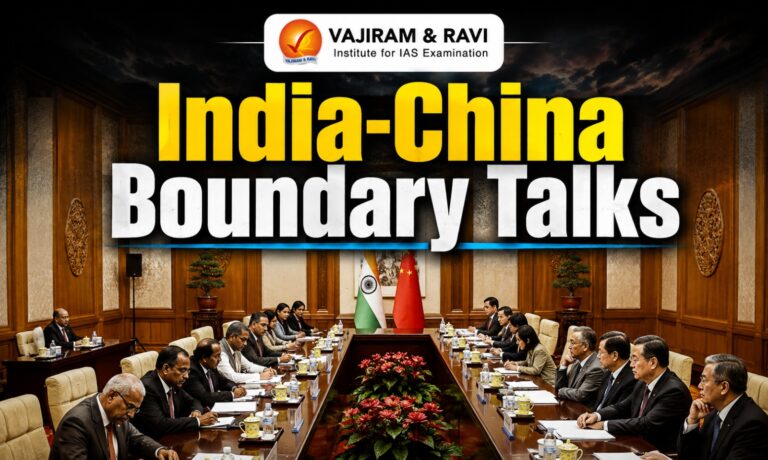
- The 25th round of Special Representatives (SR) talks concluded in Beijing between India’s NSA Ajit Doval and China’s Foreign Minister Wang Yi.
- The two sides reached an eight-point consensus. This comes ahead of President Xi Jinping’s expected visit to India for the BRICS Summit.
What Was Agreed
- The talks focused on two core areas.
- First: maintaining peace and tranquillity in border areas.
- Second: advancing a framework for settling the boundary question, based on prior agreements.
- Specific steps were outlined. An Expert Group and a Working Group will explore an “early harvest” of boundary delimitation in select sectors.
- They will also work on effective border management.
- Last year, both sides agreed in principle to set up additional General-Level Mechanisms, or Senior Highest Military Commander (SHMC) meetings, in the Eastern and Middle sectors.
- This mirrors the existing mechanism at Chushul/Moldo in the Western sector.
- This time, they went further. They agreed to implement that plan. They also agreed to establish two new hotlines — one each in the Eastern and Middle sectors.


The Past as Prologue
- The current mechanisms build on decades of groundwork.
- 1992: The Joint Working Group (JWG) on the Boundary Question introduced confidence-building measures (CBMs), including Border Personnel Meetings (BPMs). This complemented progress on border trade.
- 1993: The Border Peace and Tranquillity Agreement (BPTA) led to a JWG sub-group — the India-China Expert Group of Diplomatic and Military Officials (EG).
- This became a precursor to the Working Mechanism for Consultation and Coordination on India-China Border Affairs (WMCC), set up in 2012.
- 2014: The proposal for additional BPM points was revived. Regular BPMs were established at Wacha/Kibithu, opposite Damai on the Chinese side — alongside existing venues at Bum La (Arunachal Pradesh) and Nathu La (Sikkim).
- Together with BPMs at Daulat Beg Oldie (DBO) and Tianwendian (TWD) in the Chip Chap valley, and the Chushul-Moldo meeting point in the Spanggur Gap, these venues have helped both militaries maintain direct contact.
Why Hotlines Matter
- Existing hotlines already link DBO and Chushul. Informal communication channels exist at Demchok in the Western Sector. Similar hotlines operate at Nathu La, Bum La, and Kibithu in the Eastern Sector.
- The two new hotlines — for the Eastern and Middle sectors — will strengthen this network. They can help defuse tensions quickly at the local level.
The Road Ahead
- The SR talks aim to implement the broader understanding reached between PM Modi and President Xi at Kazan (October 2024) and Tianjin (August 2025).
- Recent positive steps support this momentum:
- Resumption of the Kailash Mansarovar Yatra
- Restoration of direct flights
- Revival of border trade
- However, caution is warranted. The task of “early and substantial harvest of boundary delimitation and border management” will likely be long and difficult. It demands patient negotiation.
- It would be premature to claim substantive boundary delimitation has begun. The Expert Group and Working Group under WMCC are still finalising their Terms of Reference.
- This means the framework itself is only now being built — the process is being activated step by step.
- Another challenge remains: balancing piecemeal progress against a more holistic settlement. Differences persist in both the Sikkim sub-sector and the Middle Sector.
- Negotiators must be empowered and experienced enough to handle a dispute that has vexed generations before them.
Conclusion
- The 25th SR round marks incremental but meaningful progress in India-China border diplomacy — institutionalising communication channels and laying groundwork for future delimitation talks.
- Yet the path to a comprehensive boundary settlement remains long, requiring sustained political will, patient negotiation, and careful sequencing.
- If guided effectively, this process could pave the way for lasting peace and substantive cooperation between two major Asian powers in a shifting global order.
Source: IE

 Last updated on Oct, 2026
→ UPSC 2027 Notification will be released on 13 January 2027 at upsconline.nic.in.
→ Asian Games 2026 are being held in Aichi-Nagoya, Japan, from 19 September to 4 October.
→ Check Nobel Prize 2026 Winners List here.
→ Download PIB PRiSM Monthly Magazine 2026 here.
→ Check UPSC Monthly Current Affairs Magazine The Recitals here.
→ Check out the latest UPSC Syllabus here.
→ Download UPSC Model Answers for Mains 2026
→ UPSC Mains Question Paper 2026 is out now for Essay & GS Paper 1, 2, 3 & 4.
→ UPSC Calendar 2027 has been released.
→ Enroll in Vajiram & Ravi’s UPSC Mains Test Series 2027 for structured answer writing practice, expert evaluation, and exam-oriented feedback.
→ Join Vajiram & Ravi’s UPSC Mentorship Program 2027 for personalized guidance, strategy planning, and one-to-one support from experienced mentors.
→ Go through the UPSC Mains Previous Year Papers to enhance your preparation.
→ UPSC has released UPSC Toppers List 2025 with the Civil Services final result on its official website.
→ Also check Best UPSC Coaching in India
India-China Boundary Talks FAQs
Q1. What are the latest developments in India-China Boundary Talks?+
Q2. What role will new hotlines play in India-China Boundary Talks?+
Q3. Have India-China Boundary Talks begun substantive boundary delimitation?+
Q4. What mechanisms support India-China Boundary Talks?+
Q5. Why is a comprehensive settlement difficult in India-China Boundary Talks?+
Tags: India-China Boundary Talks mains articles upsc current affairs upsc mains current affairs