Why India-EU FTA in News?
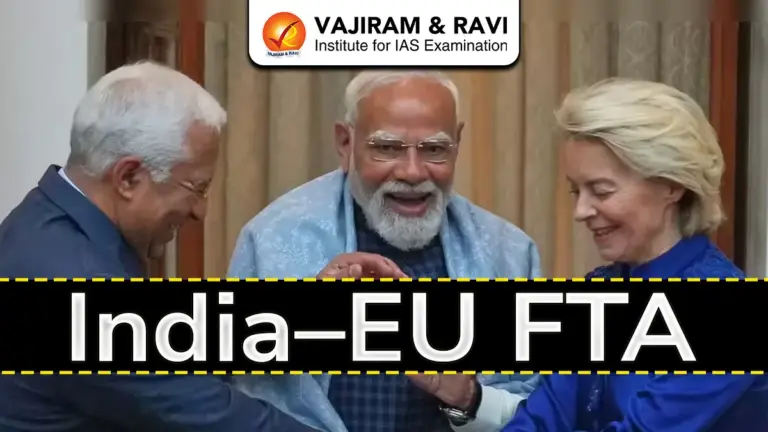
India and the European Union have concluded the negotiation on a free trade agreement, “Mother of all Deals”, which is expected to boost India’s export and strength India’s vision of Viksit Bharat at 2047.
India-EU Free Trade Agreement (FTA) Objectives
The objectives of the India-EU Free Trade Agreement have been discussed below:
- To reduce or eliminate tariffs on goods to improve market access for Indian exports in the EU.
- To liberalise trade in services, especially IT, digital, healthcare, and professional services.
- To promote easier movement of skilled professionals between India and the EU.
- To attract high-quality European investment by ensuring regulatory certainty and transparency.
- To strengthen regulatory cooperation and reduce non-tariff barriers.
- To integrate India into global and European value chains as a reliable manufacturing hub.
- To boost export-led growth in line with Make in India and PLI schemes.
- To diversify India’s trade partnerships and enhance economic resilience.





India-EU Free Trade Agreement (FTA) Benefits
- Boost to Exports: The EU is India’s largest export market bloc, accounting for about 17% of India’s total exports. Duty-free or reduced tariffs will benefit labour-intensive sectors like textiles, apparel, leather, and footwear, as well as pharmaceuticals, engineering goods, and chemicals. Indian goods worth USD 75-80 billion were exported to the EU in 2024-25.
- Expansion of Services Trade: India exported around USD 50 billion in services to the EU in 2024-25, mainly in IT, telecom, digital, and business services. Easier mobility of skilled professionals and regulatory alignment under the FTA will further increase India’s services footprint.
- Increased Foreign Investment: Enhanced investment protection and regulatory certainty can attract high-quality FDI from Europe. Europe accounted for USD 70 billion of FDI inflows into India in 2023-24.
- Integration into Global Value Chains: The FTA positions India as a “China-plus-one” destination, helping Indian manufacturers integrate into European supply chains and strengthen export competitiveness.
- Industrial Growth and Make in India: Access to the 450-million-strong European market will promote industrial upgrading in pharmaceuticals, engineering goods, auto components, and chemicals, complementing Make in India and PLI schemes.
- Employment Generation: Growth in manufacturing and services exports is expected to create jobs in sectors such as textiles, leather, IT services, and pharmaceuticals. Labour-intensive exports could see 10-15% growth under duty-free access.
- Strategic and Geopolitical Gains: Strengthened economic ties with the EU reduce dependence on a few trade partners and enhance India’s influence in global trade forums.
- Technology and Knowledge Transfer: FDI and collaboration with EU firms will accelerate adoption of advanced technologies, boosting competitiveness of domestic industries and innovation capacity.
Challenges Associated with the Free Trade Agreement
- High Environmental and Labour Standards: The EU’s stringent environmental and labour norms increase compliance costs for Indian exporters and act as non-tariff barriers.
- Carbon Border Adjustment Mechanism (CBAM): The proposed carbon tax on imports like steel, cement, and aluminium may reduce the competitiveness of Indian exports.
- Intellectual Property Rights (IPR) Issues: EU demands for stronger IPR protection, especially data exclusivity in pharmaceuticals, could affect India’s generic drug industry.
- Digital Trade and Data Protection: Differences over data localisation and cross-border data flows remain unresolved.
- Tariff Reduction on Sensitive Sectors: Pressure to cut duties on automobiles, wines, spirits, and dairy could impact domestic industries and MSMEs.
- Public Procurement Access: The EU’s demand for access to India’s government procurement market conflicts with India’s local-preference policies.
- Regulatory and Standards Compliance: Meeting EU technical, sanitary, and phytosanitary standards is challenging for small Indian exporters.
- Adjustment Costs: Domestic industries may face short-term disruptions due to increased competition from European imports.
Way Forward
- Phased Tariff Liberalisation – Gradually reduce tariffs, giving sensitive sectors like agriculture, dairy, and MSMEs time to adjust.
- Safeguard Domestic Industries – Use protective carve-outs to prevent disruption to small-scale manufacturers and local producers.
- Align with Make in India & PLI – Leverage the FTA to boost high-value manufacturing, technology transfer, and industrial growth.
- Protect Digital Sovereignty – Negotiate data-sharing rules that balance trade facilitation with privacy and national digital infrastructure.
- Address IPR & CBAM Issues – Safeguard India’s generic pharmaceutical industry and ensure competitiveness under EU carbon-related regulations.
- Enhance Strategic & Services Gains – Expand IT, telecom, and professional services exports, attract European FDI, and strengthen India’s global economic resilience.
About Eurpoean Union
The European Union (EU) is a political and economic union of 27 European countries that work together on trade, governance, and regional development. It has a single market allowing free movement of goods, services, people, and capital among member states.
- Formation and Members: Established in 1993 by the Maastricht Treaty, the EU consists of 27 member states, including Germany, France, Italy, Spain, and the Netherlands.
- Single Market: Promotes free movement of goods, services, people, and capital across member countries, creating one of the largest economic zones in the world.
- Common Policies: The EU coordinates on trade, agriculture, competition, environment, energy, and foreign policy to maintain regional stability and growth.
- Euro Currency: 19 of the 27 member states use the euro as their official currency, facilitating economic integration.
- Global Economic Influence: The EU is one of the largest trading blocs, contributing around 15-17% of global exports and a major source of FDI worldwide.
Institutions: Key EU institutions include the European Commission, European Parliament, European Council, and Court of Justice, which oversee policy, legislation, and enforcement.

 Last updated on March, 2026
→ UPSC Final Result 2025 is now out.
→ UPSC has released UPSC Toppers List 2025 with the Civil Services final result on its official website.
→ Anuj Agnihotri secured AIR 1 in the UPSC Civil Services Examination 2025.
→ UPSC Marksheet 2025 is now out.
→ UPSC Notification 2026 & UPSC IFoS Notification 2026 is now out on the official website at upsconline.nic.in.
→ UPSC Calendar 2026 has been released.
→ Check out the latest UPSC Syllabus 2026 here.
→ UPSC Prelims 2026 will be conducted on 24th May, 2026 & UPSC Mains 2026 will be conducted on 21st August 2026.
→ The UPSC Selection Process is of 3 stages-Prelims, Mains and Interview.
→ Prepare effectively with Vajiram & Ravi’s UPSC Prelims Test Series 2026 featuring full-length mock tests, detailed solutions, and performance analysis.
→ Enroll in Vajiram & Ravi’s UPSC Mains Test Series 2026 for structured answer writing practice, expert evaluation, and exam-oriented feedback.
→ Join Vajiram & Ravi’s Best UPSC Mentorship Program for personalized guidance, strategy planning, and one-to-one support from experienced mentors.
→ Shakti Dubey secures AIR 1 in UPSC CSE Exam 2024.
→ Also check Best UPSC Coaching in India
India-EU Free Trade Agreement (FTA) FAQs
Q1. Why is the India-EU FTA important for India?+
Q2. Which sectors are expected to benefit the most?+
Q3. What are the key challenges in the FTA?+
Q4. How will services trade benefit India?+
Q5. How does the FTA align with India’s development vision?+
Tags: india eu free trade agreement