India–Israel Relations Latest News
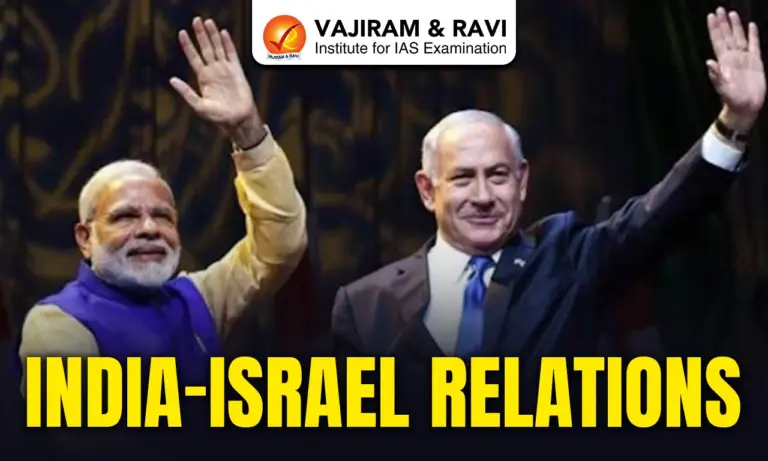
- Prime Minister Narendra Modi is on an official visit to Israel, marking his first trip there since his landmark 2017 visit (the first-ever by an Indian Prime Minister after diplomatic ties were established).
- That visit elevated India-Israel relations into the open and strengthened bilateral cooperation.
- However, the current visit takes place in a far more tense regional context, with concerns over a possible US-Iran conflict and a fragile ceasefire in Gaza.
- Against this backdrop, the visit highlights the evolution of India-Israel ties and underscores their growing strategic significance.
The Early Years: Recognition Without Full Ties
- India recognised the state of Israel soon after its creation in 1948.
- However, full diplomatic relations were delayed for over four decades due to political sensitivities and regional considerations.
- In January 1992, during Palestinian President Yasser Arafat’s visit to India, Prime Minister P V Narasimha Rao conveyed that diplomatic ties with Israel could strengthen India’s ability to influence the Palestinian cause.
- Arafat publicly respected India’s sovereign decision, paving the way for a historic shift.
- India formally established diplomatic relations with Israel on January 29, 1992 — a move that marked a decisive turning point in bilateral relations.
Growing Defence Cooperation
- India had sourced Israeli weapons during the 1962 war with China, though engagement remained limited and episodic.
- During the Kargil conflict, Israel swiftly supplied precision bombs from its emergency stockpiles to the Indian Air Force.
- This timely support significantly strengthened defence ties.
Political Engagement Deepens (2000–2003)
- In 2000, India organised high-profile visits to Israel, including External Affairs Minister Jaswant Singh and Home Minister L K Advani.
- To address domestic political concerns, leaders across party lines — including Jyoti Basu and Najma Heptullah — also visited Israel.
- Israeli Prime Minister Ariel Sharon’s visit to India in September 2003 further consolidated defence and security cooperation.
- Later, the then External Affairs Minister S M Krishna visited Israel in 2012.
- Public discussions focused on science and technology, agriculture, and commerce, while strategic defence ties were kept relatively low-profile.




India–Israel Relations After 2014
- After assuming office in 2014, Prime Minister Narendra Modi brought India-Israel ties into the open.
- He met Prime Minister Benjamin Netanyahu in New York in September 2014 — the first such meeting in a decade — signalling renewed political engagement.
High-Level Political Exchanges
- Home Minister Rajnath Singh visited Israel in 2014.
- President Pranab Mukherjee made the first-ever Indian Presidential visit in 2015.
- External Affairs Minister Sushma Swaraj followed in 2016.
- Over the past decade, several Indian ministers and parliamentarians have also visited Israel.
The 2017 Breakthrough Visit
- PM Modi’s 2017 visit was historic not only as the first by an Indian Prime Minister but also because he skipped the customary stop in Palestine, signalling a more confident and independent diplomatic stance.
- His current visit similarly focuses solely on Tel Aviv.
Reciprocal Engagement
- Prime Minister Netanyahu visited India in January 2018, reinforcing bilateral ties.
- Since Netanyahu’s re-election, the two leaders have spoken at least 10 times in three years, reflecting sustained high-level engagement.
Expanding Strategic and Economic Cooperation
- India and Israel have deepened defence ties, evident during Operation Sindoor, and enhanced cooperation in cybersecurity, highlighted during the Pegasus disclosures.
- In November 2025, both sides signed defence pacts and launched negotiations for a free trade agreement. Cooperation now spans sectors such as artificial intelligence, agriculture, and advanced technologies.
A Shifting Geopolitical Landscape
- Since PM Modi’s first visit in 2017, West Asia’s geopolitical dynamics have changed significantly.
- Israel and several Arab nations have moved toward normalisation under the Abraham Accords signed during Donald Trump’s first term.
Gaza War and Fragile Ceasefire
- The Hamas attack on October 7, 2023 triggered a prolonged war in Gaza, resulting in massive casualties and destruction.
- An uneasy truce now holds under a US-backed peace plan, with the key challenge being the disarmament of Hamas.
Rising Iran Tensions
- Tensions with Iran have intensified following a 12-day Israel-Iran conflict in June 2025, during which the US struck Iranian nuclear facilities.
- The US has since increased its military presence around Iran, further destabilising the region.
India’s Diplomatic Tightrope
- PM Modi’s visit comes amid regional turmoil, making it a sensitive diplomatic move. New Delhi must carefully balance costs and benefits.
Importance of Israel for India
- A crucial defence and security partner.
- A key economic partner in the India-Middle East-Europe Economic Corridor.
- A significant regional political player with expanding ties in West Asia.
Regional Sensitivities
- Iran and other regional nations are closely observing India’s growing proximity to Israel and assessing its implications for their own ties with New Delhi.
- Prime Minister Benjamin Netanyahu, facing political pressure at home, is projecting the visit as a diplomatic success.
Conclusion
- PM Modi’s Israel visit unfolds in a volatile regional environment and will be closely watched across West Asia. It reflects India’s effort to navigate complex geopolitical realities while safeguarding its strategic and economic interests.

 Last updated on April, 2026
→ UPSC Final Result 2025 is now out.
→ UPSC has released UPSC Toppers List 2025 with the Civil Services final result on its official website.
→ Anuj Agnihotri secured AIR 1 in the UPSC Civil Services Examination 2025.
→ UPSC Marksheet 2025 is now out.
→ UPSC Notification 2026 & UPSC IFoS Notification 2026 is now out on the official website at upsconline.nic.in.
→ UPSC Calendar 2026 has been released.
→ Check out the latest UPSC Syllabus 2026 here.
→ UPSC Prelims 2026 will be conducted on 24th May, 2026 & UPSC Mains 2026 will be conducted on 21st August 2026.
→ The UPSC Selection Process is of 3 stages-Prelims, Mains and Interview.
→ Prepare effectively with Vajiram & Ravi’s UPSC Prelims Test Series 2026 featuring full-length mock tests, detailed solutions, and performance analysis.
→ Enroll in Vajiram & Ravi’s UPSC Mains Test Series 2026 for structured answer writing practice, expert evaluation, and exam-oriented feedback.
→ Join Vajiram & Ravi’s Best UPSC Mentorship Program for personalized guidance, strategy planning, and one-to-one support from experienced mentors.
→ Shakti Dubey secures AIR 1 in UPSC CSE Exam 2024.
→ Also check Best UPSC Coaching in India
India–Israel Relations FAQs
Q1. Why are India–Israel relations strategically important?+
Q2. How did India–Israel relations evolve historically?+
Q3. What made Modi’s 2017 visit historic?+
Q4. How do regional tensions affect India–Israel relations?+
Q5. What sectors define modern India–Israel relations?+
Tags: India–Israel Relations mains articles upsc current affairs upsc mains current affairs