What’s in today’s article?
- Why in news?
- What is a CCP?
- What is the Issue?
- What will be the Impact of the Move?
Why in news?
The European Securities and Markets Authority (ESMA), the European Union (EU’s) financial markets regulator has derecognised six Indian central counterparties (CCPs) from April 30, 2023.
What is a CCP?
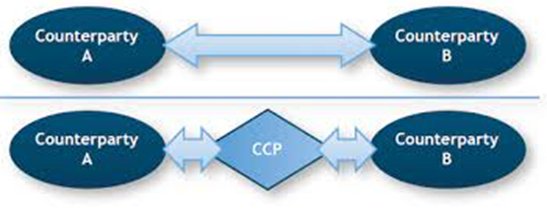
- It is a financial institution that perform two main functions as the intermediary in a market transaction –
- Clearing and settlement for trades in foreign exchange, securities, options, and derivative contracts.
- Guarantee the terms of trade.
- CCP is a system provider, who by way of novation (act of replacing an obligation with another) –
- Interposes between system participants in the transactions admitted for settlement,
- Thereby becoming the buyer to every seller and the seller to every buyer, for the purpose of effecting settlement of their transactions.
- CCPs are highly regulated institutions that specialise in managing counterparty credit risk.
- In India, a CCP is authorised by the Reserve Bank of India (RBI) to operate under the Payment and Settlement Systems Act, 2007.
What is the Issue?
- The six CCPs derecognised are:
- The Clearing Corporation of India (CCIL),
- Indian Clearing Corporation Ltd (ICCL),
- NSE Clearing Ltd (NSCCL),
- Multi Commodity Exchange Clearing (MCXCCL),
- India International Clearing Corporation (IFSC) Ltd (IICC) and
- NSE IFSC Clearing Corporation Ltd (NICCL).
- Why are they derecognised?
- As per the European Market Infrastructure Regulations (EMIR), a CCP in a third country (TC-CCPs) can provide clearing services to European banks only if it is recognised by ESMA.
- The decision to derecognise Indian CCPs came due to ‘no cooperation arrangements’ between ESMA and Indian regulators – the RBI, the SEBI and the International Financial Services Centres Authority (IFSCA).
- Regulations of CCPs:
- According to the Financial Stability Report 2022 (RBI), after the global financial crisis of 2007-09, the legislations governing CCPs were enacted in some advanced jurisdictions to give them an extra-territorial reach.
- Such regulations created a parallel maze of laws with overlapping requirements or restrictions and showed a lack of trust in the capabilities and quality of oversight exercised by other regulators.
- Argument of Indian regulators:
- Since these domestic CCPs operate in India and not in the EU, these entities cannot be subjected to the ESMA regulations.
- These CCPs have robust risk management and there is no need for a foreign regulator to inspect them.


What will be the Impact of the Move?
- On the TC-CCPs: With the withdrawal of recognition, these TC-CCPs will no longer be able to provide services to clearing members and trading venues established in the EU.
- On the lenders (European banks): They will have to set aside additional capital to trade in the domestic market.
- On the clearing members: They will also be impacted by way of higher capital requirements, enhanced credit risk, etc.
- On the Indian economy: Of the total foreign portfolio investors (FPI) registered in India, close to 20% are from Europe. However, the SEBI has said that the derecognition is unlikely to have any impact.
Q1) What is the Payment and Settlement Systems Act 2007?
It is an Act to provide for the regulation and supervision of payment systems in India and to designate the Reserve Bank of India as the authority for that purpose.
Q2) What is the International Financial Services Centres Authority (IFSCA)?
IFSCA is a unified regulator responsible for the development and regulation of financial products, financial services and institutions in the IFSCs.
Source: Derecognition of six Indian central counterparties by EU regulator: What will be the impact?

 Last updated on Oct, 2026
→ UPSC 2027 Notification will be released on 13 January 2027 at upsconline.nic.in.
→ Check Nobel Prize 2026 Winners List here.
→ Download PIB PRiSM Monthly Magazine 2026 here.
→ Check UPSC Monthly Current Affairs Magazine The Recitals here.
→ Check out the latest UPSC Syllabus here.
→ Download UPSC Model Answers for Mains 2026
→ UPSC Mains Question Paper 2026 is out now for Essay & GS Paper 1, 2, 3 & 4.
→ UPSC Calendar 2027 has been released.
→ Enroll in Vajiram & Ravi’s UPSC Mains Test Series 2027 for structured answer writing practice, expert evaluation, and exam-oriented feedback.
→ Join Vajiram & Ravi’s UPSC Mentorship Program 2027 for personalized guidance, strategy planning, and one-to-one support from experienced mentors.
→ Go through the UPSC Mains Previous Year Papers to enhance your preparation.
→ UPSC has released UPSC Toppers List 2025 with the Civil Services final result on its official website.
→ Also check Best UPSC Coaching in India