India Rice Production Latest News
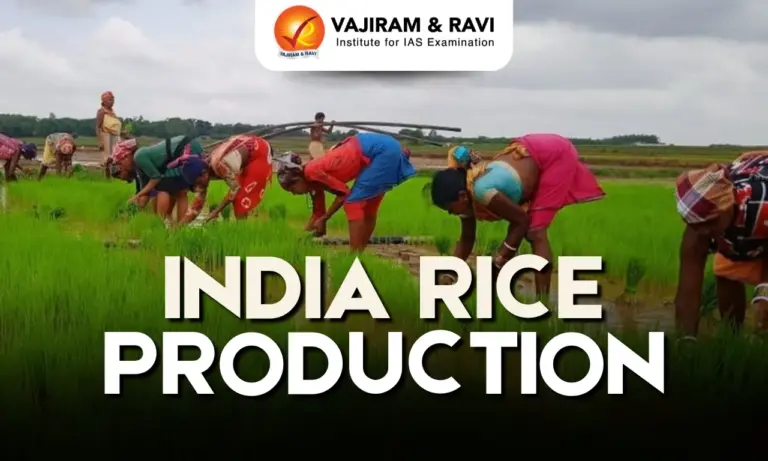
- India has overtaken China to become the world’s largest rice producer in 2024–25, producing about 150 million metric tonnes and accounting for nearly 28% of global output.
- While this marks a sharp rise from a decade ago and reflects stagnant Chinese production, the achievement has downsides.
- Paddy’s profitability has encouraged its spread into water-scarce regions, yields remain uneven across states, and its dominance raises concerns about water stress, crop diversification, and long-term nutritional security.
Steady Rise in India’s Rice Production
- Long-Term Growth Trend – India’s rice output has grown consistently since the Green Revolution era. Between 1969–70 and 2024–25, the area under paddy expanded by over 36%, yields tripled, and total production rose nearly fourfold.
- Sharp Expansion in the Last Five Years – The most notable surge occurred recently. Paddy area increased from 43.66 million hectares in 2019–20 to 51.42 million hectares in 2024–25, while production jumped from 118.87 to 150 million metric tonnes.
- Growing Global Share – As output rose, India’s share of global rice production climbed from 21.95% in 2011 to about 28% in 2024, placing it just ahead of China and far above other producers like Bangladesh and Indonesia.





India’s Rice Stocks: Surplus Beyond Food Security Needs
- Rising Central Pool Reserves – With sustained production growth and high procurement, rice stocks in the central pool have risen steadily. As of January 1, 2026, stocks stood at 63.06 million metric tonnes, including unmilled paddy.
- Far Above Buffer and Welfare Requirements – This level far exceeds prescribed norms. Stocking rules require only 7.61 million tonnes on January 1, while annual needs under the NFSA and welfare schemes are about 37.2 million tonnes.
- Efforts to Reduce Excess – The government has attempted to offload surplus rice through open market sales and by diverting rice for ethanol production. Despite these measures, stocks remain elevated.
- Procurement Concentrated in Few States – During the 2023–24 kharif season, the Food Corporation of India procured 525.48 lakh tonnes—about 38% of national output. Over half of this came from Punjab, Haryana, Chhattisgarh, and Odisha.
Why Paddy Dominates Indian Agriculture
- Wide Cultivation and Scale – Paddy is India’s most widely grown crop, cultivated in over 600 districts and spread across more than 514 lakh hectares—far exceeding the area under wheat or other major crops.
- Assured Returns Through MSP – A key attraction is assured procurement at Minimum Support Price. Paddy offers higher net returns per hectare than crops like maize and moong, making it financially safer for farmers.
- Weak Performance of Alternative Crops – Stagnant or declining yields in crops such as cotton reduce their attractiveness. Compared to global averages, India’s yields in some non-paddy crops remain low.
- Strong Export Demand – India is the world’s leading rice exporter, earning substantial foreign exchange from basmati and non-basmati rice exports to West Asia, North America, and Europe, reinforcing paddy’s appeal.
- The country exported six million tonnes of basmati and 14.13 million tonnes of non-basmati rice during 2024-25, earning $5.9 billion and $6.5 billion respectively.
- India exported basmati to Saudi Arabia, Iraq, Iran, Yemen, the UAE, the US, the UK, Kuwait, Oman, Qatar, Jordan and Israel during 2024-25.
Environmental and Regional Challenges of Paddy Cultivation
- Paddy is an extremely water-intensive crop, requiring nearly 1–3 tonnes of water to produce just one kilogram of rice.
- Its widespread cultivation has severely depleted groundwater in many regions.
- In Punjab, excessive groundwater extraction has led to serious environmental and health problems, while paddy expansion into already water-stressed states has worsened declining water tables.
- Rice productivity also varies sharply across states due to differing agro-climatic conditions.
- In 2024–25, yields ranged from 4,428 kg per hectare in Punjab and 3,928 kg in Andhra Pradesh to much lower levels in Bihar (2,561 kg) and Uttar Pradesh (2,824 kg), compared to the national average of 2,929 kg per hectare.
Push for Crop Diversification Away from Paddy
- With a growing preference for paddy among farmers, the Union government is intensifying efforts to promote crop diversification.
- The objective goes beyond farm incomes to include nutritional security and conservation of scarce water resources.
Incentives Linked to Fiscal Savings
- The Agriculture Ministry has proposed incentivising farmers who shift away from paddy to alternative crops.
- These incentives could be financed from savings in the economic cost of rice, estimated at ₹1.36 lakh per hectare.
- This cost reflects expenses borne by the Food Corporation of India on MSP-based procurement, milling, transport and storage.
- According to officials, rice stored by the FCI costs around ₹33 per kg, and with an average yield of 41.25 quintals per hectare, government spending reaches about ₹1,36,000 per hectare, excluding subsidies on power, fertilisers and seeds.
- Officials suggest focusing diversification efforts on districts with below-national-average paddy yields (2,929 kg per hectare) and relatively lower paddy coverage.
Promoting Oilseeds and Pulses
- The strategy prioritises oilseeds and pulses to reduce India’s heavy dependence on edible oil imports.
- These crops would be promoted in a phased manner, aligned with agro-climatic suitability and soil conditions, to ensure sustainable transitions for farmers.
Source: IE

 Last updated on April, 2026
→ UPSC Final Result 2025 is now out.
→ UPSC has released UPSC Toppers List 2025 with the Civil Services final result on its official website.
→ Anuj Agnihotri secured AIR 1 in the UPSC Civil Services Examination 2025.
→ UPSC Marksheet 2025 is now out.
→ UPSC Notification 2026 & UPSC IFoS Notification 2026 is now out on the official website at upsconline.nic.in.
→ UPSC Calendar 2026 has been released.
→ Check out the latest UPSC Syllabus 2026 here.
→ UPSC Prelims 2026 will be conducted on 24th May, 2026 & UPSC Mains 2026 will be conducted on 21st August 2026.
→ The UPSC Selection Process is of 3 stages-Prelims, Mains and Interview.
→ Prepare effectively with Vajiram & Ravi’s UPSC Prelims Test Series 2026 featuring full-length mock tests, detailed solutions, and performance analysis.
→ Enroll in Vajiram & Ravi’s UPSC Mains Test Series 2026 for structured answer writing practice, expert evaluation, and exam-oriented feedback.
→ Join Vajiram & Ravi’s Best UPSC Mentorship Program for personalized guidance, strategy planning, and one-to-one support from experienced mentors.
→ Shakti Dubey secures AIR 1 in UPSC CSE Exam 2024.
→ Also check Best UPSC Coaching in India
India Rice Production FAQs
Q1. Why has India rice production increased sharply in recent years?+
Q2. How does India rice production compare with China?+
Q3. Why are high rice stocks a concern?+
Q4. What environmental issues arise from India rice production?+
Q5. How is the government responding to paddy overdependence?+
Tags: India rice production mains articles upsc current affairs upsc mains current affairs