India-US Interim Trade Agreement (ITA) Latest News
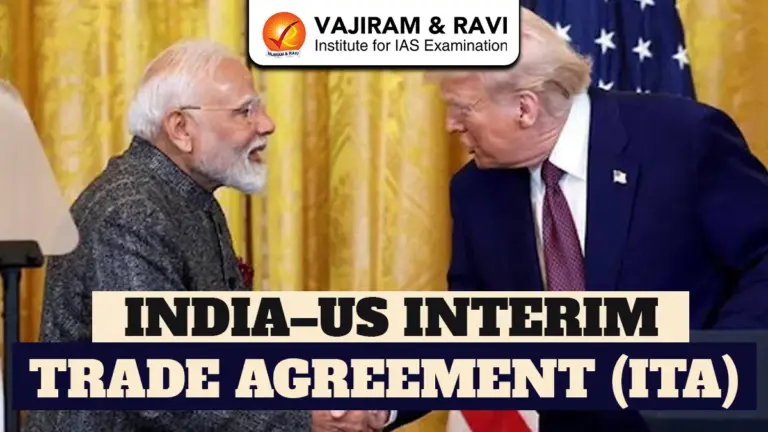
- The United States and India have agreed upon a Framework for an Interim Trade Agreement (ITA) aimed at delivering early trade gains while negotiations continue for a comprehensive US–India Bilateral Trade Agreement (BTA).
- The US-India BTA was launched in February 2025 by President Donald Trump and Prime Minister Narendra Modi.
- The framework reflects evolving geopolitical realities, particularly China’s rise, supply chain diversification, energy security concerns, and technology competition, which have injected new urgency into bilateral trade negotiations.
Nature and Scope of the Interim Agreement
- A transitional but strategic arrangement:
- Designed as a reciprocal and mutually beneficial trade arrangement, it is –
- Intended to generate early trade benefits
- Serves as a stepping stone toward a comprehensive BTA
- The agreement signals renewed momentum in a relationship that has struggled for years over issues such as agriculture, digital trade, and market access.
- Designed as a reciprocal and mutually beneficial trade arrangement, it is –
- India’s commitments:
- Tariff liberalisation and rationalisation: India will eliminate or reduce tariffs on all US industrial goods, reduce tariffs on US agricultural and food products, including dried distillers’ grains, red sorghum, tree nuts, fresh and processed fruits, soybean oil, wine and spirits.
- Addressing non-tariff barriers (NTBs):
- India agreed to tackle import licensing delays; standards-related restrictions; and barriers affecting medical devices, ICT goods, food and agricultural products.
- Talks to align with US or international standards to conclude within six months.
- Significance: Non-tariff barriers have long been contentious in WTO discussions. Their removal signals regulatory convergence.
- US commitments:
- Tariff reductions for Indian exports:
- The US will remove tariffs on generic pharmaceuticals; gems and diamonds; selected aircraft and aircraft parts.
- India will receive ally-equivalent tariff treatment in certain aviation sectors, and get a preferential quota for auto parts at lower tariff rates.
- However, the US will apply an 18% reciprocal tariff on several Indian exports including textiles, clothing, leather, footwear, plastics, chemicals, and certain machinery.
- Relief under national security tariffs:
- The US will lift certain tariffs imposed under national security provisions, especially in aviation sectors.
- This is significant because national security tariffs are often invoked under domestic trade laws, and their removal indicates strategic trust.
- Tariff reductions for Indian exports:





Trade, Technology and Supply Chain Cooperation
- Strategic economic integration:
- India plans to purchase $500 billion worth of US goods over five years, including energy products, aircraft, precious metals, technology products, and coking coal.
- Both sides agreed to expand trade in high-tech goods such as GPUs, and deepen cooperation in innovation, supply chains, economic security, and addressing non-market practices of third countries (implicit reference to China).
- Digital trade commitments:
- Both countries agreed to address barriers to digital trade, committed to establishing clear and mutually beneficial digital trade rules.
- Digital trade has been a key friction point, especially concerning data localisation, cross-border data flows, and e-commerce regulations.
Strategic Significance
- Geopolitical drivers: China–US rivalry, supply chain realignment (“China +1” strategy), energy security, and Indo-Pacific strategic convergence.
- Economic implications: Enhanced market access for both sides, strengthening India’s position in global value chains, potential boost to manufacturing and exports, reinforcing India’s role in trusted technology supply chains.
Key Challenges
- Agricultural sensitivities: US agricultural access may affect Indian farmers.
- Reciprocal tariffs: The US will apply a reciprocal tariff rate of 18% on many Indian goods, which may hurt labour-intensive sectors like textiles and leather.
- Pharmaceutical uncertainty: Subject to US tariff investigations.
- Digital trade disputes: Data sovereignty vs open digital markets.
- Rules of origin enforcement: Ensuring benefits accrue primarily to US and Indian producers.
Way Forward
- Fast-track: Conclusion of the Interim Trade Agreement (ITA).
- Build: Trust through early harvest implementation.
- Protect: Sensitive sectors via calibrated tariff reduction.
- Align: Digital governance frameworks with global best practices.
- Strengthen: Institutional mechanisms for dispute resolution.
- Integrate: Trade negotiations with broader strategic cooperation (Quad, Indo-Pacific frameworks).
Conclusion
- The India–US Interim Trade Framework represents more than a tariff adjustment exercise—it reflects a strategic recalibration of bilateral economic ties amid shifting global power dynamics.
- If implemented effectively, this framework could redefine India–US economic relations, reinforce supply chain resilience, and strengthen India’s position in the evolving global trade architecture.

 Last updated on April, 2026
→ UPSC Final Result 2025 is now out.
→ UPSC has released UPSC Toppers List 2025 with the Civil Services final result on its official website.
→ Anuj Agnihotri secured AIR 1 in the UPSC Civil Services Examination 2025.
→ UPSC Marksheet 2025 is now out.
→ UPSC Notification 2026 & UPSC IFoS Notification 2026 is now out on the official website at upsconline.nic.in.
→ UPSC Calendar 2026 has been released.
→ Check out the latest UPSC Syllabus 2026 here.
→ UPSC Prelims 2026 will be conducted on 24th May, 2026 & UPSC Mains 2026 will be conducted on 21st August 2026.
→ The UPSC Selection Process is of 3 stages-Prelims, Mains and Interview.
→ Prepare effectively with Vajiram & Ravi’s UPSC Prelims Test Series 2026 featuring full-length mock tests, detailed solutions, and performance analysis.
→ Enroll in Vajiram & Ravi’s UPSC Mains Test Series 2026 for structured answer writing practice, expert evaluation, and exam-oriented feedback.
→ Join Vajiram & Ravi’s Best UPSC Mentorship Program for personalized guidance, strategy planning, and one-to-one support from experienced mentors.
→ Shakti Dubey secures AIR 1 in UPSC CSE Exam 2024.
→ Also check Best UPSC Coaching in India
India–US Interim Trade Agreement (ITA) FAQs
Q1. Why does the India–US Interim Trade Framework mark a shift?+
Q2. What is the significance of tariff rationalisation and removal of non-tariff barriers in the India–US ITA? +
Q3. How does the India–US ITA strengthen supply chain resilience and economic security? +
Q4. What potential challenges India may face under the reciprocal tariff and agricultural access commitments? +
Q5. What is the role of digital trade negotiations in shaping the future of India–US Bilateral Trade Agreement (BTA)? +
Tags: india–us interim trade agreement (ita) mains articles upsc current affairs upsc mains current affairs