Trade Dispute Latest News
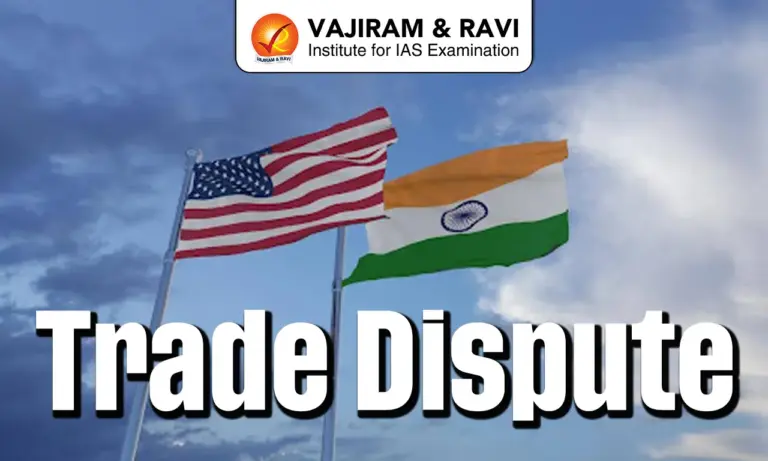
- The United States has initiated Section 301 investigations against India and several other economies to examine whether their trade practices harm U.S. commerce.
Background: India-US Trade Relations
- India and the United States share one of the largest bilateral trade relationships in the world.
- The US remained India’s largest trading partner for the fourth consecutive year in 2024-25, with bilateral trade valued at $131.84 billion.
- However, despite growing economic ties, trade disputes occasionally arise over tariffs, market access, and industrial policies.
- The recent investigation launched by the U.S. government represents one such development in the evolving trade relationship between the two countries.
- The investigation has raised concerns about potential new tariffs that could affect Indian exports to the U.S.





Current Tariff Situation in the United States
- The background to the investigation lies in recent developments in the U.S. tariff regime.
- In February 2026, the U.S. Supreme Court ruled against the use of the International Emergency Economic Powers Act (IEEPA) by the U.S. President to impose reciprocal tariffs on trading partners.
- Before this ruling, India had been subjected to reciprocal tariffs of up to 50% from August 2025, which were later reduced to 25% until February 2026.
- Following the court decision, the U.S. administration imposed a temporary 10% tariff on imports from all countries for 150 days under Section 122 of the Trade Act of 1974.
- However, the U.S. government also indicated that other legal provisions, such as Section 301, could be used to introduce additional tariffs if required.
Section 301 of the U.S. Trade Act
- Section 301 of the Trade Act of 1974 allows the U.S. government to investigate and respond to foreign trade practices that are considered unfair, discriminatory, or harmful to U.S. businesses.
- Under this provision, the Office of the United States Trade Representative (USTR) can examine policies of foreign governments that restrict U.S. commerce.
- If such practices are confirmed, the U.S. government may take retaliatory actions such as imposing tariffs or other trade restrictions.
- Section 301 has previously been used in trade disputes with several countries, including China.
First Investigation: Excess Manufacturing Capacity
- On March 11, 2026, the U.S. Trade Representative initiated a Section 301 investigation against 16 economies, including India.
- The investigation aims to determine whether these countries have developed excess manufacturing capacity that allows them to export large volumes of goods to the U.S., thereby harming American industries.
- In India’s case, the U.S. government cited the country’s bilateral trade surplus with the United States, which it estimated at $58 billion in 2025.
- However, Indian government data suggests that the surplus was around $42.2 billion during the same period.
- The U.S. investigation also identified certain sectors where India may have surplus production capacity, including Solar modules, Petrochemicals, Steel and Manufacturing sectors such as textiles and automotive goods.
- According to the U.S. order, India’s solar module manufacturing capacity is reportedly almost three times higher than domestic demand, indicating the possibility of export-driven production.
Second Investigation: Forced Labour Concerns
- A day after the first investigation, the U.S. announced a second Section 301 investigation covering 60 countries, including India.
- This investigation aims to determine whether countries have taken adequate steps to prevent the import of goods produced through forced labour.
- The U.S. government argues that the failure to eliminate such practices could negatively affect American workers and businesses.
- This inquiry will evaluate whether the participating countries have implemented effective policies to prevent forced labour in global supply chains.
Possible Impact on Indian Industries
- The outcome of the investigations could have implications for several Indian export sectors.
- For example, sectors such as steel, aluminium, automobiles, and auto components already face significant tariffs in the U.S. market.
- In addition, India’s textiles and apparel sector has expressed concerns about rising uncertainty in global trade conditions.
- Industry representatives have noted that the new investigations could add further pressure on export-oriented industries that are already facing global economic challenges.
- However, trade experts have emphasised that the investigations will likely take several months to conclude and may not have immediate consequences.
Responses from Governments and Industry
- So far, the Indian government has not issued an official public response to the investigations.
- In contrast, the European Union, which is also part of the investigation, has strongly reacted and warned that it will respond proportionately if trade commitments are violated.
- Indian industry leaders have adopted a cautious approach. Experts have stated that these investigations are typically lengthy processes and do not necessarily lead to immediate trade restrictions.
Source: TH

 Last updated on March, 2026
→ UPSC Final Result 2025 is now out.
→ UPSC has released UPSC Toppers List 2025 with the Civil Services final result on its official website.
→ Anuj Agnihotri secured AIR 1 in the UPSC Civil Services Examination 2025.
→ UPSC Marksheet 2025 is now out.
→ UPSC Notification 2026 & UPSC IFoS Notification 2026 is now out on the official website at upsconline.nic.in.
→ UPSC Calendar 2026 has been released.
→ Check out the latest UPSC Syllabus 2026 here.
→ UPSC Prelims 2026 will be conducted on 24th May, 2026 & UPSC Mains 2026 will be conducted on 21st August 2026.
→ The UPSC Selection Process is of 3 stages-Prelims, Mains and Interview.
→ Prepare effectively with Vajiram & Ravi’s UPSC Prelims Test Series 2026 featuring full-length mock tests, detailed solutions, and performance analysis.
→ Enroll in Vajiram & Ravi’s UPSC Mains Test Series 2026 for structured answer writing practice, expert evaluation, and exam-oriented feedback.
→ Join Vajiram & Ravi’s Best UPSC Mentorship Program for personalized guidance, strategy planning, and one-to-one support from experienced mentors.
→ Shakti Dubey secures AIR 1 in UPSC CSE Exam 2024.
→ Also check Best UPSC Coaching in India
Trade Dispute FAQs
Q1. What is Section 301 of the U.S. Trade Act?+
Q2. Why has the U.S. launched investigations against India?+
Q3. What sectors are mentioned in the investigation involving India?+
Q4. How large is India’s trade surplus with the U.S.?+
Q5. Will the investigation immediately affect India’s exports?+
Tags: mains articles trade dispute upsc current affairs upsc mains current affairs