Biostimulants Latest News
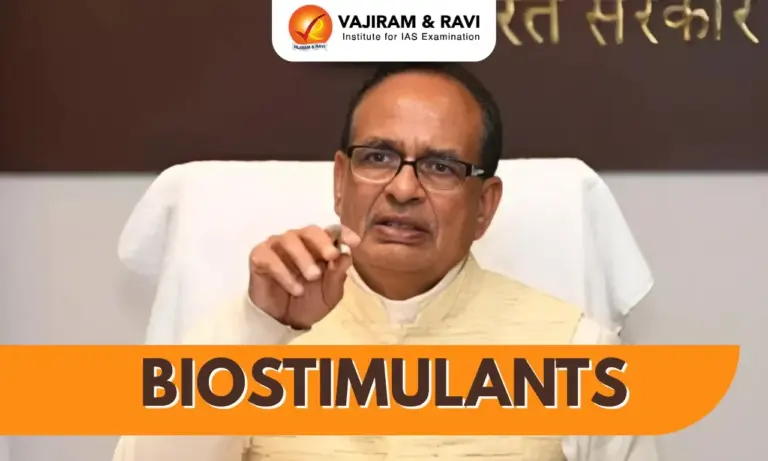
- The Union Agriculture Ministry has revoked approval for 11 biostimulants derived from animal sources such as chicken feathers, pig tissue, bovine hide, and cod scales.
- These products, earlier cleared for use in crops like paddy, tomato, potato, cucumber, and chilli, were withdrawn following complaints citing “religious and dietary restrictions.”
Biostimulants: An Overview
- Biostimulants are natural or synthetic substances that enhance plant growth, nutrient uptake, and stress tolerance, without being traditional fertilizers or pesticides.
- It can be derived from plant extracts, microorganisms, animal by-products, or synthetic compounds.
- Importantly, biostimulants are distinct from pesticides or plant growth regulators, which are covered under the Insecticide Act, 1968.
Examples of Biostimulants with Uses
- Seaweed extracts: Improve root growth, enhance flowering, and increase resistance to drought and salinity.
- Humic & fulvic acids: Boost nutrient absorption and soil fertility.
- Protein hydrolysates & amino acids: Promote early plant growth, increase yield and fruit quality.
- Microbial inoculants (e.g., Azotobacter, Mycorrhizae): Aid in nitrogen fixation, phosphorus solubilization, and better soil health.
- Chitosan (from crustacean shells): Enhances plant defense mechanisms against pests and diseases.
Advantages
- Improve nutrient use efficiency, reducing dependence on chemical fertilizers.
- Enhance plant tolerance to abiotic stresses like drought, heat, or salinity.
- Contribute to higher yields and better quality produce (size, color, taste).
- Promote soil health and microbial activity, supporting sustainable agriculture.
- Environmentally friendly alternative compared to excessive agrochemical use.
Regulation of Biostimulants in India
- Biostimulants in India are regulated under the Fertilizer Control Order (FCO), 1985, formally included through a 2021 amendment.
- Manufacturers must register products in Schedule VI with detailed data on chemistry, bio-efficacy, toxicology, and heavy metals.
- Oversight lies with the Central Biostimulant Committee.
India’s Biostimulants Market
- India’s biostimulants market, valued at US$ 355.53 million in 2024, is projected to rise to US$ 1,135.96 million by 2032.
- Major producers include Coromandel International, Syngenta, and Godrej Agrovet.
- Biostimulants are typically sold in liquid form and applied to crops via spraying.





Centre Withdraws Approval for Animal-Based Biostimulants
- The government has withdrawn approval for 11 biostimulants derived from animal-based protein hydrolysates—made from bovine hide, chicken feathers, pig tissue, cod scales, sardines, and other animal parts.
- These biostimulants were earlier cleared for crops like paddy, tomato, chilli, cotton, cucumber, soybean, grapes, and green gram.
Regulatory Action
- The move came via a recent notification, which omitted these products from Schedule VI of the Fertiliser Control Order (FCO), 1985.
- Though cleared earlier this year by the Indian Council of Agricultural Research (ICAR), ICAR later withheld permission citing ethical, religious, and dietary concerns.
- It stressed the need for pre-harvest interval data before allowing animal-derived foliar sprays.
Regulatory Evolution
- Biostimulants, distinct from fertilisers, are used mainly as sprays to boost crop yield, quality, and growth.
- Until 2021, they were freely sold without specific rules on safety or efficacy.
- The 2021 amendment to the FCO mandated registration and proof of safety, but companies could continue sales until June 16, 2025, if applications were filed.
Minister’s Concerns on Market Proliferation
- Union Agriculture Minister Shivraj Singh Chouhan highlighted the rampant sale of unregulated biostimulants, with nearly 30,000 products in circulation earlier.
- Even after stricter checks, about 8,000 remained in the last four years, but the crackdown has now reduced this to around 650 products.

 Last updated on March, 2026
→ UPSC Final Result 2025 is now out.
→ UPSC has released UPSC Toppers List 2025 with the Civil Services final result on its official website.
→ Anuj Agnihotri secured AIR 1 in the UPSC Civil Services Examination 2025.
→ UPSC Marksheet 2025 is now out.
→ UPSC Notification 2026 & UPSC IFoS Notification 2026 is now out on the official website at upsconline.nic.in.
→ UPSC Calendar 2026 has been released.
→ Check out the latest UPSC Syllabus 2026 here.
→ UPSC Prelims 2026 will be conducted on 24th May, 2026 & UPSC Mains 2026 will be conducted on 21st August 2026.
→ The UPSC Selection Process is of 3 stages-Prelims, Mains and Interview.
→ Prepare effectively with Vajiram & Ravi’s UPSC Prelims Test Series 2026 featuring full-length mock tests, detailed solutions, and performance analysis.
→ Enroll in Vajiram & Ravi’s UPSC Mains Test Series 2026 for structured answer writing practice, expert evaluation, and exam-oriented feedback.
→ Join Vajiram & Ravi’s Best UPSC Mentorship Program for personalized guidance, strategy planning, and one-to-one support from experienced mentors.
→ Shakti Dubey secures AIR 1 in UPSC CSE Exam 2024.
→ Also check Best UPSC Coaching in India
Biostimulants FAQs
Q1. What are biostimulants and how do they help crops?+
Q2. Why did India withdraw approval for 11 biostimulants?+
Q3. Which crops were these biostimulants approved for?+
Q4. What regulations govern biostimulants in India?+
Q5. What is the size of India’s biostimulants market?+
Tags: biostimulants mains articles upsc current affairs upsc mains current affairs